

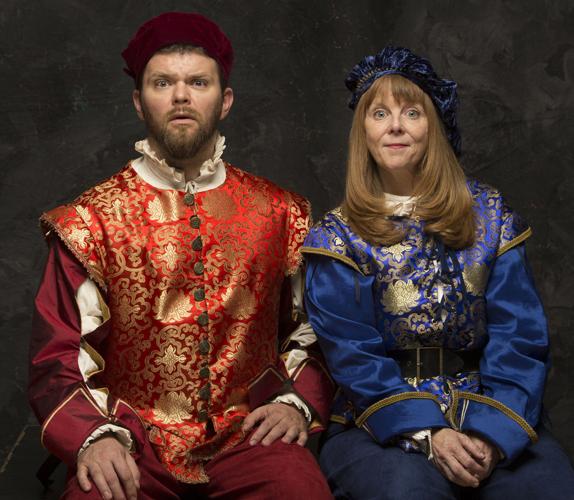
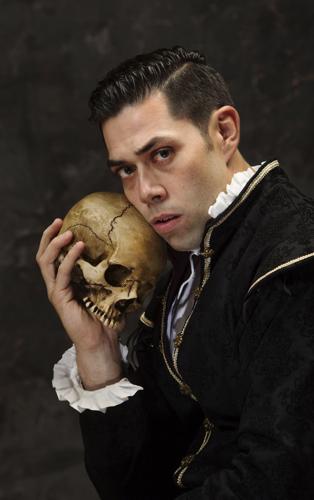
The Rogue Theatre is giving us a sublime duet: Shakespeare‘s “Hamlet” and Tom Stoppard’s “Rosencrantz and Guildenstern are Dead.”
The plays will alternate performances and are scheduled so that audiences have a chance to indulge in the brilliance of both playwrights.
While Stoppard’s play was written to be a length contemporary audiences can handle, Shakespeare’s play — his longest — would run four hours if not cut.
And that’s exactly what director Cynthia Meier has done.
“I cut Hamlet surgically,” says Meir, who has done this for other Shakespeare plays.
“If a speech is eight lines long, and we can understand what the character is saying in four, it’s cut. I’ve made those kind of decisions on every page.”
People are also reading…
Surgical or not, Meier must be loathe to whittle “Hamlet” down to almost half its length — it’s her favorite Shakespeare
“It’s the poetry,” she says. “It’s the humanity of it. Every page has got one or another line that we’ve grown up to.” Among them: “Goodnight sweet prince,” “To thine own self be true,” “To sleep, perchance to dream.” The play is chock-full of Shakespeare’s greatest hits.
“Hamlet” is about the young prince of Denmark, who returns home for his father’s funeral only to discover his mother has already married his father’s brother. As if that’s not confusing enough, his father’s ghost comes to him explaining he was murdered and revenge is in order. Hamlet’s job is to discover the truth — not easy for a young confused man — and when he discovers it, what he should do about it.
Rosencrantz and Guildenstern are minor characters in “Hamlet.” The two were classmates of the prince’s and they end up dead in Shakespeare’s story.
Stoppard takes those two minor characters and tells Hamlet’s story through their eyes. Hamlet becomes a minor character in the Stoppard play.
Years ago, Meier had seen “Hamlet” and “Rosencrantz and Guildenstern” in repertory and has longed to pair them ever since.
“What’s most interesting is listening to Shakespeare through Stoppard, and hearing his great mind reflect on this great play,” she says.
Here’s a side-by-side look at the two plays:
The genres: “Hamlet” is one of Shakespeare’s tragedies; “Rosencrantz and Guildenstern” is an absurdist comedy.
Central themes: Hamlet struggles with his doubts about who killed his father, and when he gets clarity on that, he struggles with whether or not it is right to seek revenge. Rosencrantz and Guildenstern are also confused — about who they are, what’s happening, why they are there.
Soliloquies: There are seven in “Hamlet” and they are glorious — you can tell by just the first lines: “O, what a rogue and peasant slave am I …”, “O that this too too solid flesh would melt.” The only soliloquy in “Rosencrantz and Guildenstern …” is one they overhear Hamlet muttering. The two take Hamlet’s talks to himself as proof of the prince’s madness.
Ghost busters: In “Hamlet,” the appearance of the ghost of Hamlet’s father is a key to understanding the young prince’s actions throughout the play. That ghost is never mentioned in Stoppard’s play — which means Hamlet seems as nutty as Rosencrantz and Guildenstern think he is.
What they say: “Who’s there?” is the first line of both plays. Hamlet asks “To be or not to be, that is the question,” “What the hell is going on?” is the question in “Rosencrantz and Guildenstern.” Hamlet says “What piece of work is a man….” “Who do you think you are?” is the question in “Rosencrantz and Guildenstern.”
Which to see first: Up to you, says Meier. “ ‘Rosencrantz and Gildenstern’ is a kind of introduction to ‘Hamlet’ — a condensing of ‘Hamlet,’” she says. “But if you see ‘Hamlet’ first, you might get more of the jokes in ‘Rosencrantz and Guildenstern.’” You don’t need one to get the other, she adds: Both plays stand on their own.
Contact reporter Kathleen Allen at kallen@tucson.com or 573-4128. On Twitter: @kallenStar

Kathleen Allen
Reporter


