

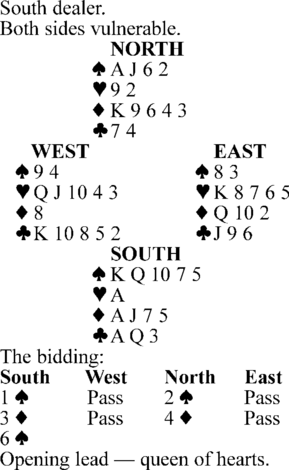
One of the very first general principles learned by the budding bridge player is the "eight ever, nine never" rule. In effect, it states that when the queen is the only high card missing in a suit, declarer should finesse when he holds eight or fewer cards in the combined hands, but play for the drop of the queen if he holds nine cards or more.
This is certainly good advice, since it reflects the percentages that can be found in any table of bridge probabilities. Nevertheless, percentages sometimes have to take a back seat to the special circumstances of a particular deal.
Such was the case in today's deal, where South found the winning route to making six spades. He took the opening heart lead with the ace, crossed to the ace of spades and ruffed dummy's last heart before drawing a second round of trumps.
Next came a diamond to the king and a diamond back. When East followed with the 10, South, disdaining the "nine never" rule, successfully finessed the jack. Declarer later lost a club finesse to the king and finished with 12 tricks.
People are also reading…
Note that if South had played the ace of diamonds instead of the jack on the second round of the suit, he would have gone down one, eventually losing a diamond and a club.
Although it might be argued that declarer merely made a lucky guess, the fact remains that it was the correct play in this instance because, whether the finesse won or lost, South was sure to make the slam.
Suppose the finesse had lost. In that case, West would have been in a hopeless position. He would either have to return a club into the A-Q or lead a heart, allowing declarer to discard a club from dummy as he ruffed in his hand. Either way, the slam was assured.


