

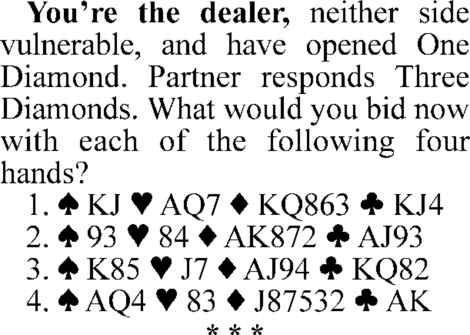

1. Four no-trump. Partner can be expected to have from 13 to 16 points for his three-diamond bid, which puts you in the 33-point zone generally required for 12 tricks. A small slam is thus practically certain, while a grand slam is a possibility. The number of aces partner holds is the key to how far to go, so you invoke the Blackwood convention.
If partner responds five diamonds, showing one ace, you pass; if partner bids five hearts (two aces), you bid six diamonds; and if partner responds five spades (three aces), you bid five no-trump, asking for kings. If the response to this is six diamonds, showing one king, you bid seven diamonds.
2. Four diamonds. Here your opening bid is only slightly above a minimum, and you indicate this by rebidding in minimum terms. If partner next bids five diamonds, you pass.
But if partner evinces interest in a slam by bidding four hearts or four spades over four diamonds, you bid five clubs. This cannot be construed as a strong bid because your previous four-diamond bid announced a minimum hand.
People are also reading…
3. Three no-trump. This is not a pleasant rebid, considering your weakness in hearts, but three notrump offers a better chance for game than any other contract.
It is possible that the best spot is five diamonds, but there is no sensible way of finding out whether an 11-trick contract is superior without going past three no-trump. If partner passes three no-trump, the odds favor making it.
4. Four clubs. A slam is decidedly possible. Partner might have something like:
and this typical three-diamond response would provide an excellent shot for six.
If partner responds to four clubs with four diamonds, you would be entitled to make still another slam try by bidding four spades. If partner next retreats to five diamonds, ignoring both invitations to slam, you would have to respect his signoffs and abandon the effort.
Note that Blackwood should not be used on this type of hand.


