

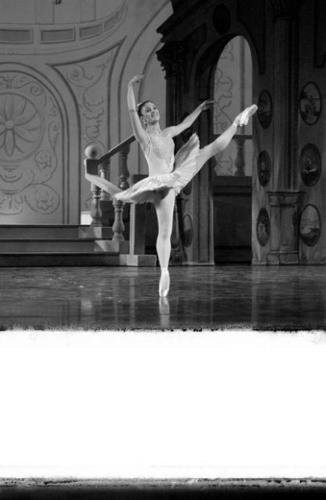
As Ballet Tucson gears up for its final production of the 2007-08 season, company dancer Meredith Dulaney is just trying to keep shoes on her feet.
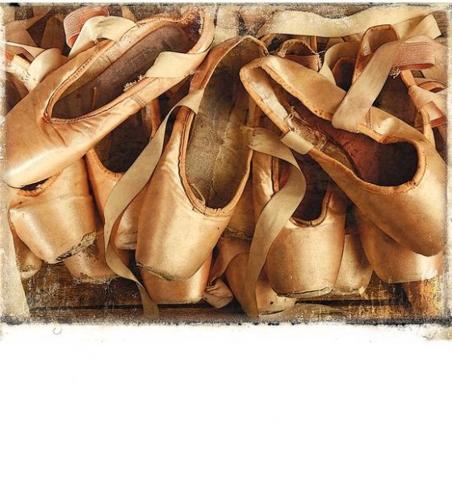
By late last month, the 22-year-old had gone through almost all of the 24 pairs of traditional ballet pointe shoes, also known as toe shoes, provided by the company for the season.
The rest are in a six-pair rotation along with Dulaney's own personal back-stock of footwear, pointe shoes she has collected over the years that don't fit her feet as well or were given to her by colleagues in case of emergency.
"I have run into this problem before, unfortunately," said Dulaney, who will play the fairy godmother in this weekend's full-length production of "Cinderella." "I've worn out shoes to the point where the seams are ripping and the satin is coming off. You just have to anticipate that this may be an issue."
People are also reading…
Dulaney's shoe situation is common for women in the ballet world. Pointe shoes have historically had short shelf lives, thanks to the rigorous wear-and-tear when performing en pointe (on the tips of your toes).
Your classic pair can last anywhere from a couple of weeks to a couple of days.
Ballet Tucson artistic director Mary Beth Cabana said she could easily go through a pair a rehearsal when she was dancing full time.
"They break down easily," Cabana said. "Once you start to perspire and your entire body weight is resting in the shoe, constantly moving, they can't take it."
Cabana says Ballet Tucson buys 24 pairs, one for each week of the season, for all nine women company members and half that number for the apprentices at $50 to $100 a pair.
Men, who generally don't do pointework, receive eight pairs of soft ballet slippers.
The company's shoe budget for the 2007-08 season was roughly $15,000.
That's small potatoes when compared to larger companies. The San Francisco Ballet provides 120 pairs of pointe shoes for each of its 40 female dancers. The American Ballet Theatre in New York City sets aside $350,000 for pointe shoes per season, about $7,500 per ballerina.
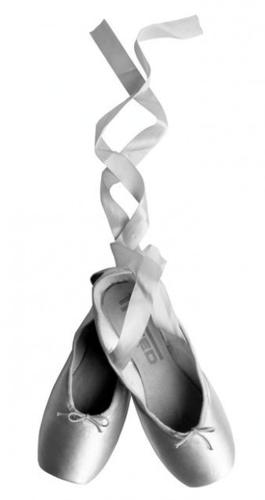
Most of the shoes purchased for Ballet Tucson come from Freed of London, an established British pointe shoe maker since 1929.
Melissa Lowe, a professor with the University of Arizona's School of Dance, says many of the companies she has worked with over the years have invested major chunks of their seasonal budgets into pointe shoes for their women dancers.
She adds that the high cost of these shoes is an issue for students enrolled in the school, who are required to provide their own footwear.
"It makes me sad," Lowe said. "Occasionally a student will come in teary-eyed and tell me her shoes are totally broken; that she ordered new ones but they are not here yet. They are not cheap. Students are not financially situated to order a big stock. And if they are performing in a lot of our work, we ask them to. We can't jeopardize our performances."
In order to keep shoes going, dancers have developed certain techniques that they apply on a regular basis.
Dulaney uses a traditional method of lining the insides of the shoe with jet glue, an industrial-strength adhesive, then letting it harden.
Lowe said other methods have involved the use of floor wax and shellac.
"They can be quite effective when you want to get more life out of the shoes," Lowe said. "But you can only do it so long before the shoe starts disintegrating. It is like trying to resuscitate a person on his way out. There is a chance they won't come back again. Once the shoe becomes misshapen, it becomes hopeless."
Some dancers have looked to more advanced footwear.
Jenna Johnson, principal dancer for Ballet Tucson, has made Gaynor Minden her pointe shoe company of choice.
Rather than use traditional materials, Gaynor Minden produces shoes with parts made from a synthetic rubber geared to last longer.
Johnson has found advantages and disadvantages to the new style.
"It is nice to have a shoe that you can depend on in rehearsal and onstage," Johnson said. "But it doesn't form to your foot the way a traditional shoe does and the look is slightly different. I have to make the shoes form to my foot. I have to do a lot more to prepare it before I work in it."
Dulaney doesn't mind the process she goes through in order to keep her shoes running.
After years of wearing out what she wears on her feet, she said, she has things down to a science.
Still, she looks forward to what the future holds in pointe shoe production.
"A lot of pointe shoes are made for people with small feet," she said. "It is very hard to find a shoe that will fit the width of my foot. That narrows down the different types of shoes I can wear. I'd like to see a shoe for a wider-footed person."
If You Go
"Cinderella"
• Presented by: Ballet Tucson.
• When: 7:30 p.m. Saturday and 2 p.m. Sunday.
• Where: Centennial Hall, 1020 E. University Blvd.
• Tickets: $29-$32 with discounts available through the Centennial Hall box office, 621-3341.
• More information: 903-1445.


