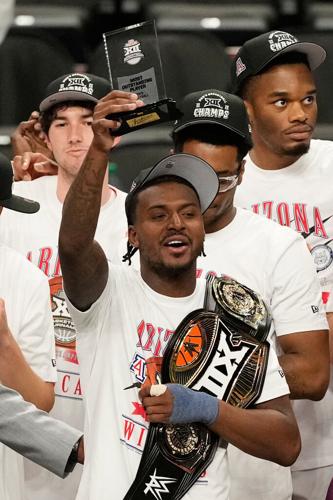
Because the Arizona Wildcats reached their first Final Four in a quarter century, it was not a surprise that Arizona legislators and Gov. Katie Hobbs invited them to stop by the Capitol to celebrate last Thursday.
But it might have been that all of them showed up.

Members of the Arizona men's basketball team pose for a photo in the state Senate on Thursday, April 9, 2026, after a proclamation that Thursday was "Arizona Wildcats Day."
Five days after their season ended in a national semifinal loss to Michigan — an eternity when the transfer portal floodgates are open — the Wildcats were still hanging out together.
Last year, after all, guard KJ Lewis was headed for the portal 48 hours after the Wildcats’ season ended, and forward Henri Veesaar followed less than two days after that. Two other reserves, Conrad Martinez and Emmanuel Stephen, also followed suit quickly.
But the lure of the NIL-fueled transfer portal and NBA Draft was expected to start breaking down Arizona’s 2025-26 roster at some point — and, sure enough, less than 24 hours after the Wildcats returned from Phoenix, WildcatAuthority reported that reserve forward Sidi Gueye was hitting the transfer portal.
People are also reading…
The news was later confirmed, officially opening the Wildcats' spring roster transition season. As of early Saturday, here’s a look at some key questions they face entering that ever-fluid period:
1. Wait. Can everyone play five years now?
Any look at Arizona’s 2026-27 roster pretty much starts with the assumption that seniors Jaden Bradley, Tobe Awaka and Anthony Dell'Orso are gone because they have to be. All of them have exhausted their four seasons of eligibility.
But Yahoo Sports reported Wednesday that an NCAA committee is considering a new five-year, hard-cap rule in which athletes will have five years to play up to five seasons starting with their 19th birthday or high school graduation, whichever comes earlier.
While players can play up to five seasons within that five-year clock, they would not be allowed any extra time via redshirts or waivers allowed, except for those on religious missions, military service or maternity leave.
If approved, the rule could be implemented in time for the 2026-27 academic year, though Yahoo Sports said it is unclear if players who have completed four years but still fall under the five-year clock could return for a fifth season. Currently, players can play a maximum of four seasons within a five-year window.
Reached by Capitol Media Services during the Wildcats’ appearance in Phoenix, UA coach Tommy Lloyd indicated he doubted the proposed rule change would prompt his seniors to consider staying if they could.
“Probably not going to happen right now. That would be my guess,” Lloyd said. “But I’d love them to.”

Arizona guard Jaden Bradley celebrates being awarded tournament MVP after winning the Big 12 championship game against Houston, March 14, 2026, in Kansas City, Mo.
In any case, Bradley indicated he’s on the way out for good. In a social media post Thursday afternoon, Bradley said he was declaring for the NBA Draft while thanking UA coaches, players and fans for their support during his three-year stint with the Wildcats.
“To my coaches and teammates, thank you for trusting me and going to battle with me every day. There's no group I'd rather have shared this journey with,” Bradley posted. "And to the best fans in the country, thank you for your energy, your passion and for standing by me through the highs and lows. I'll carry these moments with me forever."
2. Does NIL change the equation for Burries, Peat?
Another widely held assumption about Arizona’s 2026-27 roster is that freshmen Brayden Burries and Koa Peat won’t be on it. That’s been the case pretty much since they committed to the Wildcats, and there were no indications through Friday that changed that assumption.
Burries is projected as a mid-lottery pick by all major mock NBA Drafts, indicating he could be making well over $5 million next season, while Peat is landing anywhere between picks 11-26.
Still, NIL-fueled player compensation packages have risen so much that elite players with college eligibility left who aren’t at least projected mid-first round NBA picks now have something to think about.
They could sign up for a guaranteed college payday that approaches or even exceeds what they would make as an NBA rookie if drafted toward the lower end of the first round, an area that appears to be Peat’s draft floor.
Forward JT Toppin, for example, took a reported $4 million to return to Texas Tech last season rather than enter the 2025 NBA Draft as a potential late first-round or second-round pick.
While the 2026-27 rookie salary scale is not yet set, a player picked 20th last year could earn a maximum of about $3.6 million — or about the same as a handful of top college players are receiving now.
Players projected in the late first round have even more incentive to return to college: A player picked with the final first-round slot last year, at No. 30, could earn a maximum of $2.7 million — or much less if he fell into the second round.
But there are other factors, too: Jumping in the draft now means starting the clock earlier toward a second, potentially more lucrative NBA contract, while returning to school could hurt without significant improvement, since a player's upside is often perceived to be more limited the older he is.
For what it’s worth, Peat left Tucson for his Chandler home shortly after the season, though he did meet with the Wildcats at the Capitol on Thursday.

Arizona forward Koa Peat (10), left, and guard Jaden Bradley (0) head off the court while Michigan players get their high fives in after their Final Four loss in Indianapolis, Ind., on April 4, 2026.
3. Is the real suspense over what Krivas and Kharchenkov do?
Pretty much. Both have eligibility remaining, improvements to make and potentially competitive compensation packages awaiting if they do return to Arizona. Both have also made it clear they have enjoyed their time with the Wildcats, with Kharchenkov doing so every time he gestures wildly in front of McKale Center fans.
But Krivas is also projected as a late first-round pick, while Kharchenkov could have potentially lucrative options in the transfer portal or European basketball, even if he doesn't leap straight to the NBA.
Having gone through a foot/ankle injury that all but ruined his sophomore season of 2024-15, Krivas also may have more incentive to lock down an NBA contract now rather than risk a return to college.

Arizona forward Ivan Kharchenkov, left, and center Motiejus Krivas jostle the ball out of the hands of Texas Tech forward JT Toppin in the first half of their Big 12 game, Feb. 14, 2026, in Tucson
Either way, their decisions are likely to trigger a domino effect on the Arizona roster: Without Krivas, Awaka and Peat, the Wildcats would have to rebuild their frontcourt completely, while losing Kharchenkov would take away a versatile two-way forward who can’t be easily replaced.
It is possible either or both players sign a deal to return to Arizona while testing the NBA Draft, as Bradley did last spring.
4. Who else joins Gueye in the portal?
The eighth player in Arizona’s rotation this season, freshman forward Dwayne Aristode, appeared the most likely of the Wildcats’ other players to at least sniff around the market as of Friday.
Aristode averaged just 13.3 minutes and just 7.2 in the NCAA Tournament, but flashed high-level 3-and-D potential after sitting out his senior year of high school with an injury. Having led the Wildcats in 3-point percentage (46.2), Aristode could likely command a bigger role and/or a significant NIL package elsewhere.

Arizona guard Dwayne Aristode celebrates his basket against Michigan during the first half of an NCAA Tournament semifinal game at the Final Four, April 4, 2026, in Indianapolis.
Aristode did join the Wildcats at the Capitol, but he was non-committal about a return to Arizona when asked during the tournament.
Meanwhile, Gueye's case appears reminiscent of Emmanuel Stephen — a similar developmental talent who transferred to UNLV last spring — except that Gueye's freshman year was limited from the start for reasons out of his control.
Gueye missed all of UA's summer workouts because of visa issues that kept him in Spain, where he was playing for Real Madrid's junior club, and then struggled with a knee issue in the preseason.
He was a redshirt candidate entering the regular season but played 10 nonconference games and Lloyd said he told him in December to be ready to play in a major game within a month.
Roughly two months later, Gueye had his shot, collecting four points and four rebounds over 10 minutes against BYU on Feb. 18, when Peat and Aristode were both out.
Gueye said before UA’s first NCAA Tournament game that his mentality was “get ready, my time will come, keep getting better.”
Meanwhile, redshirting players Mabil Mawut and Bryce James are unknowns, since neither were available to the media during the season. Both are considered developmental prospects, though Lloyd said before the Final Four that they have made “real physical progress” this year and helped in practice.
“Both of them are trending in the right direction,” Lloyd said.
5. How much can Arizona afford anyway?
Arizona will not disclose the amount of school-paid revenue-sharing and outside-funded NIL money that men’s basketball receives, but indications to the Star have been that Wildcats had a roster budget of around $10 million from those areas last season — competitive with but not at the top of high-major team budgets.
With the program receiving assurances from UA over revenue-sharing and NIL-fundraising efforts — assurances that are not spelled out publicly in the term sheet for Lloyd's latest contract — that budget is likely to be higher for next season.
Still, the reported cancellation of a visit by Oregon transfer guard Jackson Shelstad was one indication the Wildcats aren’t likely to throw a Toppin-style deal at new acquisitions. Shelstad has been expected to choose Louisville.
Arizona’s recent pattern under Lloyd has been to lock up valued returning players with competitive packages — the Wildcats re-signed Krivas, Awaka, Bradley and Dell'Orso in April last season — and navigate the international and domestic market carefully for freshmen and transfers to fill gaps.
Already, Arizona has lined up two incoming freshmen for next season in five-star guard Caleb Holt of Alabama and four-star forward Cameron Holmes of Goodyear Millennium.
Lloyd's track record indicates he'll also pull in more foreign talent, having added international players such as Kharchenkov, Krivas, Veesaar and Paulius Murauskas in recent springs.
International players' recruitments often don’t surface publicly until the last minute, in part because college coaches aim to keep their efforts quiet while competing with European clubs. But it was reported that Arizona brought in Lithuanian wing Dovydas Buika for a visit earlier this season.
During the NCAA Tournament, Lloyd acknowledged that his experience helping international players adjust to college is helping him recruit new ones.
But overall, Lloyd said he hasn’t changed his approach with any recruiting targets even as the NIL/revenue-share era continues to evolve — and as roster budgets continue to increase.
“I don't go into these conversations saying 'Man, you're going to be an NBA all-star and we're going to just let you do whatever you want,'" Lloyd said. “That's not how we recruit.
"I don't want to build a team where I'm just trying to accumulate talent to overcome the dysfunction that comes with the talent. There's always going to be dysfunction. We're human beings. But one of the things we really try to do is limit as much dysfunction as possible and get the most talented, least dysfunctional people we can get in our program.
“We're not perfect by any stretch. So this is not a holier-than-thou speech. But that's how we've always approached it, and it seems to be working.”
Contact sports reporter Bruce Pascoe at bpascoe@tucson.com. On X(Twitter): @brucepascoe
Bruce Pascoe
Reporter


 Tommy Lloyd's new contract calls for bigger bonuses, assistant salary protection