

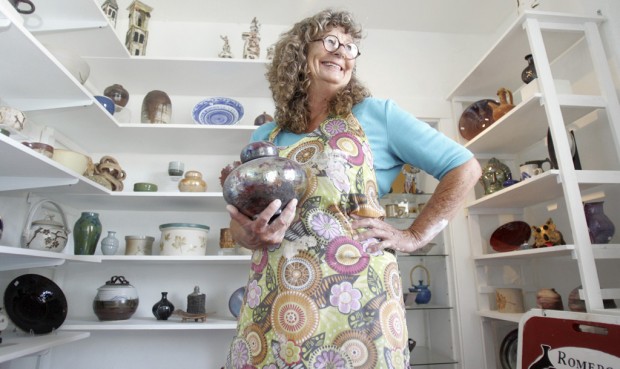
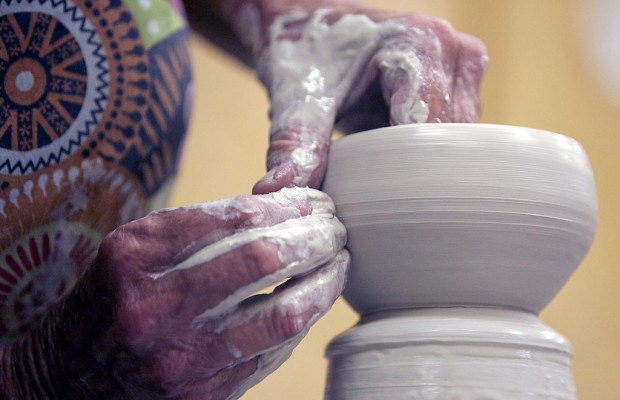
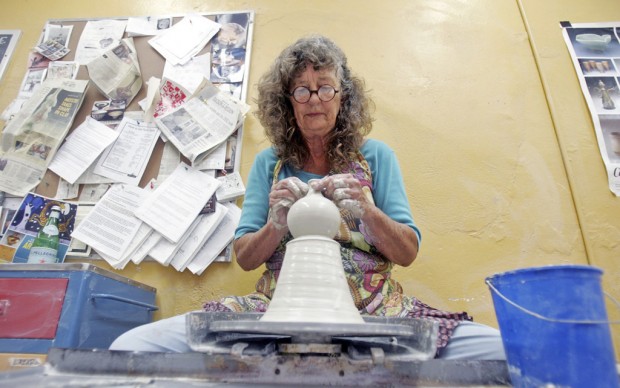
There's aesthetic art, and there's functional art. Janet Burner likes to do a bit of both. Nowadays the potter, 64, is focusing more on the artistic side of her work.
"I'm heading toward more sculptural, away from functional pottery," she said. "There's lots of potters out there making plates and bowls."
She loves raku, a term derived from the Chinese character meaning happiness and contentment.
"It's very immediate," she said. "The entire process takes an hour versus days."
After glazing a raku piece and pulling it hot from a kiln, Burner puts it in a garbage can with sawdust and paper, where the materials ignite.
Results can be bright metallic colors, crackling effects and deep contrasting carbon colored hues.
"Chemically, carbon is attacking the glaze," said Burner, adding that she leaves the piece to smoke in the garbage can for about 15 minutes. "And then you have your results."
People are also reading…
Burner's recent work also includes repoussé, which means "pushing out from the inside." Many pieces are in the forms of nudes and animals, and each takes her about a month to complete.
She works with five types of clay: black sand porcelain, porcelain, white and brown stoneware, and flameware.
Her flameware - a heat-resistant special clay that is used in creating pots, plates and other cookware - makes cooking even more of an art.
"Clay can take more heat than metal," said Burner, who still owns the frying pan she made in 1972.
But there are drawbacks.
"It throws like cement," she said. "It's hard to work with - it cracks."
But people who have bought it as cookware say food tastes better.
"It cooks slower, more evenly," said Burner, whose casserole dishes cost about $85; her frying pans about $125.
Upon walking into Burner's cozy, 630-square-foot midtown home that she shares with her cat, Splashius, you can see her work everywhere - a pan on the stove, sculptures in the living room, a vase on a table.
The Tucson native recently had moved from her historic home at 326 E. Fifth St., which housed her and Sabino Stoneware Pottery, her studio-gallery, since 1985. That house was purchased by developers and recently demolished to make room for a dormitory.
Burner said selling was a no-brainer.
"It was either that or I had the choice of living next to a six-story dorm with 756 students," she said wryly.
Right now, her works can be seen and purchased at the Tucson Museum of Art and at galleries in Silver City, N.M., and Massachusetts, which her mentor, sculptor Harry Holl, established.
Burner fell in love with art while living in Portugal with friends during her senior year at the University of Arizona and started taking art classes that same year.
To hone her skills, she apprenticed under Holl in Massachusetts for six months in 1972.
When she returned to Tucson, Burner started teaching ceramics at the Tucson Arts Center, which later became the Tucson Museum of Art.
That same year, she opened her first pottery shop on Meyer Avenue in Barrio Viejo.
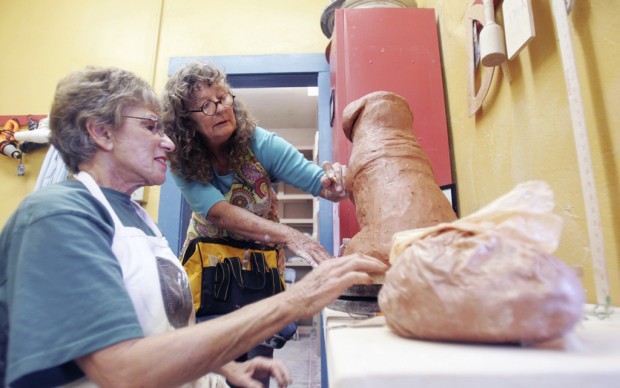
She's currently teaching about 15 adults in two classes each week at the Romero House, 140 N. Main Ave.
Gail Leiken is a current student of Burner's. The retired community volunteer moved to Tucson from Peoria, Ill., about 11 years ago.
While in Peoria, she had taken sculpture classes at a wildlife gallery and shop.
When she moved to Tucson, she tried a variety of classes, hoping to duplicate her experience in Peoria.
"I was looking for a teacher that really inspired me to do my best," said Leiken, who's making a sculpture of a Labrador retriever for her sister in Virginia Beach.
"Then I found Janet, and I was like 'Wow.' I remember coming home and telling my husband, 'I finally found the teacher I've been looking for. I've found the perfect class.' "
In April, what used to be a storage room at the Romero House was transformed into a small gallery.
It's there that you can see and purchase some of Burner's work. Prices range from $5 for a small dish or a cup to $2,200 for an intricately sculpted piece. Burner also sells pastels and charcoal drawings.
Her website, www.sabinopottery.com, showcases her work. For more information, email janet@sabinopottery.com
Pottery terms
• Bisque fire: Preliminary low-temperature firing to harden the clay and make it porous so it will absorb glaze.
• Clay: A decomposed granite-type rock that must have fine particles so it will be plastic. It is formed (decomposed) by rivers and glaciers and often contains iron.
• Glaze: A liquid suspension of finely ground minerals that is applied by pouring, brushing or spraying on the surface of bisque-fired ceramic ware. After drying, the ware is fired to the temperature at which the glaze ingredients will melt together to form a hard, glassy surface.
• Kiln: A furnace made of refractory clay materials used for firing ceramic products.
• Porcelain: A primary (decomposed by pressure), hard, nonabsorbent clay body that fires white and translucent when thin-walled; fired to at least 2,283 degrees Fahrenheit.
• Raku: An earthenware that originated in Japan for ceremonial tea bowls. It came to the United States in about 1970, where raku was transformed to its present-day method of firing.
• Repoussé: A form of pottery that means "pushing out forms from the inside." The potter alters wheel-thrown vases and bowls into abstract forms, nudes, flowers and animals in a sculptural technique called bas relief.
Source: Janet Burner


