

A feminist saint?
That’s what George Bernard Shaw made Joan of Arc in his play “Saint Joan,” based on the life and trial of the illiterate teenage warrior who successfully led the French in battle against the British.
He also made her a religious zealot, a woman of conscious and conviction, and a mighty fine soldier.
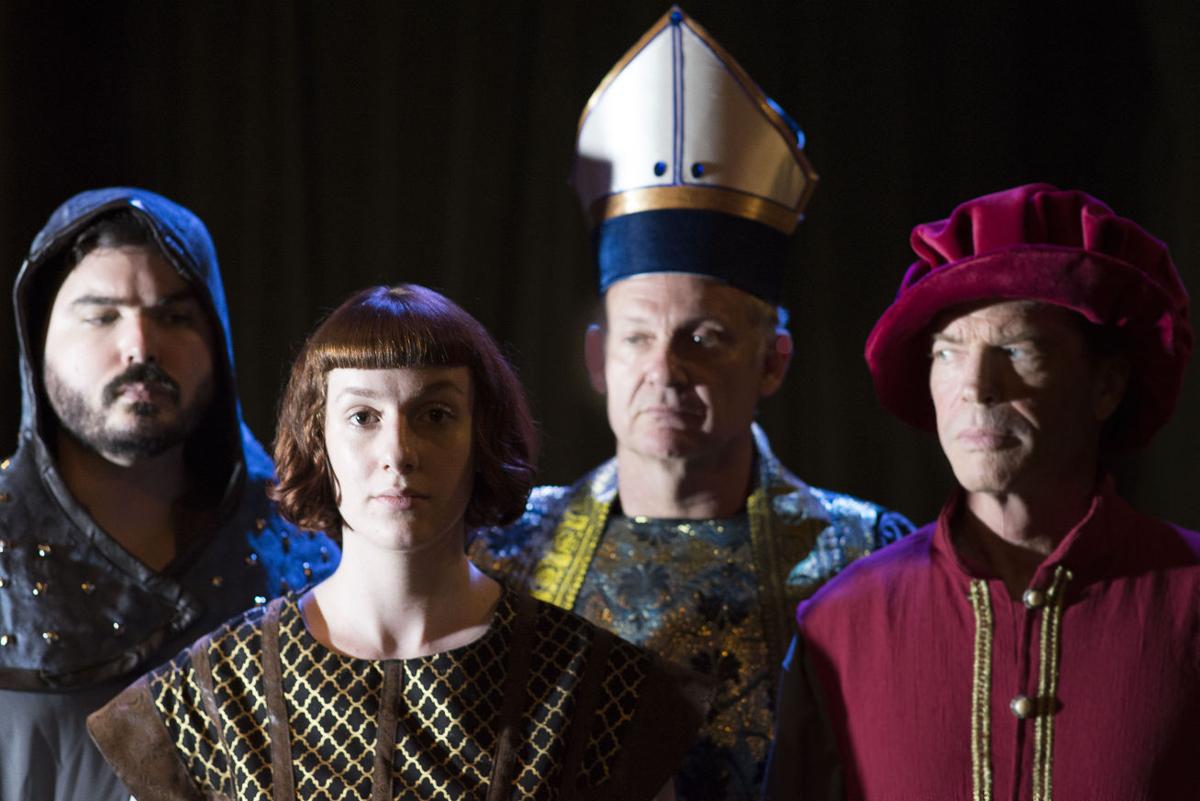
Lucille Petty captured the innocence and religious fervor of Joan of Arc in Winding Road Theatre Company’s solid production of “Saint Joan.”
That’s particularly impressive because this is a character that’s hard to grab hold of: she hears voices, she naively demands horses, armor and soldiers from powerful men, and she’s a teen who cannot read or write. And on top of that, she has a feverish belief that the voices she hears come from the saints and she must obey them and lead the French army.
People are also reading…
I mean, really, who would fall for that?
They did in the 15th century. Joan of Arc was burned at the stake in 1431 after she had been convicted of heresy in a trial that dripped with politics from both the church and state. Shaw wrote this in 1924, four years after she was canonized.
Susan Arnold directs this heady production with a script adapted by playwright Toni Press-Coffman, a co-founder of Winding Road.
Press-Coffman shortened the script, but kept the heart, the humor and the glorious rhythm of Shaw’s language. In doing so, she underscored what hasn’t changed all that much since the 15th century — intolerance continues to reign, war wages, religions clash, power corrupts, strong women are vilified.
Much worked about this production — the acting was strong, the staging simple, the pace easy enough to allow some breath in the delivery, yet fast enough to avoid dragging.
There were a few hiccups. Most of the actors played multiple characters and that led to some confusion. Steve Wood is the first on stage, playing Baudricourt, the first man Joan must convince to give her a horse and armor; in the next scene he plays la Trémouille, head of the French forces. While fine in both, it took a few moments to figure out who he was. That was a few moments taken out of the play. He played two more roles beyond that. The same confusion followed Clark Ray, who played three roles (plus the executioner, whose face we never see), David Alexander Johnston, who played two, and Ben Adami, cast in three roles.
Shaw’s original had 22 characters — a size almost unheard of in plays today (unless it’s a Broadway musical or the University of Arizona’s Arizona Repertory Theatre). So casting an actor in multiple roles generally makes sense. Here, it was difficult to make sense of who was who.
But this is the most egregious stumble:
Toward the end, when Joan is at trial and passionately and eloquently explains why burning at the stake is preferable to life in prison, music overtook the gorgeous, moving speech. All the music one needs at that moment is Shaw’s words spoken by an actor such as Petty.
Confusion at times, and words are occasionally buried under musiccannot negate the power of Shaw’s words and Joan of Arc’s story — which this production shows us quite well.
Contact reporter Kathleen Allen at kallen@tucson.com or 573-4128. On Twitter: @kallenStar

Kathleen Allen
Reporter


