

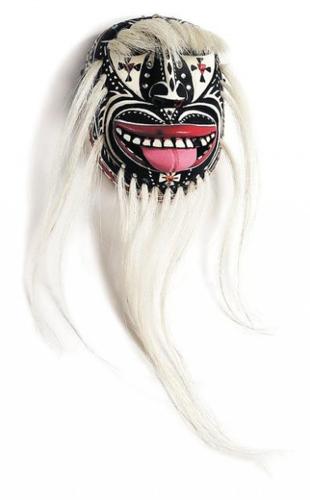
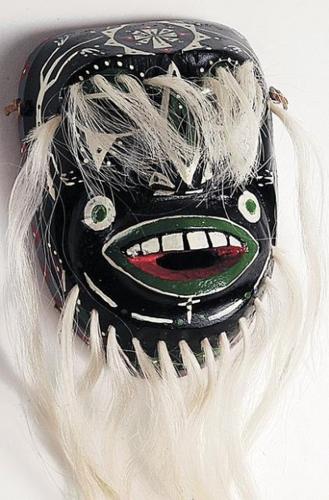
Frank Martinez uses humble raw materials — driftwood from the Santa Cruz River and "store-bought" acrylic paint — to create precious ceremonial masks for his Yaqui people.
Some of his finest masks are on display at the Arizona State Museum.
The exhibit — "Carving Culture: The Yoeme Masks of Frank Martinez" — continues through April 2. Yoeme is the traditional name for Yaqui people, including the Pascua Yaqui Tribe in Tucson.
"The masks are for the Yaqui Pahko'ola dancers during the fiestas," said Martinez, 48, using the Yaqui name for what are widely known as Pascola masks.
"I have been carving since I was 12," he said. "I learned from my uncle. He used to carve, and I helped him a little and picked it up from there. I started using the chisel and the hammer and I learned from that."
People are also reading…
Over the years, Martinez has carved and painted hundreds of masks and taught his techniques to others — including his son, Frankie Martinez Jr., who died in an accident at the age of 21 in 2004.
Martinez uses native wood, basic hand tools and paint supplies that carry no special pedigree.
"The masks are made from cottonwood," he said. "I get driftwood along the Santa Cruz River. I paint them from store-bought acrylic paint."
Tom Kolaz, a fellow at the Arizona State Museum and curator of the mask exhibit, said Martinez is "not only a traditional mask carver but an artist in his own right.
"He has taken the traditional mask form and has stuck to that as far as the size and the way it would fit over the face," Kolaz said. "But he has taken it and added more depth and dimension to the mask by the type of carving that he will do.
"He has done deep incising — carving out lips, teeth and tongues, and they look very naturalistic. It's not just a stylized version. That's where he stands above the crowd with the other mask carvers."
He said the museum exhibit includes 24 masks by Martinez and two by his late son. Two additional carved figures in the exhibit are collaborative pieces by Martinez and his wife, Feliciana.
Feliciana said her husband's work has helped "keep the tradition alive, the culture. That's why he did a lot of the carving. It was to respect the culture."
Many of Martinez's masks have been used in Yaqui ceremonies, but Feliciana said non-Yaquis "came from all over to buy his masks."
Buyers would pay $45 to $100 or more for the masks, she said.
"In the ceremonies, the masks are mostly human faces," she said. "But sometimes they use the goat mask, another traditional one. . . . He has made masks (depicting) humans, animals and birds."
Kolaz said many Pascola masks include symbols for the sun, the sun's rays, tears, rain and animals such as snakes and lizards.
About a dozen carvers were producing Pascola masks in Southern Arizona 20 years ago, Kolaz said. Today, Martinez and one other man are the only carvers known to make the masks here, he said.
Martinez continues to work on masks, but health problems have slowed his production.
"His son, Frankie Jr., was the future of mask carving when he passed away," Kolaz said, noting that the exhibit is dedicated to Frankie Jr. "We don't know how many more masks Frank will carve."
What: An exhibit called "Carving Culture: The Yoeme Masks of Frank Martinez"
Where: Paths of Life Gallery at the Arizona State Museum, 1013 E. University Blvd. It's just inside the Main Gate at North Park Avenue and East University Boulevard on the University of Arizona campus.
When: 10 a.m.-5 p.m. Mondays-Saturdays and noon-5 p.m. Sundays. The exhibit continues through April 2.
Cost: The museum requests a $3 per person donation for admission.
Information: 621-6302 or www.statemuseum.arizona.edu/exhibits online


