

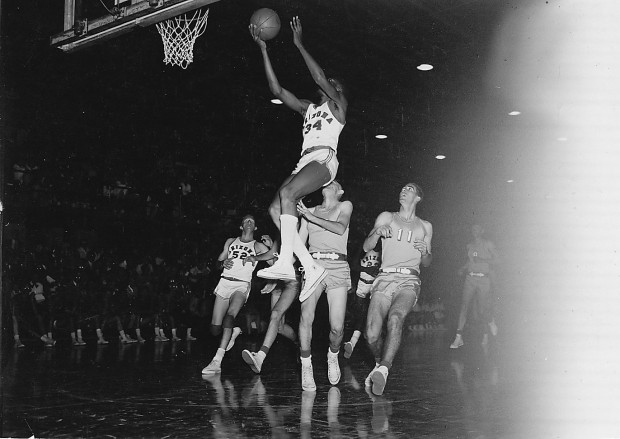
In 1960, the UA was still a year away from getting permission to develop a College of Medicine. It had fewer than 12,000 students and covered less than 11 percent of its current 380 acres in midtown Tucson.
On Feb. 6 of that year, Ernie McCray, a 6-foot, 5-inch center, would score 46 points against Cal State-Los Angeles, a UA record that still stands.
"I don't even think about the points record," says McCray, who grew up in Tucson and attended Tucson High School.
"It sure was fun doing it and experiencing a standing ovation, but records at that point in my time weren't part of my vocabulary. I'm just glad I got to play ball."
McCray graduated from the College of Education and moved to San Diego, where he established himself as an author and an actor. He also worked as both a teacher and principal in the San Diego Unified School District.
People are also reading…
He's one of about 2,000 members of the Class of '60 expected to attend activities this weekend. Many of the alumni will take in the football game against Washington, too.
McCray looks back on his UA years and notes the huge differences in those pre-Civic Rights Act days.
"We only had one black pool, we had to sit in the back of the movies, and we couldn't go to the cafe but one day," he says. "The school was a bit backward back then, as to now, where it seems to be a forward-thinking university."
McCray will be the featured speaker at the Reunion Dinner and is also being honored by the UA Black Alumni Club.
"I was planning on just going to Tucson with a friend and hanging out," he says. "Now, homecoming is a bit of a chore. It's not a vacation anymore. I've got to be on."
In addition to the Reunion Dinner at the Marriott University Park Hotel tonight, there's a luncheon with UA President Robert Shelton on Friday and an appearance in the homecoming parade on Saturday.
McCray will be joined on campus this weekend by classmates Tom Moore and Patricia Preciado Martin, among many others.
Moore started at UA in 1956 with the help of the GI Bill after he got out of the Army. He graduated with a degree in marketing, but he found success in mutual funds.
He stayed in Tucson after college, and every year since 1980 has hosted a party with members of his fraternity, Phi Gamma Delta, to bring back members of his class. His party will be held at Knights of Columbus, and his wife, Ann Grose-Moore, expects about 75 people to attend.
Moore says his parties have gotten noticeably more tame since his first homecoming soiree 30 years ago.
"We used to eat, dance to the bands we'd have play and drink all the booze to where it would get out of hand," he says. "Then, we got old. Now people tend to come in and make an appearance after their dinner and look at old photographs and catch up with people. These people are in their late 60s and 70s. We slowed down."
Moore is an avid sports fan and looks forward to Arizona's game against Washington. He notes that the competitiveness of UA sports is much the same as it was when he attended the school.
"I came here to play baseball," he says. "Right away, I discovered I was in a different league and got cut from the team."
Moore is astonished at the growth of his alma mater.
"When I started here in 1956, Tucson High was bigger than the university," he says. "I was a vet, and a third or fourth of everyone there were also there on the GI Bill. . . . Everybody knew everybody."
Preciado Martin graduated from the College of Education in 1960. A native Tucsonan, she has since become a noted author, winning the Arizona Library Association's Author of the Year award in 1997.
"I am excited to bring back the emotions of what UA means to me," she says. "There weren't many Mexican-American students back then, and I feel lucky to have been supported by such wonderful parents to attend such a great university."
Preciado Martin's published work includes fiction, photo essays, oral histories and children's stories. "I write about Mexican-American culture and history," she says.
She is proud of UA's growth as a progressive institution.
"The UA really believes in offering opportunities to Latinos," she says. "There are so many programs for Latinos there, and even beyond that, the opportunities for woman at the university have increased tenfold."
A UA die-hard, she's happy that her nephew is now a freshman at the school.
"We're proud of our family tradition," she says.
Adam Lehrer is a University of Arizona student who is apprenticing at the Star. Contact him at starapprentice@azstarnet.com


