

He's Good
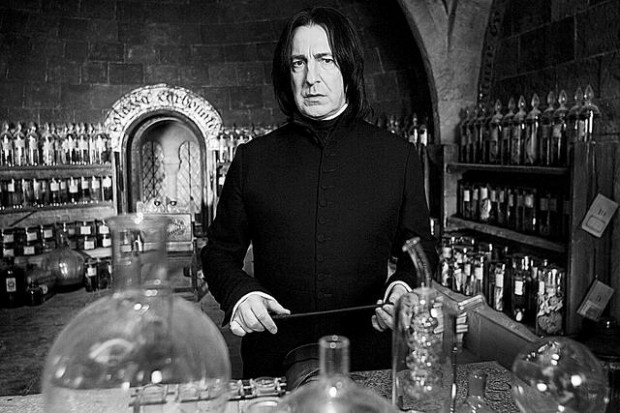
Severus Snape is a cruel and elitist professor who loves to make Harry Potter's life at school difficult, but he's nevertheless on the good side.
Snape seems to relish reprimanding Potter and his friends and shows unbridled favoritism toward students in his own house, Slytherin.
Nevertheless, when it really counts in the battle of good versus evil, Snape chooses to do good.
He muttered countercurses when Professor Quirrell tried to make Potter fall off his broom during a Quidditch game in "Harry Potter and the Sorcerer's Stone," and, in "Harry Potter and the Order of the Phoenix," he alerted the good Order that the Death Eaters were at the Ministry of Magic.
People may argue that Snape was once a Death Eater — someone who supports the evil Voldemort.
People are also reading…
But even Death Eaters can change. When Snape joined Voldemort's ranks, he was young and fresh out of being bullied at Hogwarts School of Witchcraft and Wizardry.
It made sense for someone who was tormented at school to join Voldemort — someone who was clearly rising in power against the status quo.
However, Snape somehow managed to convince Hogwarts' headmaster, Albus Dumbledore, that he wanted to join the good side. Dumbledore trusted him so much that he made him a teacher at Hogwarts.
Some might say that Dumbledore's trusting nature was his fatal flaw. It certainly seemed that way when Snape killed him.
But things often aren't what they seem in Harry Potter's world. Just look at the false, yet very believable, Mad-Eye Moody in "Harry Potter and the Goblet of Fire."
Snape's seemingly murderous action at the end of the series sixth book, "Harry Potter and the Half-Blood Prince," must have been part of Dumbledore's plan. It may not have been Plan A, but it was definitely part of a larger scheme that will surely unravel in the last book of the seven-book series.
-- Danielle Sottosanti
He's Evil
Great greasy-haired Snape. Snivellus.
The archenemy of James Potter and Sirius Black — and James' son, Harry.
From the beginning of the Harry Potter series, Severus Snape has been portrayed through the eyes of Harry Potter — and to a lesser extent best mates Ron Weasley and Hermione Granger — as arguably the worst professor to ever step foot in Hogwarts.
And who could blame them? From the first day, Snape targeted Harry by grilling him on magic-related questions that both knew Harry knew nothing about. From the first book, Snape's motives have been called into question.
The biggest argument about Snape's true allegiance can be made in the sixth book, "Harry Potter and the Half-Blood Prince."
For many, Snape committed the ultimate act of betrayal by killing Hogwarts Headmaster Albus Dumbledore. That was after Draco Malfoy failed to fulfill that task, set to him by Voldemort.
At this point, Snape is given a choice. He is bound by an Unbreakable Vow to Draco's mother, Narcissa. Should Draco not carry out his task, Snape must step in and do it in his place or else he will die. Snape could have sacrificed himself for the cause of Light. However, even after Dumbledore's pleading, Snape kills him with revulsion and hatred on his face.
This, combined with Snape's ongoing loathing of Harry, endless fascination with the Dark Arts and his position as a double agent with both Voldemort and the Order of the Phoenix, shows that Snape is not thinking about the greater good of defeating Voldemort. He's only thinking about preserving his own life and Voldemort's power.
When he destroyed the man who gave him a second chance at a decent life, Snape threw his lot in with the Death Eaters for good.
-- Megan Lavey


