

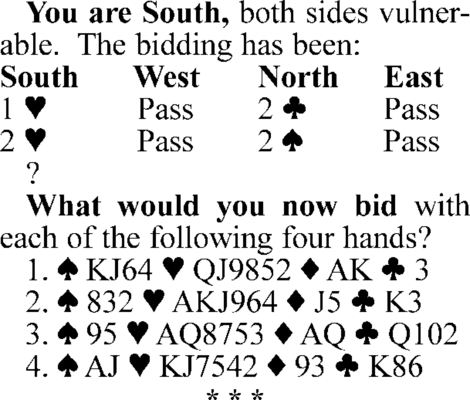
1. Four spades. The value of a hand goes up and down as the bidding progresses. Take this one, for example. When you open the bidding, your hand is considerably better than a minimum opening bid. Although you have only 14 high-card points, the 4-6-2-1 distribution increases the value of the hand by two or three points, pending subsequent developments in the bidding.
When partner responds two clubs, your hand certainly does not improve and actually shrinks somewhat in value. The club response doesn't help your hand one bit, and about all you can count on at this stage is your 14 high-card points.
But when partner next bids spades, the situation changes again. Your hand is now worth an additional three or four points in distributional values, and you show this by jumping to four spades to inform partner about the improved nature of your hand.
2. Three hearts. Here you have no choice but to stick to your story that you opened with minimum values, since neither of partner's responses has helped you at all. Partner might go on, depending on his hand, but you've done your duty by hoisting a red flag.
People are also reading…
3. Three no-trump. The two-heart bid on the preceding round was a slight underbid, and you now make up for it by jumping to three no-trump. A two-no-trump bid at this point would make it appear that you started with a bedrock minimum, which is simply not the case.
4. Three clubs. All you can do here is to indicate a preference for partner's first suit. You started with a relatively weak hand, and you have to bid weakly in order to try to slow partner down. If partner proceeds in the face of two sign-offs, he does so at his own risk.


