

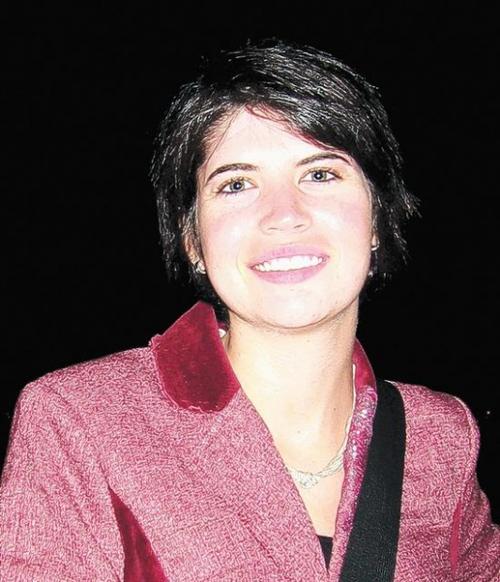
Tucson native Brooke Sebold brings the documentary she co-directed to town this weekend as part of the Wingspan Reel Pride series at the Loft Cinema, 3233 E. Speedway.
The 26-year-old St. Gregory College Preparatory School grad, who now lives in San Francisco, directed "Red Without Blue" along with the husband-wife duo of Todd and Benita Sills.
The film is about identical twins — Mark and Alexander (Clair) Farley — whose relationship evolved when Alexander pursued a sex change.
The film screens at 1 p.m. Sunday, and Sebold will also host a Q&A session along with the Farleys. General admission is $10, and includes hors d'oeuvres and beverages.
Sebold spoke to the Star over the phone.
What brought you into filmmaking?
People are also reading…
"When I was a young kid, I got into a skiing accident. I was bedridden for a year and a half, and I just watched film after film. I kind of knew what I wanted to do. I made a few shorts in school, and I came across this subject. It's my first documentary and first feature-length film. I didn't want to make a narrative piece out of this. Sometimes, truth is stranger than fiction."
How did you find this subject?
"When I first moved to San Francisco, I sublet my room, then all of my roommates moved out. I was looking for a bunch of new roommates, and Mark, a friend of a friend, moved in. Mark became really my first friend in San Francisco, and we were best friends very quickly. In a few months I learned he had a twin that was transitioning, and their past and what they'd been through fascinated me."
Was it tough to make a film about a friend?
"It was basically a personal documentary, which is difficult. There's kind of a fine line making a personal documentary about a story that was not my own. It was difficult for us, trying to do a film that Mark would make for himself if he were a filmmaker. It's not objective, but really intimate. The family really accepted us as their own. If it was objective, we wouldn't have been privy to some situations. There were times where we were going to a party, and we'd pick up a camera and go shoot it."
Did any other documentary influence you?
"One of the biggest fascinations for us was (the Farleys') home movies. They were picture-perfect twin boys jump-roping in unison, but the movies were lies — the reality couldn't have been more different. They were struggling with their sexuality, dabbling in drugs and alcohol, and struggling with sexual abuse.
"The filmmaker who really exposed that kind of thing is Jonathan Caouette. In 'Tarnation' (2003), he picked up a camera and made a film about himself with home video footage, a personal documentary that transcends all of those lines. It was a filmmaker inviting the viewer into his personal space. Mark was a collaborator on every level, and we really, really wanted it to be in that vein."


