

LOS ANGELES - Matthew McConaughey has just cracked open his second Corona when the man wearing Mardi Gras beads and a Village People policeman's cap approaches his car.
"Do you know Duane?" the inebriated-looking man asks with suspicion, poking his head inside the window and gesturing to the house the car happens to be parked in front of. "Because I'm just giving you a word to the wise. He's hypersensitive about security and things like that. He'll have his people come and shake you down."
It's 9:30 on a Tuesday night, and McConaughey is sitting in the back of a black SUV with crime novelist Michael Connelly. They're high above the lights of Los Angeles on a twisty and noiseless street in Laurel Canyon, nursing beers and reflecting on the actor's role as on-the-make attorney Mickey Haller in the adaptation of Connelly's "The Lincoln Lawyer."
Parked down the street from Connelly's one-time residence - which served as inspiration for Haller's home - they discuss the building's remove from the city and how it symbolizes Haller's status as a legal-system outsider. Neither of them know Duane.
People are also reading…
"You like Mardi Gras?" Connelly deadpans to the 50-ish interloper, who has emerged from a home nearby to offer his unsolicited warning. The man begins an enthusiastic affirmative answer, and Connelly further defuses a fraught situation, saying he used to live up the street, and downshifts to small talk about Beverly D'Angelo, who lives here too. Growing excited, the stranger responds with a semi-coherent story about how D'Angelo has been engaged in a rivalry with actress Carrie Fisher over a role. Then he walks away.
"Well, daa-yam," McConaughey says in his Texas drawl, laughing as he turns to Connelly. "You could have written a whole novel right there. The Croatian gangsters come, Mickey Haller sorts it all out. Beverly D'Angelo is saved."
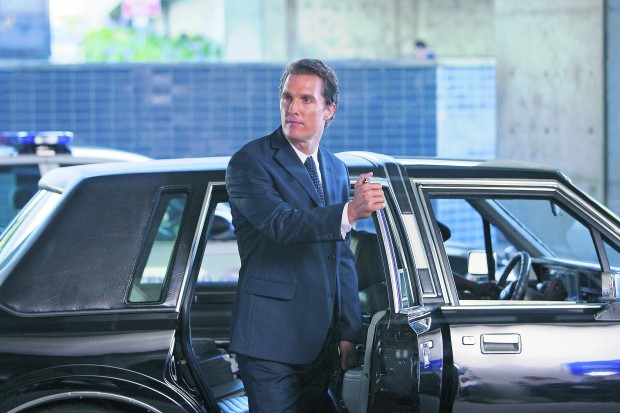
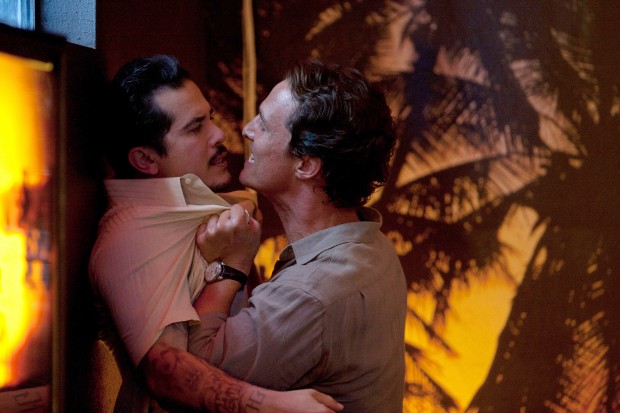
It's a scene that wouldn't be out of place in McConaughey's new legal thriller, where Haller, a small-time lawyer who instead of an office works from a Lincoln Town Car, offering back-seat banter and attitude to clients and antagonists alike. Brad Furman's Los Angeles-shot and -set film, which opens Friday, examines what happens when Haller is called upon to defend Louis Roulet (Ryan Phillippe), scion of a wealthy Beverly Hills family who's accused of attempted rape and attempted murder. It's less a victim tale than a chess match; Roulet is not as innocent as he appears, and Haller soon finds himself in a legal and moral quagmire.
But if McConaughey's rakish playfulness is evident as he talks about the movie, the part - his first dramatic role after five years of romantic comedies - also has him in a philosophical mood. "With a romantic comedy, the goal is not to hit too hard. It's a jab. It's a spar," McConaughey says. "This is like a Frazier-Ali fight. Ali could have his best day and still lose. This is basic survival."
It's also the actor's first role as a lawyer since his turn as Jake Brigance in "A Time to Kill" vaulted him to stardom 15 years ago, and McConaughey says the onscreen job suits him.
"I always thought I was going to do criminal defense law for a living," he says. "It's actually close to the job of an actor or an artist. The defense attorney is a storyteller. He has to weave the web of reasonable doubt, tell the story that could" - he puts his hands together and snakes them through the air - "have happened like this, or could have happened like that."
As McConaughey has his driver take him and Connelly to the author's former home, the actor pulling Coronas from a cooler next to his seat and offering bottles and limes to his ride mates, he says the experience of shooting across the city was an education. "We'd go to neighborhoods I'd never been to, that many people in L.A. have never seen, areas where you can feel a sense of desperation. Mothers and kids are walking in the park in the same square footage as the guys from the gang," he says. Connelly has written more than two dozen crime-fiction bestsellers, most of them set in Los Angeles. But "Lincoln Lawyer," which features his best-known character after Det. Harry Bosch (not yet seen on screen), marks only his second book to be filmed. (The Clint Eastwood-directed "Blood Work" came out in 2002.) Connelly is poised to win a long legal battle with Paramount over Bosch rights.
A former Los Angeles Times reporter now living in Tampa, Fla., the novelist had little input on "Blood Work," which proved to be a critical and commercial disappointment. But on this one he met with McConaughey before production and came to the set to talk to Furman, who directed from a script by John Romano. Months before McConaughey was cast, Connelly recalls watching the actor in "Tropic Thunder" and telling his wife he thought McConaughey would make a good Mickey Haller.
"Really? I didn't know that was my audition tape," McConaughey says, chuckling.
"This story requires constant momentum," Connelly replies. "Things are always in motion. And Matthew looks like he's in motion even when he's standing still."
McConaughey nods his head in agreement. "Momentum and hunger are baseline components of that character. He's always running to something … even if he's not sure where he's going."


