

SAN FRANCISCO — Even now, lounging around her apartment at the age of 62, wearing Mephisto slippers and a far-from-revealing hoodie, Linda Ronstadt is thinking back to a summer in Guadalajara when she was 12, and a light-haired Mexican boy named Mario.
"I would flirt with him," she recalls wryly, her come-hither eyes and heart-shaped lips still echoing the days when she was decreed "Rock's Venus" by Rolling Stone. "One night I heard music and ran to the window. I peeked through the curtain, and there was Mario with two taxis full of mariachis serenading me with firecrackers."
To Ronstadt, whose roots are deeply embedded in Mexican soil, it was the ultimate seduction. "These are big-voiced songs, filled with the exuberance of nature, the fertility of the earth, love and romance," she says of mariachi music, the focus of much of her artistic passion since she abdicated the throne of rock Venus-dom in the early '80s. "They're about growing the land, and romance blooming in that context. The songs are more complex sexually, I think, than the romantic love we grew up on."
People are also reading…
A mistress of self-reinvention who likens her resolve to "a Mexican crossed with a Sherman tank," Ronstadt's post-"Heart Like a Wheel" career has included pop standards with Nelson Riddle, Gilbert & Sullivan's "Pirates of Penzance" onstage for Joseph Papp (she was nominated for a Tony), twangy Appalachia (with Dolly Parton and Emmylou Harris), French Cajun (her recent "Adieu False Heart" with Ann Savoy) and, of course, with "Canciones de Mi Padre," mariachi — which reconnected her to her Tucson childhood as the granddaughter of a German-Mexican mining engineer and rancher whose mariachi band serenaded the populace from a now-defunct bandstand in the city's central plaza.
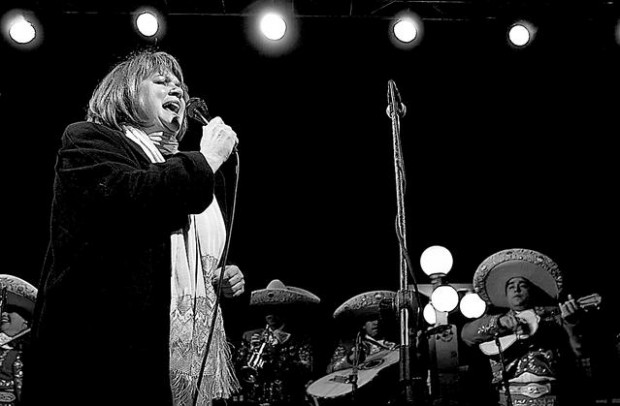
Today, Ronstadt, whose zeal for eclecticism extends to her décor — a cross between the Hubbell Trading Post in Arizona and Mario Buatta — is transforming herself again, this time as the consulting artistic and educational director of the Mexican Heritage Plaza's 17th Annual International Mariachi and Latin Music Festival in San Jose, Calif. Last weekend, she performed there with artists like Lila Downs and Aida Cuevas as part of a tribute to three dead mariachi divas, including her own musical heroine, Lola Beltran.
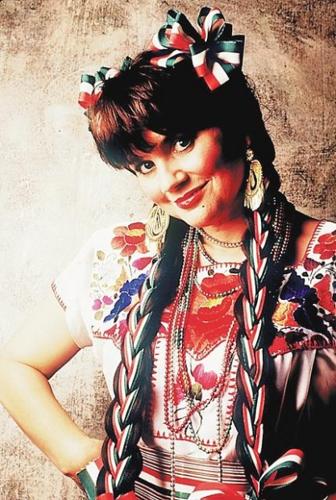
Ronstadt used her stardom to raise the profile of Mexican music. "Canciones de Mi Padre," released in 1987 and her first album of traditional mariachi music, became the biggest-selling non-English album in U.S. history at the time, with sales of more than 2 million copies. The next year it was adapted for a Broadway show, in which she appeared in full Mexican costume, complete with fake braids.
"She put us on center stage," said Nati Cano, 75, a national heritage fellow who recently performed with mezzo-soprano Suzanna Guzmán and the Mexico City Philharmonic in Los Angeles. "After Linda, mariachis became popular in concert halls, not just at the cantinas and the piñata parties."
Through the music of her father and grandfather, Ronstadt seemed finally to inhabit herself, like Peter Pan finding his shadow. On the radio, the soulful melodies of traditional mariachi ensembles still lie under the radar, though individual artists accompanied by mariachi bands, like Vicente Fernández, regularly top the Latin charts. For many Mexican-Americans, mariachi remains the emotional soundtrack of daily life, performed at baptisms, weddings, birthday parties, funerals.
The music emanates a sense of place, where young couples stroll arm in arm and dance under strings of lights in village plazas. "There's a lot of homesickness in Mexican music, a profound yearning because of the need to migrate, which is why I relate to it so much," Ronstadt said, sitting on her chintz sofa sipping tea, her drug of choice. "I left home when I was 17, and it was quite a wrench. I was homesick my whole life."
To hear her talk about her girlhood memories — the smell of wool on the Navajo blanket she would lie on as she begged her parents to sing, her father on the guitar and her mother on the banjo — is almost to forget about Ronstadt's other life. That's the one with the platinums and Grammys, and the much-publicized romances with George Lucas and Jerry Brown.
For Ronstadt being a rock star was something of an out-of-body experience, despite being one of her generation's sexiest brunettes.
Unlike Bonnie Raitt, Joni Mitchell and Harris, contemporaries she reveres, Ronstadt was marketed as "this sexualized being, somebody else's version of me walking around with my name," she said. "It became a strange distortion. Eventually, I had to put out the complete version of who I was."
She moved back to Tucson, literally and musically, adopting two children — Mary Clementine, now 17, and Carlos, now 14 — when she was in her early 40s. She has never married. "I'm very bad at compromise, and there's a lot of compromise in marriage," she says. "Even swans aren't as monogamous as they say."
She is not a having-it-all mom, deciding early to limit her touring so that Mary, who is into fashion design, and Carlos, who likes Rob Zombie and Motorhead, would not become "tour sausages." In Tucson, where she grew up in a large musical family — the von Trapps with cacti — she had hoped to give her children a life resembling her own, in which boys and girls rode ponies to the drugstore to buy a Coke. But that Tucson is long gone now.
So though she maintains a house in Tucson, she moved with the children back to her old neighborhood in San Francisco, a place with sidewalks where she had lived during much of the '80s.
Ronstadt continues to be involved in humanitarian groups like the Samaritan Patrol along the border in her beloved Sonoran Desert, where she cleans feet and applies bandages. "If there was a plane crash killing 100 people in the desert, there'd be an outcry," she said. "But 100 people dying on foot? They don't care."


