

NEW YORK - Less than three months ago, the Metropolitan Opera's new production of "Boris Godunov" faced a crisis.
Peter Stein, the German director who had been working on it for more than a year, abruptly quit because of difficulties with his visa, after the sets and costumes had already been designed but before rehearsals could start. To salvage the project, the Met called in American Stephen Wadsworth, who had never before directed Mussorgsky's somber masterpiece.
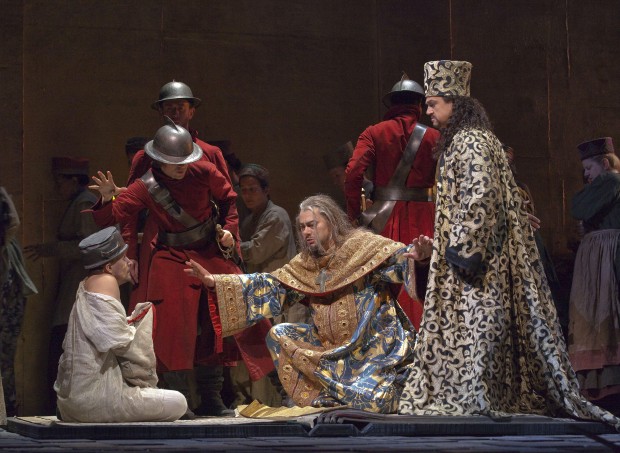
The production had its premiere Oct. 11, and to say "crisis averted" would be an understatement. In fact, it's more like "Bravo, Boris!" The result of this unusual amalgam of talents is a huge success on every count - from the superb cast led by bass Rene Pape in the title role to the inspired conducting of Valery Gergiev to the remarkably fluid and psychologically acute direction by Wadsworth.
People are also reading…
"Boris," adapted by the composer from a play by Alexander Pushkin, is a sprawling historical epic, recounting a troubled period in Russia's history at the turn of the 17th century. As the opera begins, Boris - who has murdered the young heir to the throne, Dmitri - is proclaimed czar, but he is wracked with guilt and self-doubt. A young monk, Grigory, claims to be Dmitri and becomes a pretender to the throne, forming an alliance with a Polish princess, Marina, to lead an army against Boris.
As a backdrop to this tale of ruthless personal ambition and conflict, the chorus represents the Russian people, who suffer from hunger, deprivation and brutality. When the opera ends, Boris is dead, Grigory is ascending the throne and the people are no better off.
The music Mussorgsky composed for "Boris" is filled with mournful melodies and austere, even bleak, orchestration. Under Gergiev's guiding hands, the score unfolded with a quiet inevitability as it moved toward its tragic conclusion.
Wadsworth's direction, too, had an irresistible momentum, thanks in large part to his decision to lighten Ferdinand Woegerbauer's already spare sets - mostly building facades and walls - so that the many scene changes could happen instantaneously, one literally flowing into the next.
The production, greatly enhanced by Moidele Bickel's colorful period costumes, is imbued with a sense of history and geography. A huge manuscript lies open near the front of the stage for much of the evening. In it, an aged monk, Pimen, is writing Russia's history, including Boris' murder of Dmitri.
The staging is filled with insightful touches that, while not specified in the libretto, add to our understanding of the characters.
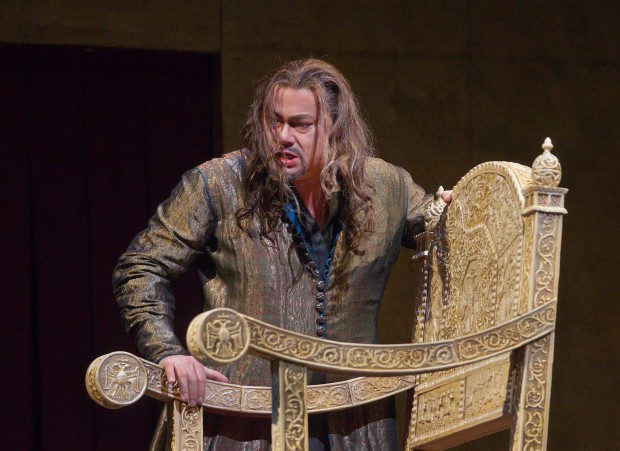
Though Boris sings substantially in only three of the 10 scenes, he dominates the opera - especially as embodied by Pape. The German bass is noted for his impressive power and warm, velvety sound, but as Boris, his voice takes on a mournful, sometimes yearning, sometimes anguished quality. His torment is evident from the beginning in the haunted look on his face and his teetering posture, as if he has difficulty standing erect under the weight of his crime. His death, falling to the floor and gasping a final breath, comes almost as a relief.
The large supporting cast has not a weak link. Ekaterina Semenchuk, a mezzo-soprano from Belarus, fills out Marina's insinuating phrases with lush vocalism. Russian bass Mikhail Petrenko does stalwart work as Pimen, and Vladimir Ognovenko, another Russian bass, has a memorable comic turn as the rascally monk Varlaam. As the Holy Fool, Russian tenor Andrey Popov lets his plangent tenor voice ring out with urgency. And the chorus, such an integral part of this work, sings with astonishing beauty and control under the direction of Donald Palumbo.
If you go
Metropolitan Opera's Live in HD series: Mussorgsky's "Boris Godunov."
• Conducted by: Valery Gergiev.
• When: 9 a.m. Saturday.
• Where: Century El Con 20, 3601 E. Broadway; Century Park Place 20, 5870 E. Broadway; and Century Theatres at the Oro Valley Marketplace, 12155 N. Oracle Road, at Tangerine Road.
• Running time: 4 hours, 30 minutes.
• Tickets: $24 for adults; $22 for seniors; $16 for children through Fandango.com or at the theaters.
• Details: metoperafamily.org


