

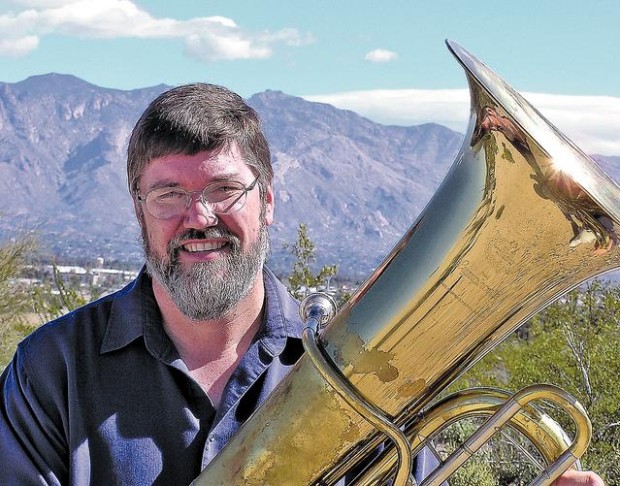
The tuba is often relegated to the back of an orchestra or the butt of a joke, but tuba lovers — the few and the proud — are passionate about their chosen instrument. So much so that there's an annual day of celebration — International Tuba Day, which is today — to honor those who put up with the hassles of playing an unwieldy 20- to 30-pound instrument and the hardships associated with society's perceptions (or misperceptions) about it.
"It's not just the fat kid in the back playing oomph," said Kelly Thomas, laughing. Thomas is a University of Arizona tuba/euphonium instructor and director of pep bands.
There's so much more to the 20-odd feet of shiny, twisted metal than long, low notes, said Mark Nelson, who, in addition to being the Pima Community College chair of performing arts and director of bands, is a renowned solo tuba player.
"It's really probably one of the most versatile of any instrument in the orchestra," he said. "People often think you're the guy who does the oomph, but when they hear this they're amazed. The tuba can play as fast and high as a trumpet and as velvety-toned as a violin. It's like any other instrument in the hands of a capable musician."
People are also reading…
Still, many of the best-known composers of earlier centuries left the tuba out all together, though it wasn't personal — the tuba, patented in 1835, just hadn't been invented yet.
"As far as instruments go, the tuba is a very young instrument," Thomas said. "It's another reason why we have an uphill battle."
And while there has been an explosion in solo and ensemble music written for the lowest-pitched of the brass instruments over the past 30 years, many more modern orchestral parts are still a bit uninspired.
"When you're a tuba player in the band you have 40 minutes of nothing and one minute of sheer terror," Nelson said, laughing. "You have to count 1,000 measures and then come in at fortissimo."
No matter how simple or complex the part, Michael Sherline, the Tucson Symphony Orchestra's principal tuba player since 1980, focuses on finding the musical value of every note he plays.
"When you have so few notes, you concentrate on making each one as beautiful as possible," he said.
Thanks to many champions of the instrument, thousands of people play tuba today. That's never clearer than around the holidays, when low-end brass players the world over join together in groups to perform TubaChristmas concerts. Last year, 125 students, amateurs and professionals from the Tucson area participated in the local event.
"That's what I call a heavy-metal band," joked Nelson, who added that he was the first person to conduct TubaChristmas in Tuba City.
A sharp sense of humor seems to be a prerequisite for playing the tuba. It's part of the personality of the instrument and, by extension, the players, Nelson said.
"We have nothing to do in the back so we get to clown around and have fun," he said.
They may be good-natured, but they are also quite competitive. While their numbers are still relatively few, orchestral job openings are even fewer.
Last year, Carol Jantsch, then age 21, beat out 194 other tubists to become the Philadelphia Orchestra's principal tubist. She may be the first female tuba player in a major full-time American orchestra, but she certainly won't be the last. More women are picking up the tuba than ever before — eight of the 18 students in the UA tuba/euphonium program are women.
"It didn't used to be that way, but there's more and more women players today," Thomas said. "That stereotype is being broken."
Sadly, it doesn't appear that Thomas' 4-year-old daughter, Janelle, will follow her father's lead — her favorite instrument is the very un-tuba-like flute.
"She pretends to play the flute — it kills me," he said, laughing. "It breaks her daddy's heart."
Luckily, his son Keljan hasn't betrayed the monster-size instrument — yet.
"I'm still working on him," Thomas said of the 9-month-old.
International Tuba Day
• When: Today.
• What: Recognizes and celebrates tubists around the world who deal with the hassles of handling a tuba.
• Why: Joel Day founded International Tuba Day in 1979 while attending a Philadelphia high school where he found a lack of respect from his fellow classmates.
• More information: www.tubaday.com.
Suggested tuba tunes
Our local experts suggest the following tunes to hear the tuba playing a prominent role or solo:
• Hector Berlioz — "Symphonie Fantastique" (fourth and fifth movements).
• Anton Bruckner — Symphonies No. 4-9.
• Paul Creston — "Invocation and Dance."
• George Gershwin — "An American in Paris."
• Gustav Mahler — Symphony No. 1, third movement.
• Dmitri Shostakovich — "The Golden Age."
• Igor Stravinsky — "Petrouchka."
• Richard Wagner — Prelude from "Die Meistersinger" or "Lohengrin": prelude to Act III.


