

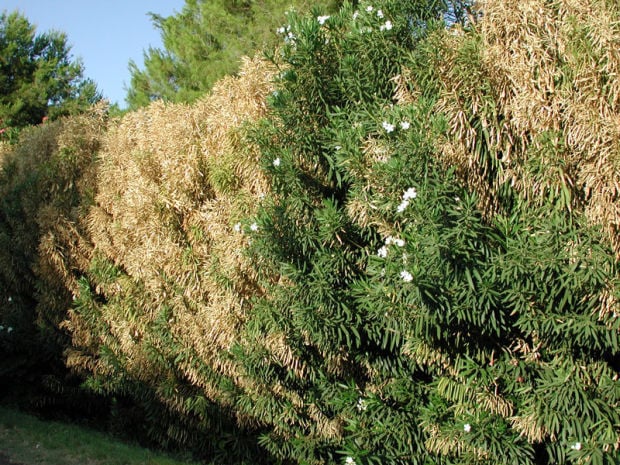
Question: Over perhaps a decade or so, my oleanders have gone from robust and green to increasingly worse, one year sharply deteriorating and dying out in a big way. This sudden decline followed at least one year in which I attempted to follow the advice to water deeply, which I checked by a soil probe. The few years prior to then, watering may have been quite hit-and-miss.
Answer: Your description sounds like oleander leaf scorch although the plant would need to be tested to be sure. Planting something else in that location should not be a problem if this diagnosis is correct.
Oleander leaf scorch is caused by the bacterium Xylella fastidiosa, which is vectored by insects that feed on the water-conducting tissue (xylem) of the plant.
Symptoms can be expressed year-round, although they may be more noticeable in late spring and summer, and include yellowing of leaves on one or more branches. The leaves begin to droop and the margins turn a deeper yellow or brown and eventually die. Eventually this spreads to other branches and then the plant dies.
People are also reading…
Symptoms are often confused with those caused by drought. However, drought-stressed leaves yellow uniformly or along the central leaf vein, while in leaf scorch disease yellowing progresses from the tip or margins inward. Also, unless the drought is severe, the plant recovers when watered. An oleander infected with X. fastidiosa will not recover because bacteria plug the xylem tubes and limit water flow.
Marginal browning of leaves can also be associated with salt or boron toxicity. In these cases leaves usually do not droop, and the symptoms are more noticeable in older leaves. A soil or tissue test can help determine if an excess of minerals causes the symptoms. If salt toxicity is the problem, plants will improve if salts are leached through the soil and below the root zone by overwatering periodically, whereas no improvement will be seen in plants infected with leaf scorch bacteria.
Question: I grew up in Southern California and am an alumnus of the U of A. I recently moved back to Arizona in the Phoenix region and have always wanted to have an avocado tree in my backyard like I did in California. Do you have any recommendations of where to get a tree and maybe someone who can help with recommendations on how to grow trees in the Valley. I’m also interested in other fruit trees as well if you have any recommendations.
Answer: Avocados do best in milder climates, like coastal California (don’t we all?). Our extreme heat and cold make it really tough for them to do well here. You might talk with some of the Rare Fruit Growers; they like to grow plants that most of us can’t keep alive. Check the website to learn how to contact them and maybe attend one of their meetings: www.azrfg.org
Question: For several years, my Fan Tex Ash developed a white ring around the trunk at ground level, which I would annually scrape off with a large screwdriver. The Ash eventually died (I believe due to borers) and was replaced with a jacaranda, which died within a year. When I removed it, I noticed a white powder on the roots. My neighbors, who own a tree service, had several new trees die in the same vicinity and indicated that they thought it was a fungus in the ground that became active from the tree watering. Is this possible, and if so, can the soil be tested for it? Your help would be greatly appreciated, as I would like to plant another tree in the same location.
Answer: I believe your neighbors are on the right track. There is a soil-borne fungus, Phymatotrichopsis omnivore, commonly called Cotton (Texas) Root Rot that often causes a rapid wilt and death of the host in the late spring, summer and early fall when temperatures are warm. Dead and dying leaves remain attached to the plant. However, infected plants also may decline more slowly, especially at cooler temperatures and when plants are well cared for. The roots of dying or declining plants are rotted. With careful examination, under at least 10X magnification, light brown strands or hyphal webs of the fungus can be observed on the root surface. With sufficient moisture, the fungus may occasionally produce a white to light tan sterile spore mat on the surface of the soil near the host, but these mats are not common. I believe this is what you were seeing around your ash tree. Unfortunately, the soil cannot be tested for this. The way to test is to plant a susceptible tree, which you did. You should choose from a list of trees that are tolerant of this fungus if you want to replant. Please see the Pima County Cooperative Extension publication az1150 on this topic for more information.
Peter L. Warren is the Urban Horticulture Agent for the Pima County Cooperative Extension of the University of Arizona. Questions can be emailed to plwarren@cals.arizona.edu

 As water lifeline evaporates, Arizona faces a cultural change over water use


