

Early in the history of America it was not uncommon for an enterprising individual to erect a house on a riverbank and make a living providing a ferry service moving people and goods to the opposite shore. Historical records from 1797 indicate that at St. Louis, passengers on the east bank of the Mississippi would embark from Capt. James S. Piggott’s Ferry House to sit in hollowed-out tree trunks as they were paddled and poled across the river.
Later, ferries used horses harnessed onto a circular treadmill on the boat. As the horses walked in circles they powered a paddlewheel propelling the ferry across the water. Eventually steam and gasoline engines replaced the horses, and the size of the ferries increased.

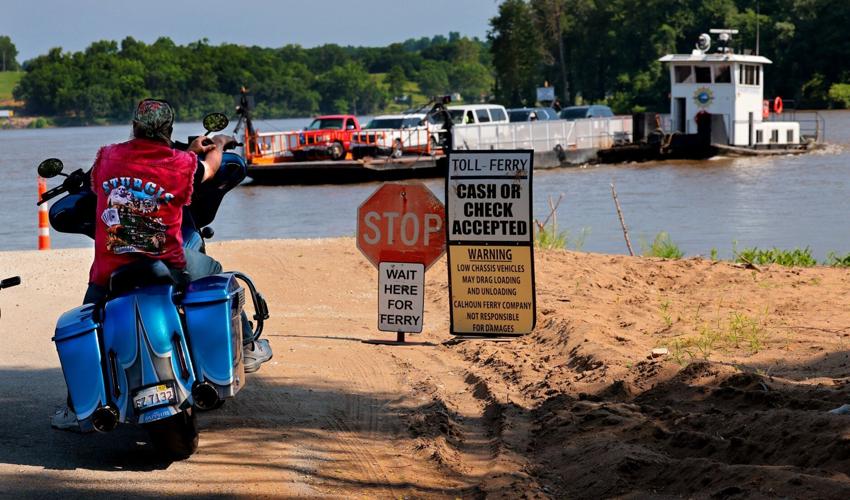
Richard Bruner of Decatur, Ill. waits to board the Golden Eagle Ferry on the St. Charles County side of the Mississippi River on May 21. Bruner, joined by Scott Gilman, were headed home after riding to Wentzville on Monday to meet a group of Memorial Day riders headed to Washington, D.C.
Another early means of power was to use a cable firmly strung from bank to bank and attached to the ferry. The cable kept the boat on course, and the current of the river delivered the power.
People are also reading…
Piggott’s ferry eventually ended up in the ownership of Samuel Wiggins, whose name would be tied to river crossings at St. Louis for the next century.
It was not until 1874 and the opening of Eads Bridge, the first pedestrian span across the Mississippi, that St. Louis area ferries began a slow decline and bridge-building proliferated.
Today, a ride on a river ferry is a distant memory almost anywhere in the United States.
And yet, 150 years since the Eads Bridge opened, use of ferries in this area is somewhat of an anomaly. It may be a surprise to learn there are still several operating within the metropolitan area. These modern-day relics cross the Mississippi and Illinois rivers in areas still underserved by a bridge. They continue to stitch together gaps in the transportation network, and remain as a vital link for farmers and commuters.
Local ferries can be found crossing the Mississippi and Illinois rivers at Winfield, St. Charles and Ste. Genevieve in Missouri, and Grafton, Kampsville and Brussels in Illinois.
Farther from St. Louis a ferry connects Dorena, Missouri, to Hickman, Kentucky.
Even with the remaining ferries being important to local economies, tourists interested in a ride on a transportation antiquity are now an important contributor to keeping the ferries running. Ferryboat Capt. Mark Mayo who pilots the Dorena-to-Hickman ferry says tourists board almost every crossing. “It is not unusual for people to drive 100 miles out of their way on a vacation to cross the Mississippi River on our ferry,” Mayo says. “This is a bucket-list experience for people who enjoy the nostalgia of crossing a river ‘the old-fashioned way.’ For a few moments it is a voyage back in time.”
David Avis, president of the Warren County Historical Society in Warrenton fondly recalls being onboard many area ferries. “I always enjoyed crossings when I was a kid traveling with the family,” he remembers. “Especially the Gasconade Osage Ferry in Fredericksburg, Missouri. It is closed now, but I believe it was one of two inland ferries in Missouri. It crossed the Gasconade River west of Hermann. The other was Akers Ferry in south-central Missouri across the Current River.
“It is interesting as you look around the St. Louis and St. Charles County areas, you see roads and streets with ‘ferry’ in the name referring to where they connected to ferries crossing the local rivers,” Avis says, referring to Lemay Ferry Road, Tesson Ferry Road and Dougherty Ferry Road.

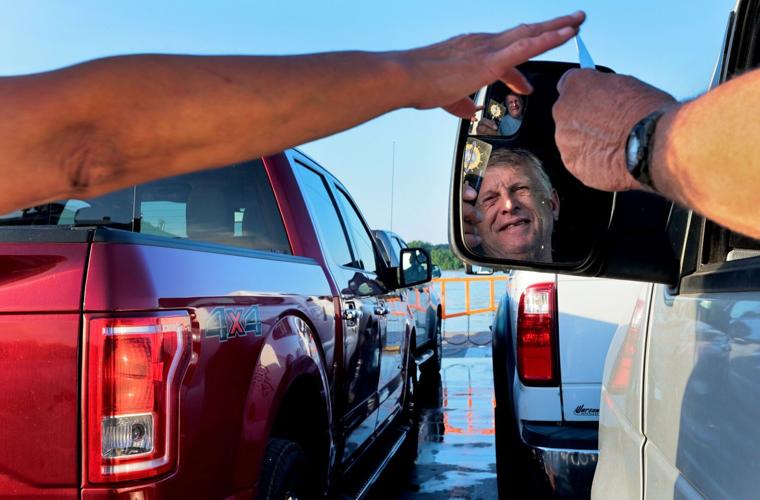
David Pohlman, fire chief at the Rivers Pointe Fire Protection District, hands his ticket to deckhand Ann Ray as he rides aboard the Golden Eagle Ferry to St. Charles County on Tuesday, May 21, 2024. Commuters ride the ferry for $17 round trip.
Sometime the memory of a historic ferry route is formally recognized. In Arrow Rock, Missouri, a ferry played a significant role in shepherding traffic across the Missouri River, onto the Santa Fe Trail and out into the western frontier. Today a plaque recognizes the importance of the site, which is now on the National Register of Historic Places.
There is a lot of old-time charm to riding a ferry. Instead of passing over a river in a minute or so while riding in a car. On board a ferry you can feel and see the river current, and enjoy the scenery, birds and other wildlife on shore.
Furthermore, it is almost impolite to sit in your car during a crossing. It is the perfect chance to talk to people making the trip with you and find out where they are going. There is a good chance someone will be from another country exploring the backroads of America, or an adventurous tourist from another state.
“I always see people get on board as strangers, and get off as friends,” Mayo says.

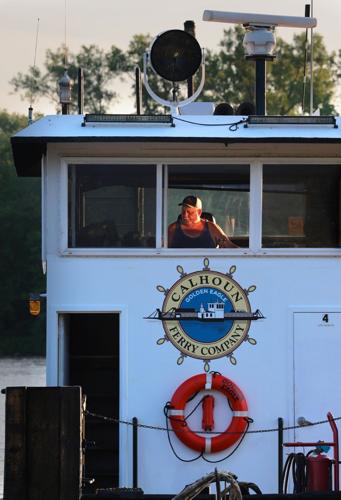
As the sun rises aboard the Golden Eagle Ferry, pilot John Ohlendorf, 61, mans the station as he has for 22 years as cars load north of Kampville in St. Charles County for a ride across the Mississippi River to Calhoun County, Ill. on Tuesday, May 21, 2024.
And, because ferries are located where there are no nearby bridges, here the location is the pastoral heartland of middle America. When you get on, and when you drive off the ferry, it will be along picturesque roads you may have never had a reason to travel.
Even the downside of having to pass time until the boat returns from the opposite shore to pick you up can be considered an adventure. The wait to get on board might take longer than the ride across the water, adding to the anticipation of the short voyage.
If the ferry is on the opposite bank, a sign at the landing may give you the phone number on the ferry to call the pilot house onboard the boat to ask them to come and pick you up. At the Dorena-to-Hickman ferry there is a call button on a pole, while at the Ste. Genevieve ferry, cars are told to flash their lights to get the attention of the ferry pilot across the river.
Just the drive onto the ferry platform is an adventure. If the river is low, the approach can be a very steep descent down to the shore and onto the ferry platform. Then the ramp onto the boat makes unfamiliar sounds as the cars and trucks board, and the boat sways and tilts under each new load.
And, if you are the first car on board driving to the edge of the ferry it can be disconcerting knowing a misstep on the gas pedal could possibly propel you into the barricade at the end of the flat ferry deck.

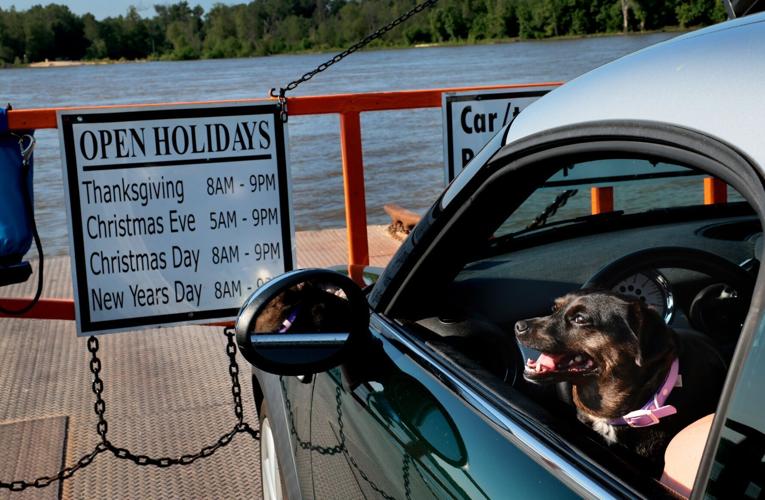
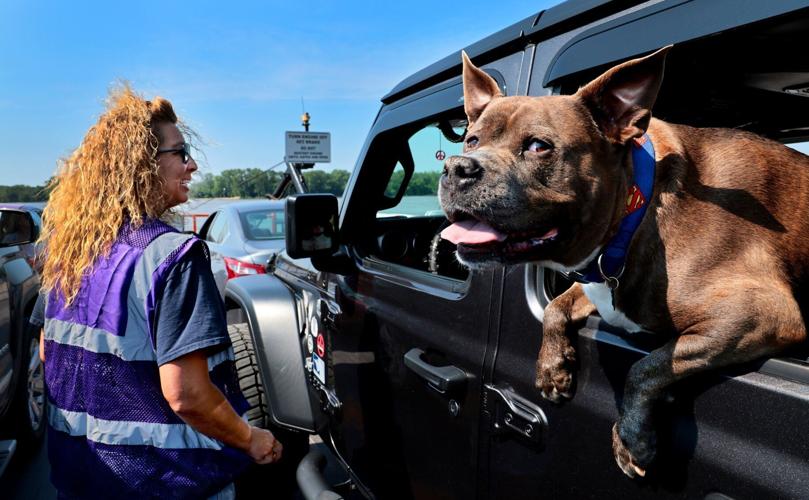
Gunnar watches out for more visitors with treats after getting one from Golden Eagle Ferry deckhand Ann Ray, as he rides with Jeff and Tammie Smith of the Golden Eagle community on May 21. Jeff Smith, recently diagnosed with cancer, rides the ferry for free to his cancer treatments in St. Peters, thanks to the ferry company owners. “That’s a tremendous effort on their part,” said Smith.

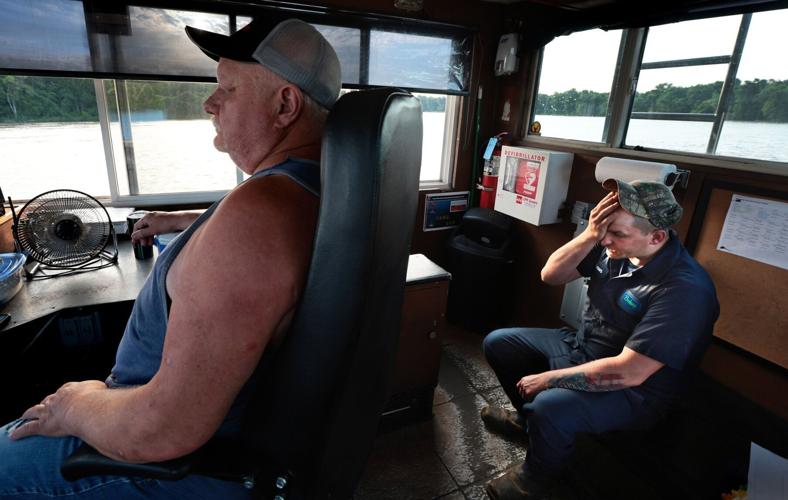
Shawn Ohlendorf rests after work while visiting his dad, pilot John Ohlendorf, as his car rides aboard the Golden Eagle Ferry on Tuesday, May 21, 2024. Shawn, who works an overnight 12-hour-shift at a cleaning chemical manufacturer in Maryland Heights, lives in Calhoun County, Ill.
Local ferries vary in how many cars and what they can carry in addition to automobiles, but the Dorena-Hickman Ferry has no restrictions. “As long as the cargo is not hazardous, we can take anything you can get on board,” Mayo says. “We can load up to 18 cars or a combination of farm combines and tractor-trailer trucks. Once we had an airplane on a trailer.”
Each passage is also an adventure for the ferryboat captain who uses a combination of river current, engine power and rudder to guide the front of the barge onto the ramp at the ferry dock.
Mayo says: “The current can change minute to minute. The wind makes a difference. Passing barges create waves. Sometimes we are dodging southbound trees floating downriver, and pleasure boats.”
Still, while many enjoy riding ferries for pleasure, the boats remain an essential transportation service to the communities they serve. “A ferry is located where it is the most convenient way across the river, and when the closest bridge shuts down, we’re ‘it,’” Mayo says.

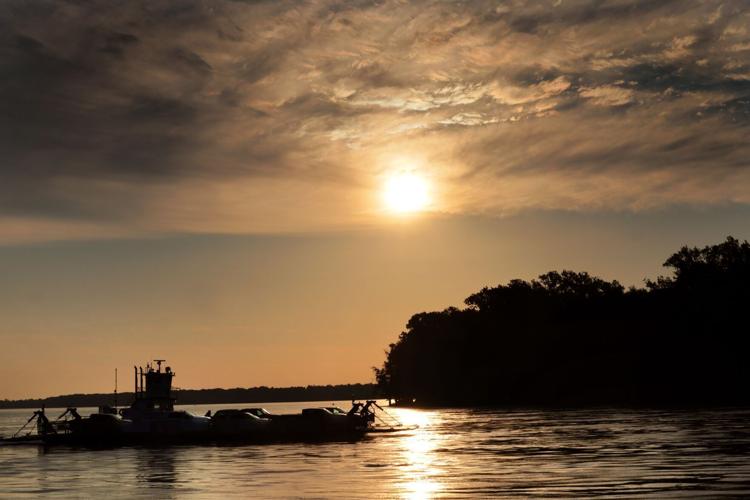
The Golden Eagle Ferry prepares to dock north of Kampville in St. Charles County from Calhoun County, Ill., as commuters ride across the Mississippi River after sunrise on May 21.
Photos: Golden Eagle ferry throws a lifeline to commuters
Commuters and tourists on the Golden Eagle ferry connect from Kampville in St. Charles County to Calhoun County in Illinois as they cross the Mississippi River in May, 2024.
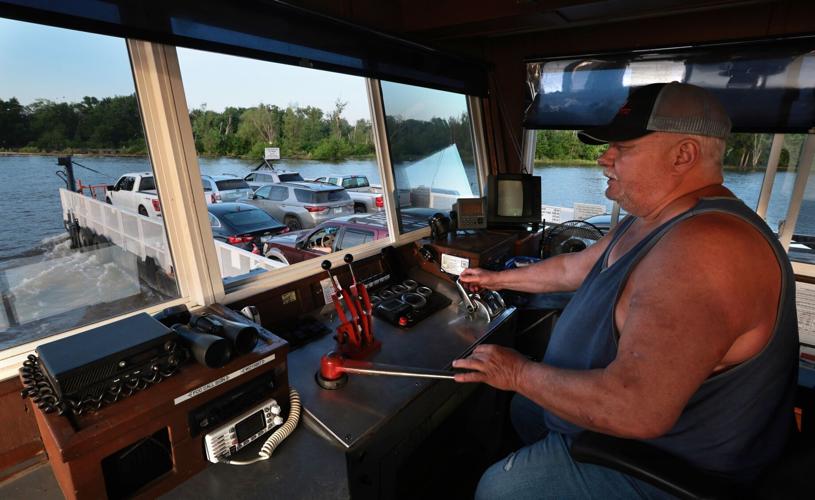
John Ohlendorf pilots the Golden Eagle Ferry from Calhoun County, Illinois, to St. Charles County across the Mississippi River on May 21. Ohlendorf, 61, lives in the Golden Eagle community and has been a ferry pilot for 22 years.
