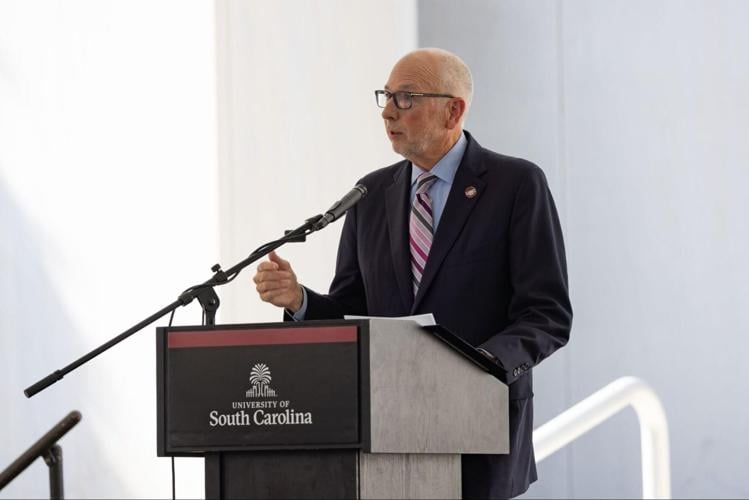

Alex Molinaroli addresses faculty, students, and guests at the University of South Carolina during a campus event focused on engineering education and workforce development.
The former CEO of Johnson Controls working to align education with industry needs
Where most successful people talk about classrooms in the language of charity or nostalgia, Alex Molinaroli, former CEO of Johnson Controls, talks about inputs, processes, outputs, and feedback loops in education. Having made a large endowment to his alma mater, and at the same time also mentoring students personally, Molinaroli is in a position to have an informed opinion about what ails education. In his view, education is an operating system for society — it either produces people who are ready to contribute, lead, and adapt, or it doesn’t. And if it doesn’t, the issue is rarely intent, but design. As a systems thinker, Alex Molinaroli is therefore focusing on structural change in education for long-term outcomes, and not just symbolic philanthropy.
People are also reading…

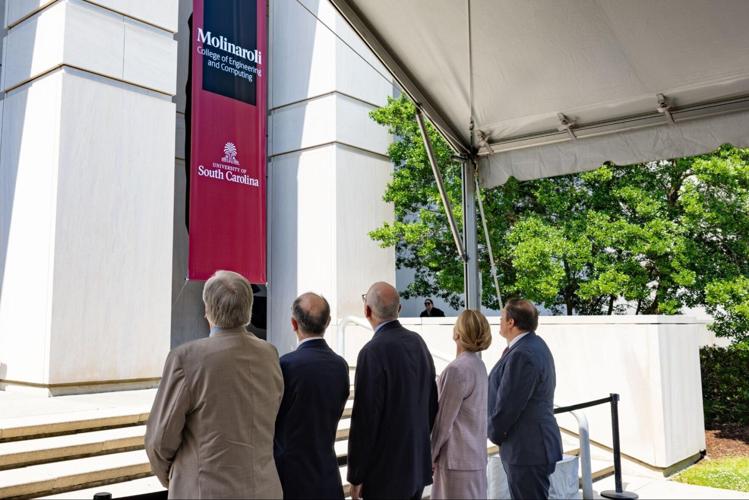
Alex Molinaroli and university leadership during the unveiling ceremony marking the renaming of the College of Engineering and Computing at the University of South Carolina.
Having trained as an engineer and been tested as a global CEO, he spent decades restructuring complex organizations, aligning incentives, and building systems that could perform at scale. That experience now shapes how he thinks about education and tries to improve it wherever possible. Molinaroli does not ask, “How do we help more students?” in the abstract. He asks, “What is this system designed to produce, and is that what the world actually needs?” If the answer is no, then better messaging, bigger donations, or new buildings are beside the point. The architecture of education has to change, he believes.
“When you look at education today, the education ‘industry’, specifically higher education, has evolved to quite often serve itself. More often, the focus is on developing undergraduates best capable of becoming Masters and PhD candidates, focused on becoming capable researchers. This is in contrast to an undergraduate curriculum positioned to support success to be highly employable and successful within traditional careers,” he says.
It is not that he devalues advanced research. It is that he sees a mismatch between who most students are and what the system is optimized to produce. “A graduate or advanced degree is a worthwhile path,” he notes, “however, it’s not the path for many if not most.” That gap, for him, is not a moral failing but a structural one.
Molinaroli’s career leading and restructuring global organizations taught him a basic rule that outcomes are engineered, not accidental. If a company rewards individual heroics but claims to value collaboration, or promotes short-term numbers over long-term resilience, it will get exactly what its systems encourage. He sees higher education the same way.
As a benefactor of Molinaroli College of Engineering and Computing, University of South Carolina, he believes universities have a responsibility to treat their “outputs” — graduates, research, leadership capacity — as performance metrics, not traditions to be defended. He argues that institutions should continuously ask whether their graduates are genuinely ready for the workforce, whether their curricula reflect how work is actually done in modern organizations, and whether they consider leadership, communication, and judgment as core outcomes and not electives.
“When outputs don’t match the needs of the economy and society,” he suggests, universities must be willing to adapt, not simply defend precedent. In boardrooms, he learned that misaligned structures do not fix themselves. The same, he believes, is true for higher education strategy.
Nowhere is the design gap more visible to him than in engineering and technical education. Alex Molinaroli has deep respect for technical rigor and considers strong technical training “the ante” to even sit at the table. But he is blunt about its limits as a differentiator in a world of rapid automation and global talent. “A strong technical education is becoming just an ante. It’s critical, but it’s only a given,” he says.
“What really matters today and even more so in the future will be ‘soft’ skills, the real differentiator in the workplace. The ability to work effectively in teams; not simply solving problems, but more importantly, the ability to identify the right problems to solve. Besides, being able to communicate effectively is increasingly becoming the most tradable skill,” he says.
For him, this is not a philosophical preference. It is a design requirement. If graduates struggle to collaborate, persuade, or exercise judgment under uncertainty, that is not a student problem. It is a system problem. Asked what structural change he would make to technical education to create more impactful outcomes, he says, “Two related things need to be done. Firstly, increasing hands-on application training, and being an effective team member and team leader, preparing for a world where individuals are most successful working with cross-functional groups.”
Molinaroli’s emphasis on workforce readiness is not about reducing education to job training. It is about honesty. “If society tells students that a degree is a launchpad for opportunity, the system should be designed to make that true,” he says. Therefore, he is for the development of a broad-based set of skills preparing students for employment success, which should include broad exposure to critical thinking, communication skills, teamwork, etc.
Molinaroli describes AI and automation as a design constraint rather than a threat. “Being able to solve difficult technical problems quickly is becoming a commodity. However, the ability to identify which problems are worth solving and knowing the right questions to ask are two skills that will always be at a premium. As machines take on more structured tasks, human value shifts upstream to problem selection, framing, and ethical judgment. If education systems do not evolve toward that, they will quietly drift into irrelevance,” he says.
Molinaroli also sees leadership development as inseparable from engineering education. In modern organizations, engineers operate within teams, across functions, under constraints, and under pressure. For him, leadership is not a title but a capability — the ability to set direction, make trade-offs, and carry responsibility for outcomes. That capability, he argues, can and should be deliberately developed, not left to chance or postponed until mid-career.
When students repeatedly practice leading and following in real projects, he believes they graduate better prepared for the messy, interpersonal, high-stakes reality of modern work. One of the most distinctive aspects of Molinaroli’s approach to education reform is his patience. He rejects short-term visibility as a primary metric. Brand campaigns, rankings, and annual statistics matter far less to him than what happens five or ten years after a student leaves campus.
“Education is a life journey, and the knowledge you gain through your formal education only provides a foundation. I hope students will gain the tools necessary to embrace, adapt and overcome inevitable changes and solve complicated problems they will face in their careers,” he reflects. Molinaroli believes that if, a decade from now, graduates he is helping are employable, adaptable, and capable of leading others, he would consider his efforts worthwhile. He does not see education as a charitable sideline to a business career, but as foundational infrastructure, an operating system that, if well-designed, can create opportunity, resilience, and leadership at scale. In that sense, Alex Molinaroli is not just trying to initiate reforms in education, but is re-engineering its foundations.