WASHINGTON — Billions fewer birds are flying across North American skies than decades ago and their population is shrinking ever faster, mostly due to a combination of intensive agriculture and warming temperatures, a new study found.

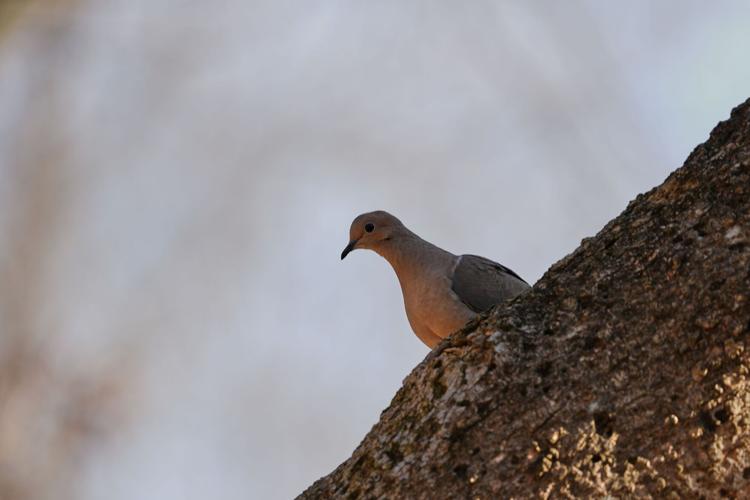
A mourning dove perches on a tree in Milford, Ohio.
Nearly half of the 261 species studied showed big enough losses in numbers to be statistically significant and more than half of those declining are seeing their losses accelerate since 1987, according to Thursday's journal Science. The study is the first to look at more than the total bird population by examining the trends in their decrease, where they are shrinking the most and what the declines are connected to.
“Not only are we losing birds, we are losing them faster and faster from year to year,” said study co-author Marta Jarzyna, an ecologist at Ohio State University. “Except for forest birds, almost every group is doing poorly. So we need to ask ourselves a question. How do we protect these groups of birds?”
People are also reading…
The only consolation is that the birds that are shrinking in numbers the fastest are species — such as the European starling, American crow, grackle and house sparrow — with large enough populations that they aren't yet at risk of going extinct, said study lead author Francois Leroy, also an Ohio State ecologist.

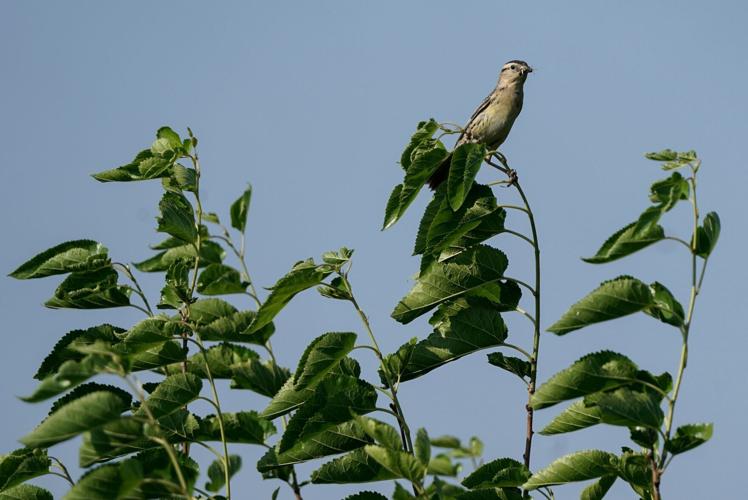
A female bobolink stands atop a shrub near its nest June 20, 2023, in Denton, Neb.
“The thing is that species extinction, they start with a decline in abundance,” Leroy said, adding that “the decline is somehow maybe giving a preview of what it could lead to in terms of species extinction.”
Cornell University conservation scientist Kenneth Rosenberg, who wasn't part of the study, said the species declining fastest in the new research “are often considered pests or ‘trash birds,’ but if our environment cannot support healthy populations of these extreme generalists and extremely adaptable species that are tolerant of humans, then that is a very strong indicator that the environment is also toxic to humans and all other life.”
A 2019 study by Rosenberg of the same bird species found North America had 3 billion fewer birds than in 1970, but didn't look at changes in the rate of loss or causes.
The biggest locations for acceleration of bird loss were in the Mid-Atlantic, the Midwest and California, the study found. And geography proved important when Leroy and Jarzyna looked for reasons so many bird species are shrinking ever faster.
When it came to population declines — not the acceleration — the scientists noticed bigger losses further south. When they did a deeper analysis they statistically connected those losses to warmer temperatures from human-caused climate change.

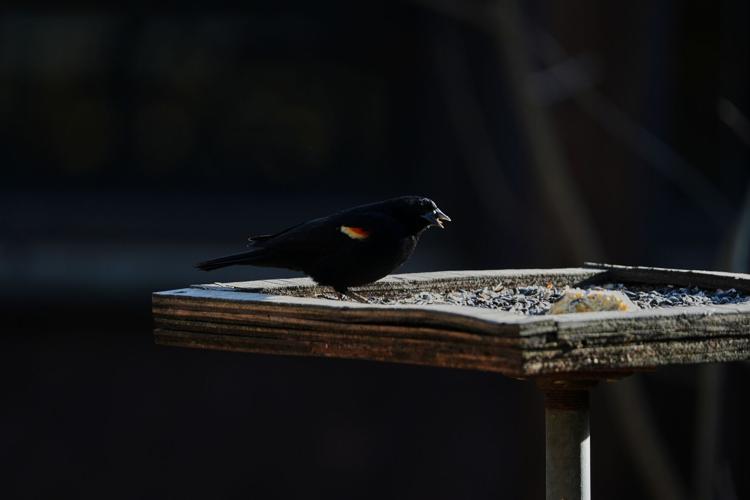
A red-winged blackbird eats from a feeder Feb. 25 in Milford, Ohio.
“In regions where temperatures increase the most, we are seeing strongest declines in populations,” Jarzyna said. “On the other hand, the acceleration of those declines, that’s mostly driven by agricultural practices.”
The scientists found statistical correlations between speeded-up decline rates and high fertilizer use, high pesticide use and amount of cropland, Leroy said. He said they couldn't say any of those caused the acceleration of losses, but it indicates agriculture in general is a factor.
“The stronger the agriculture, the faster we will lose birds,” Leroy said.
Jarzyna said there is a “strong interaction” between climate change and agriculture in their effect on bird populations.
“We found that agricultural intensification causes stronger accelerations of decline in regions where climate warmed the most," Jarzyna said.

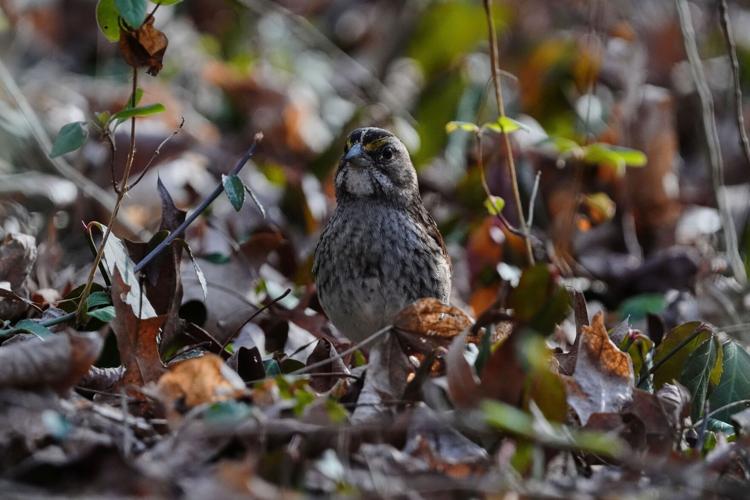
A white-throated sparrow stands in brush Feb. 25 in Milford, Ohio.
McGill University wildlife biologist David Bird, who wasn't part of the study, said it was done well and that its conclusions made sense. With a growing human population, agriculture practices are intensified, more bird habitats are being converted to cropland, modern machinery often grinds up nests and eggs, and single crop plantings offer less possibilities for birds to find food and nests, said Bird, the editor of “Birds of Canada.”
“The biggest impact of agricultural intensity though is our war on insects. Numerous recent studies have shown that insect populations in many places throughout the world, including the U.S., have crashed by well over 40 percent,” Bird said in an email. “Many of the birds in this new study showing population declines depend heavily on insects for food.”
This study is both “alarming” and “sobering” because of the sheer numbers of losses and the patterns in those accelerating declines, said Richard Gregory, head of monitoring conservation science at University College London. He was not part of this research.
The paper shows that people need to change the way they live to reduce human-caused warming, reduce agricultural intensity, monoculture of crops and broad application of chemicals, said Cornell University ornithologist Andrew Farnsworth, who wasn't part of the study.
“Here is why this study is especially important. Birds do a lot for humans,'' McGill biologist Bird said in an email. ”They feed us, clothe us, eat pests, pollinate our plants and crops, and warn us about impending environmental disasters. With their songs, colors, and variety, birds enrich our lives… and recent studies show that their immediate presence actually increases our well-being and happiness and can even prolong our lives! To me, a world without birds is simply unfathomable."
Photos: Bird lovers try to counter deadly risk of Chicago high-rises for migrating birds

An anesthetized yellow-bellied sapsucker, a kind of migrating woodpecker, is taped to a table as staff veterinarian Darcy Stephenson prepares to take x-rays at the DuPage Wildlife Conservation Center, Friday, Oct. 4, 2024, in Glen Ellyn, Ill. (AP Photo/Erin Hooley)

Veterinarian Darcy Stephenson tapes an anesthetized yellow-bellied sapsucker, a kind of migrating woodpecker, as she prepares to take x-rays at the DuPage Wildlife Conservation Center on Oct. 4 in Glen Ellyn, Ill.

Chicago Bird Collision Monitors Director Annette Prince holds an injured Nashville warbler, a kind of migrating songbird, that likely struck a glass window pane Tuesday, Oct. 8, 2024, in downtown Chicago. (AP Photo/Erin Hooley)

An injured Nashville warbler, a kind of migrating songbird, sits on the ground after likely striking a glass window pane Tuesday, Oct. 8, 2024, in downtown Chicago. (AP Photo/Erin Hooley)

Chicago Bird Collision Monitors Director Annette Prince collects a dead white-throated sparrow, a kind of migrating bird, in an alley Tuesday, Oct. 8, 2024, in Chicago. (AP Photo/Erin Hooley)

Chicago Bird Collision Monitors Director Annette Prince walks a downtown plaza searching for dead or injured birds who may have flown into glass windows Monday, Oct. 7, 2024, in Chicago. (AP Photo/Erin Hooley)

Veterinarian Darcy Stephenson looks at an x-ray of a yellow-bellied sapsucker and determines it has a fractured ulna, the equivalent of a human forearm bone, Oct. 4 at the DuPage Wildlife Conservation Center.

Sarah Reich, head veterinarian at the DuPage Wildlife Conservation Center, peaks inside a woodpecker box in the rehabilitation care facility Friday, Oct. 4, 2024, in Glen Ellyn, Ill. (AP Photo/Erin Hooley)

Bird-safe window film on the McCormick Lakeside Center building meant to prevent birds from colliding with the glass, particularly during spring and fall migration seasons, can be seen Monday, Oct. 7, 2024, in Chicago. (AP Photo/Erin Hooley)

The McCormick Lakeside Center building, which has about two football fields' worth of glass windows, now has bird-safe window film meant to prevent birds from colliding with the glass, particularly during spring and fall migration seasons, Monday, Oct. 7, 2024, in Chicago. (AP Photo/Erin Hooley)

Chicago Bird Collision Monitors Director Annette Prince writes details on a paper bag containing an injured Nashville warbler that likely struck a glass window pane Tuesday, Oct. 8, 2024, in downtown Chicago. (AP Photo/Erin Hooley)

Sarah Reich, head veterinarian at the DuPage Wildlife Conservation Center, speaks about the types of migratory bird species she and her staff receive for rehabilitation care Friday, Oct. 4, 2024, in Glen Ellyn, Ill. (AP Photo/Erin Hooley)

Rose Augustine, a wildlife program coordinator at the DuPage Wildlife Conservation Center, measures a rehabilitated Ovenbird, a migrating songbird of the warbler family, for a leg band before it is released back into the wild Oct. 4 in Glen Ellyn, Ill.

Sarah Reich, head veterinarian at the DuPage Wildlife Conservation Center, gives medication to an injured Ovenbird, a migrating songbird of the warbler family, at the wildlife center, Friday, Oct. 4, 2024, in Glen Ellyn, Ill. (AP Photo/Erin Hooley)

Veterinarian Darcy Stephenson holds a yellow-bellied sapsucker after taping its wing to help heal a fractured ulna Oct. 4 at the DuPage Wildlife Conservation Center in Glen Ellyn, Ill.

An injured yellow-shafted flicker, a kind of migratory woodpecker, rests inside a woodpecker box at the DuPage Wildlife Conservation Center, Friday, Oct. 4, 2024, in Glen Ellyn, Ill. (AP Photo/Erin Hooley)

Wildlife Keeper Stephanie Scurtu looks to net songbirds inside a rehabilitation enclosure to determine if they are healthy enough for release at the DuPage Wildlife Conservation Center, Friday, Oct. 4, 2024, in Glen Ellyn, Ill. (AP Photo/Erin Hooley)

Wildlife Keeper Stephanie Scurtu examines a wood thrush, a kind of migrating songbird, to determine if it is healthy enough for release at the DuPage Wildlife Conservation Center, Friday, Oct. 4, 2024, in Glen Ellyn, Ill. (AP Photo/Erin Hooley)

An injured Ovenbird, a migrating songbird of the warbler family, temporarily escapes during a medical examination at the DuPage Wildlife Conservation Center, Friday, Oct. 4, 2024, in Glen Ellyn, Ill. (AP Photo/Erin Hooley)