
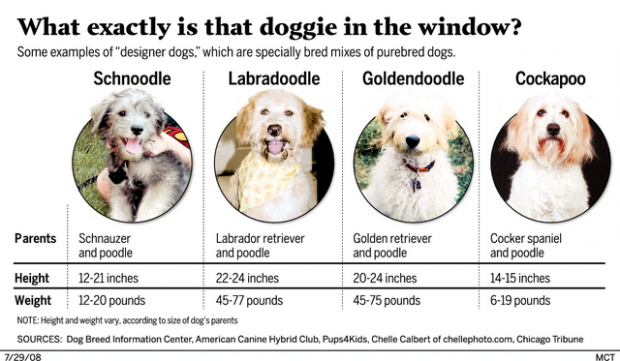
CHICAGO — The puggles, maltepoos and labradoodles scampering along city streets are bred to be cute and customizable, pet industry experts say.
But these high-priced "designer dogs" are also increasingly exploited by abusive breeders at puppy mills and unscrupulous sellers, leading to more sick puppies and unhappy owners, according to the Humane Society of the United States.
Made fashionable by celebrities like Jake Gyllenhaal and Jessica Simpson, hybrid puppies — the offspring of two purebreds — often go for more money than purebreds, which can range from $200 to $2,000 per dog.
Hybrid-puppy breeding operations are cropping up in rural areas from Pennsylvania to Kansas, animal advocates say. But a hot spot for hybrid owners, said pet industry insider Laura Bennett, can be much closer to home.
"Urban areas — the Chicagos and the New Yorks and the L.A.'s and the San Franciscos" — are where wealthier clientele prefer custom-made puppies, which are often bred for non-shedding coats, compact size and friendly disposition, said Bennett, pet blogger and CEO of Embrace Pet Insurance.
People are also reading…
But owning a designer dog can come at a price beyond the original cost.
Tracy Mattes of Woodridge, Ill., fell in love with her cockapoo, Jake, through a cage at a Downers Grove, Ill., pet shop in 2005. But by 2006, Mattes discovered her puppy had myriad serious and costly health problems, including severe allergies, a juvenile cataract, a digit on his paw that needed to be removed and a kneecap that popped out of place.
"His veterinarian bills are through the roof," Mattes said.
On top of Jake's almost $700 price tag, Mattes estimates she's spent more than $6,000 in surgeries and other vet care. Three-year-old Jake takes two medications per day and requires at least once-a-month vet checkups.
Puppies bought from pet stores or Internet breeders are much more likely to have been born in a puppy mill and therefore develop health problems, said Kathleen Summers, deputy director of the society's Stop Puppy Mills campaign. Like puppy mills that produce non-hybrids, these operations are hurting the animals through neglect and poor care, the society says.
The Humane Society defines a puppy mill as any operation — licensed or unlicensed — where animals are continually confined, kept solely for breeding and socially or physically neglected. It estimates there are about 10,000 puppy mills nationwide.
But Erika Burklow, manager at Happiness is Pets in Orland Park, Ill., disputed the assertion that pet-store puppies have been abused. Her store's owners hand-pick their puppies from private owners, keep records of genealogy and licensing, and offer warranties against certain health issues, she said.
The story of hybrid dogs dates back decades. One of the most popular, the labradoodle (Labrador retriever and poodle) was said to have been bred about 20 years ago in Australia for its "hypoallergenic" coat — a byproduct of its poodle genealogy.
But breeders looking to cash in on the cachet have started combining any curly-haired dog with a popular breed to create poodle mixes, experts and officials say, or misleading buyers through outrageous promises.
"I've heard of the breeding of dogs that don't drool," said Yuval Nir, an Illinois veterinarian, who questioned that statement.
Pet-store workers told Jennifer Tvrdik that her $900 puggle puppy (pug and beagle) should weigh between 15 and 30 pounds as an adult, she said. Two years later, Rocky is 51 pounds.
"He just kept growing," said Tvrdik, of Indian Head Park, Ill. "He has a very enormous head, big jaw, big mouth."
But another big selling point of mixed-breed pooches, sometimes called "hybrid vigor," is rooted in fact, said veterinarian Derrick Landini: The careful crossing of two breeds, each of which comes with a genetic propensity for certain illnesses, could weed out some of those weaknesses.
"In general, you'll hear the vet . . . say go the pound and get yourself a mutt because you're probably going to be better off with it," Landini said.
But Nir stressed the importance of consulting with a veterinarian before buying any dog because even the most meticulous breeder can't predict the exact result of parents.
"It's just like saying the kid is going to be the parents," he said "You know that's not true."