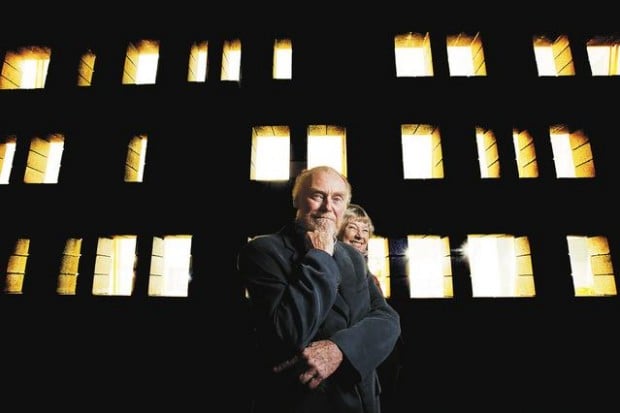

Yoke architects and poets in a common cause and expect an explosion of symbolism and simile.
The rooflines of the University of Arizona's new Poetry Center, for instance, "stack like stanzas," and the floor plan takes you on "a movement toward solitude."
There is poetry in architecture, just as there is an underlying architecture to the best poetry, but the real message of today's public housewarming for the Helen S. Schaefer Building is that poetry is not a totally contemplative art.
The life of Richard Shelton, one of the poets honored by the building, demonstrates that poetry can be a downright dangerous vocation.
And the building, according to architecture expert R. Brooks Jeffery, symbolizes that poetry "is not an art form for staid, quiet places." — Tom Beal
People are also reading…
Who knew a life of letters could be so perilous?
Richard Shelton, teacher, poet and writer, was alongside Allen Ginsberg when the famous Beat poet was assaulted by an irate journalist during Ginsberg's visit to the University of Arizona Poetry Center in 1969.
Shelton once spent four hours locked inside a classroom at the Arizona State Prison in Florence while his inmate students took turns holding the door shut against the rioting prisoners outside.
On another occasion at Florence, he was walking across the prison yard with a student when they were attacked by a shank-wielding inmate. Shelton swung his leather saddlebag of poetry books to receive the blow. He wasn't being a hero, he says. "I thought he was attacking me."
Shelton, author of several critically acclaimed volumes of poetry and the perennially popular nonfiction book "Going Back to Bisbee," details some of his harrowing adventures in his latest book, "Crossing the Yard: Thirty Years as a Prison Volunteer."
It encapsulates a lifetime spent taking academic rigor, honesty and compassion to the men and women he regarded as "monsters" before he began his creative-writing workshops in the state's prisons.
Shelton retired this year from his position as a Regents' Professor of English at the University of Arizona, but he continues teaching in the prisons and writing. His latest volume of poetry was published this spring by the University of Pittsburgh Press. Another nonfiction book will be out next year.
A line from one of his poems is memorialized in the east wall that shades the poet's garden at the University of Arizona's Poetry Center, which opened last month and has its public housewarming today. It's called the Shelton Wall, named for Richard and his wife, Lois, for their roles in sustaining the center over its 47 years.
For the Sheltons, a wall seems a particularly appropriate honor — poetic even.
Poetry Center director Gail Browne says Richard and Lois Shelton held up the walls of the center for decades as it sputtered along. Richard was interim director on two occasions and has been a mainstay of its board. Lois was executive director for 20 years.
Different walls have defined the past three decades of Richard Shelton's life — the walls we erect to protect us from monsters.
Monsters they were, in Shelton's mind, when he first gave in to his fascination with the mind of a triple murderer named Charles Schmid — the notorious "Pied Piper of Tucson," who lured Tucson teens into his cult of drugs and sex and killed three young girls.
Schmid's crimes brought national attention to this Sunbelt tale of bored, car-cruising teens that spawned a Life magazine article that famously referred to Speedway as "the ugliest street in America."
Shelton recognized the name immediately when Schmid wrote from Death Row in 1970, asking the University of Arizona English professor to read and critique his poetry.
Shelton details his reaction in "Crossing the Yard."
My immediate reaction was probably typical — nothing in my background had taught me to react in any other way — but I am ashamed of it now. Here was my chance, I thought, to read the poetry of a monster.
Perhaps even to meet him. It was thrilling. I considered him some exotic species of human I had never before encountered. He was stepping right out of a brutal murder mystery and into my quiet, academic life. Without a moment's hesitation and for all the wrong reasons, I wrote back to him that I would be willing to read and critique his poetry.
Shelton said Schmid's poetry was "rough and in need of much revision, but it indicated remarkable talent."
Eventually, he made the trip to Death Row. Returning from his first meeting with Schmid, Shelton decided there was only one way to continue this thing.
At this point I learned the meaning of the phrase "to swallow hard." For about sixty miles on the Pinal Pioneer Parkway, I swallowed hard. By the time I reached the Tucson city limits I had rationalized it out and arrived at a philosophical position that would permit me to continue to work with Tucson's most notorious killer. I was reminded of that position recently when I saw a sign in front of a church that said: YOU HAVE NO PAST HERE. ONLY A FUTURE. I would treat Charles Schmid, I said to myself, as if he were born yesterday and had no past. I would do this as long as he behaved in ways I could find acceptable. If he tried to con me or expressed attitudes I couldn't tolerate, I would have nothing further to do with him. I could not justify this position logically, but I felt that it was right for me. I felt I could take it from there, and I've been taking it from there ever since. The results, over the years, have only strengthened my belief that it was the best choice I could have made under the circumstances. Although that choice has led me to more pain than I could have imagined then, it has also enriched and enlarged my life. It has led me through bloody tragedies and terrible disappointments to a better understanding of what it means to be human and even, sometimes, to triumph.
The death of Schmid in 1975 was one of the bloody tragedies Shelton endured.
By the time two inmates nicknamed "Dirty Dan" and "Sneaky Pete" stabbed Schmid 47 times in a trusty dormitory at the Arizona State Prison in Florence, the Pied Piper had been taken off Death Row, had qualified for trusty status and had shed his notorious name and much improved his poetry. He renamed himself Paul David Ashley and found a publisher for a chapbook. Shelton had come to regard him as a friend.
Schmid lived for 10 days after the attack, and Shelton, who had been legally appointed by Schmid's ailing mother to handle his affairs, had to give doctors permission to remove Schmid's right eye and then his right kidney as he died piece-by-piece.
Shelton's students had to talk him out of quitting. He continues to teach three sections of his creative-writing class at the state prison in Tucson.
Shelton does not like prisons, and his rants against the system pepper the book. When the monsters became human to him, the inhumanity of their treatment became monstrous.
That's why he perseveres in finding his way behind the walls and allowing the passage of their voices into the wider community. He does this despite losing students to violent deaths and being disappointed by those who succeeded in his writing class, survived prison, then failed again at life on the outside, despite his support and Lois's. "When they get out, she becomes their mother," he said in saluting her at a reading in 2002.
Why keep going? "I suppose that I began to see them . . . as humans and realize they were all different, that there is no such thing as a criminal type. And there are always new ones. I had people who needed me all the time. I guess I just never could find a place to stop."
And he sees success. The 13th edition of Walking Rain Review, a journal of poetry from the Arizona Prison workshops, was recently published. Some of his workshop graduates went on to graduate from university creative-writing programs after prison. Some are now published poets and professors.
This fall, Shelton is touring book fairs and stores with a graduate of the prison creative-writing classes, Ken Lamberton, whose fourth book, "Time of Grace," details his musings on crime, punishment, the natural world and the human condition during the last three years of his prison term.
Lamberton was already famous when he walked into Shelton's prison class, though not for his writing. Lamberton is the biology teacher from Mesa who, in 1986, ran off with a 14-year-old girl who was one of his middle-school students. He served a total of 12 years for his sex crimes.
"I had a degree in biology and I came to (Shelton's) class with published work," said Lamberton. "It had been published in some religious magazines, and I was kind of proud of it."
He read to the class. "All the other inmates clapped, and Richard just shook his head, and the truth is, it was awful.
"He knew there was something more, and that's part of the honesty he demands."
Unlike Lamberton, a lot of Shelton's prison students didn't walk into class thinking they were quite so smart.
"There are a lot of people in prison who are smart and don't know it," said Shelton. "Most of the teaching in prison is unlearning ideas they have in their heads—'I know I'm worthless.' "
Writing can overcome that, he said. "Poetry seems to be the most effective. It has a wonderful effect on peoples lives."
Shelton didn't preach or offer tips for rehabilitating lives, said Lamberton. He simply taught. "In the workshops, it was all about good writing," said Lamberton. "That focus on honesty in the writing — it doesn't stay there in class, it becomes part of you."
Shelton is happy he never had to support himself, or define himself, by his second vocation.
"I'm a teacher. I've always identified as a teacher rather than a writer," he says.
IF YOU GO
What does the wall say?
The east wall of the center contains a line of Richard Shelton's poetry in computer code.
A contest to decode it will be held today as part of the public celebration of the University of Arizona Poetry Center's new Helen S. Schaefer Building, 1508 E. Helen St.
Park free in the UA's Highland Avenue garage, across the street from the new Poetry Center (accessible from Helen Street just north and east of Speedway and Mountain Avenue.)
The event, from noon to 5 p.m., features music, Madonnari chalk art, book-making, performance art, stories and, of course, poetry. Readings include Richard Shelton, Brenda Hillman, Jane Miller, Alberto Rios, Steve Orlen, Alison Deming and former U.S. poets laureate Billy Collins and Robert Hass.
Timeline
• 1960 — The Ruth Stephan Poetry Center is dedicated at 1086 N. Highland Ave.
• 1972 — Name is changed to University of Arizona Poetry Center.
• 1989 — Widening of Speedway forces move to two university-owned houses at 1216 N. Cherry Ave.
• 2003 — Campus construction forces move to temporary digs at 1600 E. First St.
• 2007 — The Helen S. Schaefer Building at 1508 E. Helen St. is dedicated.