

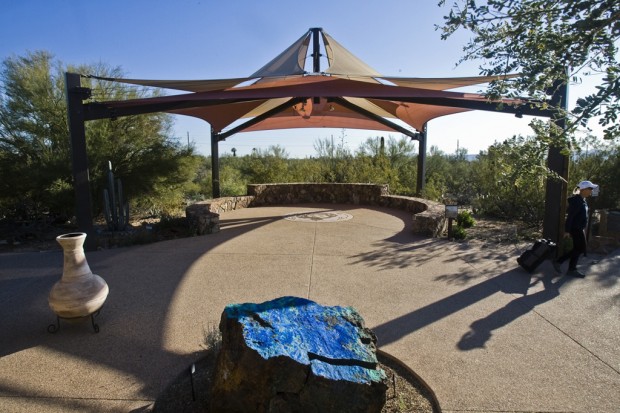

Shade has always been a precious thing in the desert, but with increased energy costs and heightened environmental concerns, it's more valuable than ever. And there's a relatively new way to beat the heat that's faster than foliage, and can be artful, too.
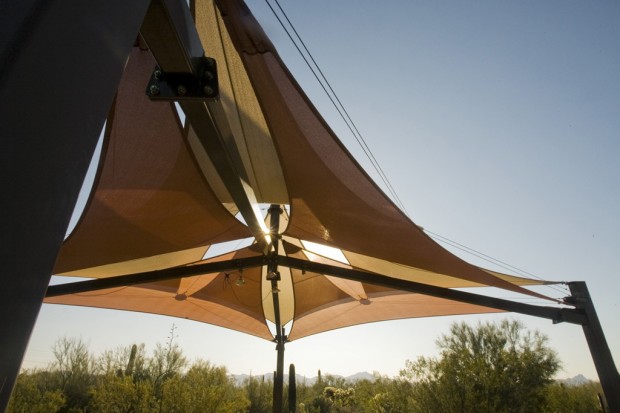
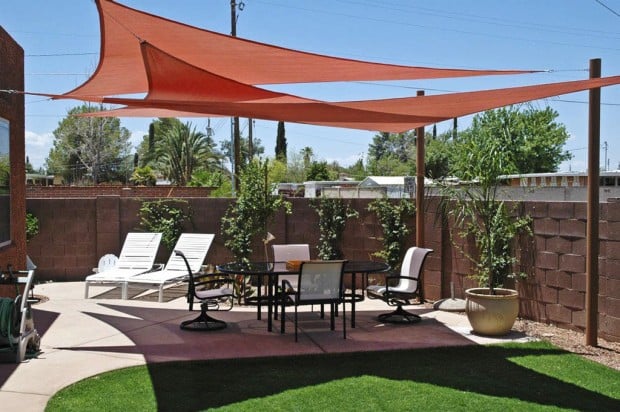
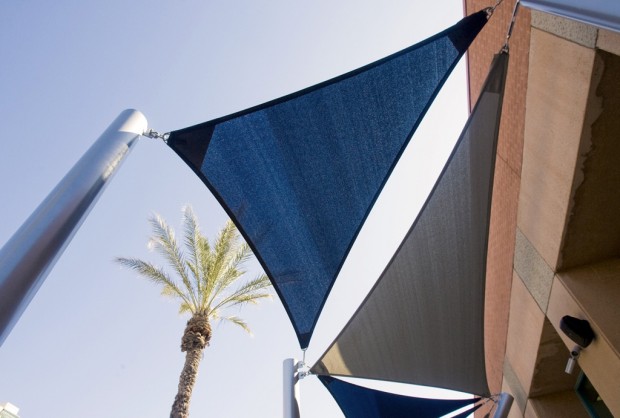
Usually referred to as shade sails or sun sails, these large - mostly horizontal - outdoor sun-blocking fabric canopies can add a colorful touch, as well as providing instant refuge from the sun. Unlike trees and shrubs, they don't use water and don't require fertilizer or raking. They can also be taken down during cooler months, when sunshine and solar gain heating may be desirable.
The shade fabrics come in a variety of colors and shapes. Some installations are done at moderate to sharp angles, providing shade next to houses with narrow side lots or other limits on using trees for shade. And they start putting out shade faster than trees, and avoid the problem of trees and hedges that sometimes invade the sewer lines that often run alongside houses.
People are also reading…
They've become increasingly popular with homeowners in the last three or four years, most often for recreational backyard space, including pools and patios. They're also being used increasingly for sidewalk cafes and other outdoor commercial spaces.
The price for an Australian-made fabric with a 10-year guarantee typically ranges from $12 to $18 per square foot, including installation, said Tim Pappas, owner of Arizona Awnings and Canvas, a locally owned company that sells shade sails.
Pappas prefers to use galvanized steel pipe for a mounting structure, rather than attaching mounting hardware to buildings or property line walls. Still, properly designed, he said safe shade installations can be done using buildings and walls as support structures for the lines that hold up the sails.
He recommends using 5-inch inside-diameter steel pipe, with a third of the total height buried underground in concrete. "So, 20 feet aboveground would be 10 feet underground. Twelve feet above ground would be six feet underground," Pappas said.
And the fabric is stretched very tightly, he said, because that prevents flapping in the wind, which causes added stress to connecting points and the supporting structures.
A sail of less than 900 square feet won't require a building permit in the city of Tucson, but Ron Brown of Development Services said the city requires a zoning review for any installation. That involves bringing in a plan that shows the proposed shade's location on a lot in respect to structures and property lines. "Come down to 201 N. Stone, go to the counter. A person at the counter will review it," Brown said. He said there usually isn't a long wait, unless they're particularly busy.
And when calculating whether a permit is needed, he said the combined square footage of separate shades is considered as one if they share support structures - as in being connected to the same building, wall or pole.
A permit might not be required, but Brown, an architect as well as a structural plan reviewer, cautioned that do-it-yourselfers shouldn't underestimate the damage an improperly engineered installation can do.
He said the building code calculations used on shades that do require a permit assume loads based on 90 mile per hour winds, something that doesn't happen often, but does occur.
"They're just like a sail on a sailboat," Brown said.
Do-it-yourselfer Dave Smith agrees. He said a microburst damaged a block wall to which he had anchored a shade sail he installed last year.
Smith installed several triangular sails and one rectangular sun sail he purchased online.
It all went well, except for a sail that was anchored to a block wall in his Northwest Side home's backyard. He said the wall was not properly built; the empty spaces in the blocks had not been filled with rebar and concrete. But that's something he didn't learn until after a microburst exerted so much force on the sail and support lines that connected it to the wall, that it cracked along the mortar joints. Afterwards he removed the cap on top of the wall and saw the empty spaces.
Smith also recommends using screws that are long enough to get a deep grip in a rafter - not just the fascia board, which is mostly decorative, not a structural element. Smith said the kit that came with the sun shade he bought online included two-inch screws which only provided about 3/8-inch of penetration into the rafters after the screw went through the mounting plate and fascia board. Smith said he didn't think that was adequate and used three-inch screws instead, an inexpensive upgrade.
And if you attach a sun sail anchor to a wall, he advises making sure the wall is solid and that the anchors go deep into the wall. Smith used Tapcon masonry screws, a specialty screw (usually blue) designed to penetrate and hold tight in masonry.
His last tip is to use lock nuts on the turnbuckles that tension the lines or cables that attach the sun sail to the house or wall. Smith recommended putting an extra nut onto the threaded shaft of the turnbuckle and tightening it against the existing nut when the desired tension is reached. Otherwise, he said, the motion of the sun sail in the wind pulls on the mounting hardware and causes the turnbuckle to loosen - an annoyance that leaves the sun sail fabric to sag and flop in the wind.
Where to get sun shades
• Arizona Awnings and Canvas, 4045 N. Highway Drive, Suite 175, 887-8725.
• Air & Sun Shade Products, 2033 E 13th St, 882-2888, www.airandsun.com
Online:
• Shade Sail USA, www.shade-sails-usa.com/
• Shade Sail Outlet, shop.shadesailoutlet.com/
• Shade Sails, www.shadesails.com/
• Shade Sails Direct, shade-sails.org/
• Home Depot (online, but a limited choice of shades have been available at Tucson stores), www.homedepot.com
Note: Sun shade fabric material, mounting hardware, prices and guarantees vary greatly.