
They were a couple of California teenagers with little in common. Her name was Katherine Otomo, daughter of a surgeon educated in Japan and England. His name was Mitsugi Tagawa, son of a tenant farmer who sold fish and vegetables out of his pickup truck. On Dec. 7, 1941, the trajectory of their lives would forever change with the Japanese attack on Pearl Harbor. Within months, tens of thousands of Japanese living in the western United States, native-born included, were forced into hurriedly thrown-together relocation camps — the victims of wartime paranoia. Katherine and Mitsugi, who now goes by Jim, were no different, even though both were born in the U.S.A.
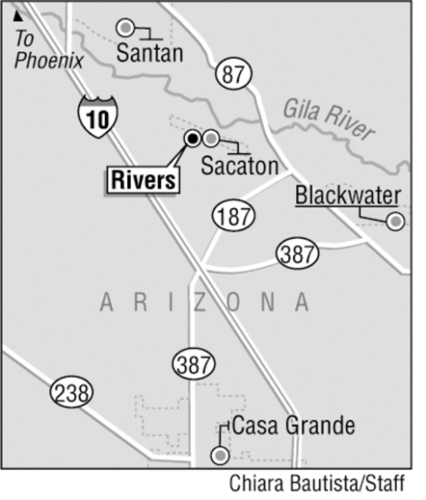
Just months after the United States declared war on Japan, both were shipped to the Gila River Indian Reservation near Casa Grande, where two relocation camps known collectively as "Rivers" seemed to spring up overnight in the barren desert.
People are also reading…
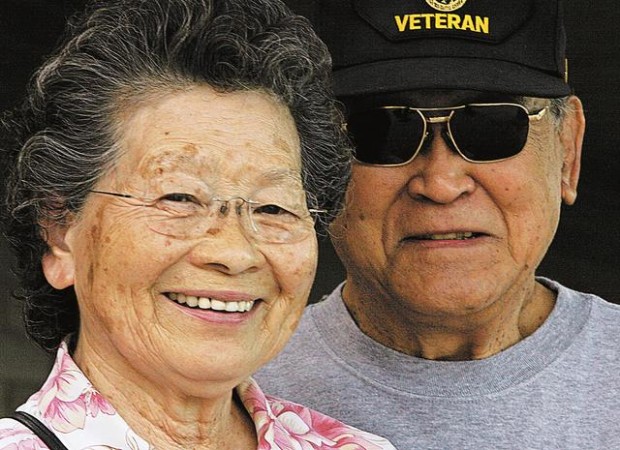
"We arrived in a sandstorm. Every time we took a step, we were ankle-deep in sand," says Katherine, 82, who grew up near Los Angeles.
Flashback to the fall of '41: Katherine is a senior at Mark Keppel High School in Monterey Park, Calif. Her father has been dead two years, leaving behind a wife and six children.
Meanwhile, Jim is working the fields in California's Central Valley and attending school in Selma.
"I was born four days after my mother got off the boat," says Jim, 83, who learned English only after he started first grade.
On the morning of Dec. 7, 1941, he was cultivating a vineyard on somebody else's land when his sister came running.
"She said the Japanese had bombed Pearl Harbor." He ran to the house, where his parents were listening to the radio.
"They could not understand what happened," says Jim, who translated for them. "They were as shocked as everyone."
Like millions of other young American men, Jim tried to enlist, only to be told by his local draft board that he had been reclassified to "alien ineligible."
Dogged by slurs in school, he still showed up for senior ditch day at a public pool. "It was in a restricted area on the other side of Highway 99. Nobody was going to tell me where to go. So I went swimming."
The next day, the FBI showed up at his house. "They scared my parents. They took the case to the JACL (Japanese-American Citizens League). They stepped in."
"You could only go certain places," says Katherine, who fared better with her high school classmates.
"They put on an assembly and said there was not to be any name-calling."
Even so, in the spring of '42 the fliers started going up on poles all around her town. "They were telling us to report to a meeting on such and such a day," says Katherine. "When we got there, we were told to be ready to leave in three days."
On the appointed day, she, her mother and five siblings — ages 3 to 19 — converged on the railroad station with whatever they could hand-carry.
"We all had the same family number pinned to us. I had to carry my younger brother, and another brother was on my coattails," says Katherine.
On a train whose windows had all been covered, they rolled 140 miles toward the Tulare Assembly Center, located in the Tulare County Fairgrounds.
"We were put into horse stalls," says Katherine. "There was asphalt on the floors, but the Johnson grass came up through the cracks. We had to stuff our mattress tickings with straw."
She and her family would live there well into the summer.
A few weeks later, Jim's family got its notice. "We were told to be ready to go to Arizona in three days. My parents sold or gave away everything."
Even so, he says, "My parents were ready to accept it. They told me, 'This is your country.' "
As for Jim: "I was a little peeved. I shook Roosevelt's hand in 1932 when I was a Cub Scout and he came through Gardena in his open car."
Ten years later, that former Cub Scout was on a train heading for Arizona. "It was a bad trip," says Jim. "A couple of people on horseback came by and shot into the cars."
As for his first impression of Rivers: "I thought it must be a POW camp. There was a barbed-wire fence, sentries, a watchtower with armed guards."
Camp was set up in blocks, each block containing 14 barracks, one mess hall and a recreation hall. Schools and a hospital would soon follow.
At its crest, Rivers would hold 13,000 men, women and children — the fourth-largest "city" in Arizona.
Jim's family was assigned to the end section of a four-unit barracks. "There were tarpaper walls and curtains for room dividers," he says.
Before long, he landed a plum job delivering the mail by truck at Rivers, first at Canal Camp, and then at Butte Camp. Pay was $19 a month.
"We all named our trucks," says Jim. "I named mine Jane Russell."
That fall, Katherine's family arrived from Tulare. Jim first spied her — odd as it sounds — at a camp talent show.
"They wanted entertainment to take the pressure off," says Katherine. "There were quite a number of kids in the shows. This one girl did the hula. And we always saluted the flag."
Dances were also held a couple of times a month, says Jim. "They played records — Dinah Shore, a lot of Glenn Miller."
In time, the camp's guards relaxed, says Katherine. Life settled into a routine. Many of the interned worked in the fields, growing corn, cabbage, cauliflower. "We sent a lot of vegetables to other camps," says Jim.
Others, such as Katherine, made camouflage netting. Pay: $2 a day.
On May 6, 1943, Eleanor Roosevelt spent the day at Gila River. "My mom was a staunch Democrat. She was elated," says Katherine.
By then, the U.S. government had reversed its stance on Japanese-Americans joining the service.
Jim promptly signed up, joining the famed 442nd Regimental Combat Team, made up solely of Japanese-Americans.
"There were 26 or so of us in camp who signed up," says Jim. "We left on a Greyhound bus."
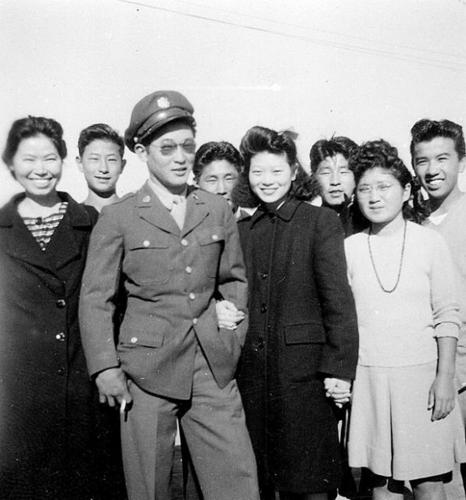
Katherine was there to see him off. But there was no throng of well-wishers. "We were not that popular in camp," says Jim.
While Jim was training at Camp Shelby, Miss., Katherine was working her way out of Gila River, saving her camouflage money and making plans to join a sister already out and working in Chicago.
"You could leave if you were going eastward and could support yourself," says Katherine, who briefly landed a job taking care of a 4-year-old boy in Dearborn, Mich., before joining her sister in Chicago.
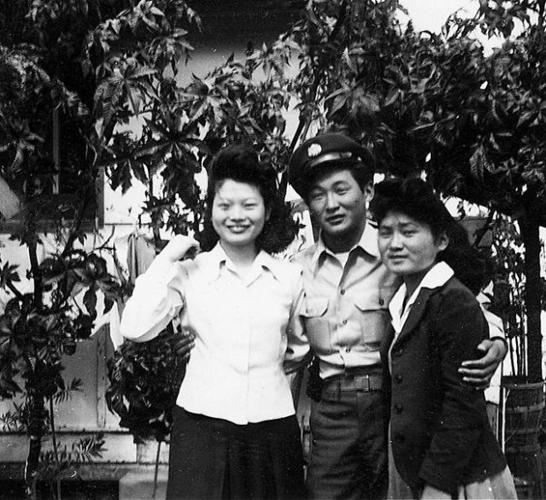
On Jan. 15, 1944, she and Jim were married in Chicago. The newlyweds then returned to the camp where their families were still incarcerated, Jim proudly wearing his Army uniform.
In May of '44, he shipped out to join the 442nd, newly linked to the famed 100th Battalion that had already slogged its way through Salerno and Anzio, earning the nickname the "Purple Heart Battalion."
Jim, who fought in Italy and France, would earn several honors himself, including two Purple Hearts.
"Four from my own company got the Medal of Honor," says Jim, who like the rest of the 442nd was feted with a heroes' parade in Washington, D.C., upon their return in the summer of '46.
Long before then, Katherine and her two sisters had saved enough money to move her mother and younger brothers out of camp to Chicago.
Meanwhile, Jim's parents had been released and given a train ride back to California's Central Valley, where they resumed working in the fields.
Like millions of other veterans, Jim went back to school on the G.I. Bill, earning a degree in mechanical engineering from Purdue University and eventually going to work for IBM.
The couple, who raised three children, made the move with IBM from California to Tucson in the late 1970s.
Not long after, Jim and Katherine flew over the once-teeming camp called Rivers. "You could see the foundation, the layout, but there's nothing there," says Katherine.
A few years ago, both she and Jim received $20,000 in reparation from the U.S. government, as did other camp survivors.
While their recollections today are laced with sharp-edged irony at times, they say they harbor no bitterness.
"My mom was very smart," says Katherine. "She told me in the camp, 'Use this as an experience. This is tough, but we can do it.' "
The camps at a glance
● In February 1942, President Franklin D. Roosevelt authorized the relocation of people of Japanese descent from the West Coast states.
● Within months, the War Relocation Authority had moved 120,000 people into 10 internment centers, stretching from California to Arkansas.
● Two were in Arizona — one at Poston, near Parker; the other at Gila River, near Casa Grande.
● All the camps were closed by the end of 1945.
● In 1988, President Ronald Reagan signed into law guaranteed reparation in the amount of $20,000 to all internment survivors.