

Mary Schanz and Ben Watkins are retired. That's why they get up before dawn seven days a week and go to work - sweaty, dirty, backbreaking work - without a paycheck.
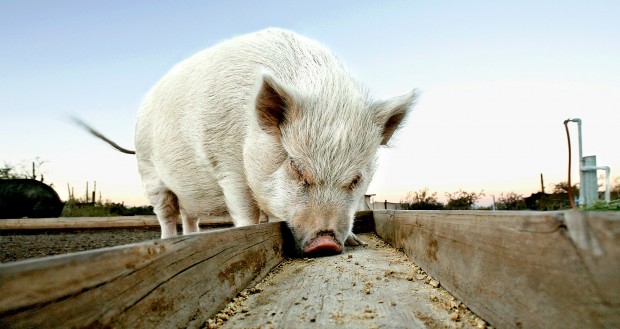
Instead of traveling the world in their retirement, the couple followed their hearts to Marana, where they invested much of their savings in a 40-acre swath of desert where they established Ironwood Pig Sanctuary, a nonprofit rescue for unwanted, neglected, abused and abandoned potbellied pigs.
Vietnamese potbellied pigs were imported into the United States from Canada in the mid-1980s to be sold as pets, according to the website for Shepherd's Green Sanctuary, a Tennessee potbellied-pig rescue. At the start of the potbelly "craze," some pigs were selling for between $25,000 and $33,000. Now owners can't give them away.
Schanz and Watkins - both environmentalists and animal-lovers - moved to Arizona 22 years ago after volunteering on animal-related projects in Costa Rica. Here, they began volunteering at a potbellied-pig rescue. When they realized it was in trouble, the couple took over its operation, then bought the Ironwood property.
People are also reading…
Now the couple cares for more than 600 potbellied pigs with the help of grants and donations.
In the beginning, Schanz hoped to curtail incoming pigs by discouraging the breeding and buying of potbellies and helping owners keep the pigs. But the pigs keep coming.
The potbellies come from all over the country and rarely arrive in ideal health. Ironwood gets pigs with arthritis, dental and vision problems, respiratory illness and injuries from dog attacks. Some are overweight, and others are emaciated. Occasionally, they are lame because their hooves are overgrown. Most new arrivals are not spayed or neutered.
Early on, Schanz encouraged adoption, but, over 10 years in operation, many of the pigs she placed in homes have been returned in much worse condition than when they originally arrived.
"I'm not too encouraged anymore," she said.
In the last few years, the national economy has been adding to the sanctuary's burden.
"Every time I think we're caught up, foreclosure, foreclosure, foreclosure," Schanz said. So far this year, Ironwood has taken in about 35 pigs because the owners lost their homes. Last year, they took in 25 pigs for that reason.
Another problem: old age. Of the 600-plus pigs, 400 are 10 or older. That creates a host of new veterinary issues for the staff. So far this year, 40 elderly pigs have died - double the number that died last year.
But employees and volunteers who get discouraged by the struggles and setbacks find strength in helping those pigs they can.
"For me, it's not hard at all. The pigs are worth it. I fell in love with all the animals," said employee Bobby Cruz.
Added staffer Taryn Schaal: "That's my passion. I wouldn't do anything else."
ONLINE ONLY - BOX1
What is a potbellied pig?
COMMON NAMES: Chinese, Vietnamese or Asian miniature potbellied pig
KINGDOM: Animalia
PHYLUM: Chordata
CLASS: Mammalia
ORDER: Artiodactyla
FAMILY: Suidae
GENUS: Sus
SPECIES: scrofa
DESCRIPTION: Full-grown potbellied miniature pigs range from 15 to 18 inches in height, average 3 feet in length and weigh between 90 and150 pounds, with some reaching 200 pounds or more. Unlike livestock pigs, potbellies have shiny dark gray, brown or black coats like wild boars, with occasional spots of white. Solid white coats are also found. Their tails are long and straight rather than curly. They have an exaggerated potbelly, a swayed back and erect ears.
GEOGRAPHICAL RANGE AND HABITAT: Found in the domesticated state in Asia, Europe and North America.
DIET: Pigs are omnivorous. Wild pigs are active mainly from dusk until dawn, but domestic pigs adjust to a daytime schedule. In the wild, pigs eat fungi, tubers, bulbs, green vegetation, grains, nuts, cultivated crops, invertebrates, small vertebrates, carrion. In captivity, they eat fruits, vegetables, pig pellets and roughage.
LIFE CYCLE/SOCIAL STRUCTURE: Wild pigs live in a group of females and their offspring, with males joining the group to mate. Pigs differ from other hoofed animals in that they are born in a nest and remain there following birth. Potbellied pigs reach puberty around 6 or 7 months of age. The gestation period is around 114 days, and a litter of 4 to 12 is typical. Full growth is not reached until about 3 or 4 years of age. Life span is 12 to 18 years.
SPECIAL ADAPTATIONS: The snout is adapted for rooting for food; a cartilaginous disc supported and strengthened by a prenasal bone makes a very good digging tool. Pigs have a very keen sense of smell and can locate minuscule amounts of food in the soil and can follow it by air-scenting. They have been used by law-enforcement agencies to sniff out drugs.
POTBELLIED HISTORY: Asian potbellied pigs are also known as Chinese or Vietnamese potbellies. They are descended from the wild boars that once roamed throughout China. Around the 10th century, these boars were domesticated and used as both pets and food.
SOURCE: Oakland (California) Zoo and California Potbellied Pig Association
ONLINE ONLY - BOX2
Pros and cons of potbellied pig ownership
Advantages
• Long life span (12-20 years).
• Clean and odor-free.
• Nonallergenic in most cases.
• No fleas.
• Very little shedding.
• Quickly trained: litter box, tricks, harness, etc.
• No barking.
• Nondestructive, unlike a puppy.
• Low maintenance: annual vet visit.
• Communicative, affectionate and intelligent.
Disadvantages
• You may not be zoned to own a pig.
• You may not have a vet available who knows how to treat potbellied pigs.
• Pigs can become spoiled and manipulative.
• Pigs require a commitment of time and energy from their owners.
On StarNet: To learn more about potbellied pigs, go to azstarnet.com for online extras.
On StarNet: See a slideshow of Ironwood Pig Sanctuary at azstarnet.com/gallery
A day at the sanctuary
It's a love of pigs, not the glamour of the job, that keeps staffers and volunteers working at Ironwood Potbellied Pig sanctuary in Marana. It's dirty, exhausting work. Scorching hot in the summers and freezing in the winters.
But the contented grunts of a potbelly that finds a tasty morsel in his food bowl and the gentle snores of a relaxed pig having her belly rubbed make the hard work worth the effort:
Pre-dawn - A staffer prepares medications for 150 pigs, hiding pills in sandwiches and Fig Newtons or mixing them with juice or yogurt.
Dawn - Five staffers and the two founders gather to decide which of the 23 fields of pigs each will feed. In the fields, bowls of food are prepared for pigs who need special diets, medications are given, feed troughs are filled and hay is spread throughout the fields. The whole process takes three hours or longer.
Midmorning - After a short break so the staff can eat breakfast and discuss the condition of individual pigs, everyone heads back into the fields to scrub and fill wading pools and water bowls and refresh mud wallows.
The process is a little faster in winter, but during the scorching summers it can take a half-dozen people four hours to finish. The well on the property pumps 2,000 gallons of water a day, but in the summer the sanctuary uses 5,000 gallons, so someone has to drive the water truck into town to replenish their supply.
Afternoon - The rest of the day, staff and volunteers make medical rounds to check on pigs who are ill or recently had surgery. They might have to treat surgical incisions, give injections, clean out infected eyes, flush abscesses, treat skin-cancer lesions on white pigs, apply sunscreen and more.
Two staffers visit pigs who are scheduled for hoof and tusk trimming - a job that requires much patience and nerves of steel on the part of workers and prompts plaintive screams on the part of pigs who object to the painless process.
As hoofs and tusks are trimmed, other employees and volunteers restock supplies, escort the visiting veterinarian on rounds, give tours to donors and school groups, hang shade cloth, perform property maintenance, prepare for the arrival of new pigs and respond to unexpected situations.
Evening - Medications are prepared and distributed to ailing pigs before the potbellies crawl under the blankets in their shelters and bed down for the night.
If you go
• What: Ironwood Pig Sanctuary's annual open house.
• When: 11 a.m. to 3 p.m. Saturday.
• Cost: Free, but donations appreciated.
• Where: Marana, about an hour from downtown Tucson.
• Call: 631-6015 to make a reservation for the open house and get directions.
• Go to: www.ironwoodpigs.org to learn more about the sanctuary.
Ironwood Pig Sanctuary by the numbers
600-plus
pigs housed at the sanctuary
21
age of oldest pig, Peanut
40
acres -
sanctuary size
5
paid staff living on-site, plus the founders who are unpaid
7
core volunteers, three on-site and four off-site
8
tons of pig pellets each month
1
ton of fresh produce each month
350
pig shelters on the property
5,000
gallons of water used daily in the summer
150
pigs need medication
$1,000
average annual cost per pig, includes direct care (feeding, veterinary), staffing, infrastructure, insurance, vehicle and property maintenance.
SOURCE: Ironwood Pig Sanctuary
Is a rescue pig right for you?
Here's a checklist of questions to consider before adopting a porcine pal. Do you know:
• How big the pig will get?
• How much time it needs to spend outdoors and how much space it needs?
• That you cannot safely house a pig with other pets, such as larger dogs and horses?
• How long pigs live?
• What it costs annually to keep a pig?
• A vet who will treat a pig?
• Whether your property is zoned for potbellied pigs?
• Whether there are other restrictions or regulations about pigs?
• What you will do with the pig if you move, get divorced or for some reason cannot keep it?
• That pigs need the companionship of other pigs?
If, after considering all of these issues you still want to adopt a potbellied pig, you will need:
• A fenced yard at least 50 feet by 100 feet.
• A warm, dry pig house or shed.
• Plenty of shade.
• A watering hole for mud baths.
SOURCE: Shepherd's Green Sanctuary
These little piggies …
Full-grown potbellied miniature pigs range from 15 to 18 inches in height, average 3 feet in length and weigh between 90 and 150 pounds, with some reaching 200 pounds or more.
Unlike livestock pigs, potbellies have shiny dark gray, brown or black coats like wild boars, with occasional spots of white. Solid white coats are also found. Their tails are long and straight rather than curly. They have an exaggerated potbelly, a swayed back and erect ears.
Contact reporter Kimberly Matas at kmatas@azstarnet.com or at 573-4191.
