



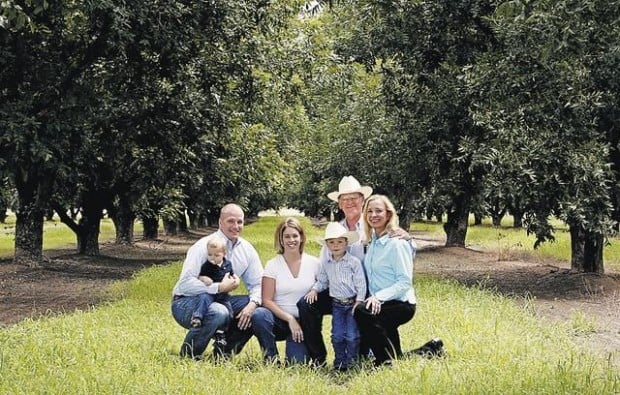
Chances are the next time you pop a pecan in your mouth, it came from the Green Valley Pecan Company, south of Tucson.
For decades, one family has been farming and processing these nuts, which are shipped around the world.
Take a trip to their farm and learn about them and their rich family history.
Acre after acre, the greenery grows, more than 100,000 pecan trees jutting up in orderly rows along the Santa Cruz Valley, south of Tucson.
Welcome to one of the world's largest irrigated pecan orchards, stretching for nearly 14 miles along the Santa Cruz River — on land owned and operated by the same family since 1949.
That same longevity also applies to employees and their families.
"We have second- and third-generation here. Some have gone on to become judges, engineers and doctors," says Dick Walden, president of Farmers Investment Co. (FICO), which his late father, Keith Walden, founded in 1946.
People are also reading…
About 250 employees work the fields here and at other FICO properties, as well as at the Sahuarita plant, where some 26 million pounds of nuts are processed annually.
"We grow about 60 percent and the rest we buy. Fifteen to 20 percent of that comes from Mexico," says Walden, who frequently visits Mexican suppliers in his twin-engine Cessna.
As he strolls the grounds of his farm in Sahuarita, Walden, dressed in jeans and low-heeled cowboy boots, converses easily with his employees, often in Spanish. They seem equally at ease with him.
"We go to their weddings and funerals, their barbecues and graduations," says Nan Stockholm Walden, Dick's wife.
Sadly, one of those funerals was recently held for 39-year-employee Layne Brandt, 63, FICO's vice president for farm operations, who died in a plane accident Aug. 14.
"He was a loving family man, an intelligent and innovative farmer, a great business manager, an expert pilot and a true cowboy," Nan Walden told the Star.
Working with Dick and Nan is Deborah Walden Ralls, Dick Walden's daughter from a former marriage. She is the company's marketing manager and human resources director. Her brother, Richard Walden, 35, is assistant manager of a golf club in Colorado and is not involved in the business.
Now living in Chandler with her husband, David Ralls, and their two young sons, Deborah, 32, telecommutes and also makes the trip to the farm twice a week.
"My biggest challenge is not being here every day," says Deborah, who, like her father, cherishes her relationships with employees. "People I went to elementary school with, some of them now work for the company," she says.
Besides the Green Valley Pecan Company — the company's pecan shelling and marketing operation — FICO owns an 1,100-acre pecan farm in Georgia and a relatively new 2,700-acre orchard in San Simon, near the New Mexico border. There, 45,000 pecan trees have been planted, with more on the way.
It all began with Keith Walden, who died in 2002. The son of a banker who also owned a citrus grove, Keith began farming cotton in California in the 1940s.
In 1949 he bought the 10,000-acre Continental Farm south of Tucson. For the next 11 years he bought up farmland in Pinal and Maricopa counties, as well as the Sahuarita farm near his farm in Continental.
Cotton was the main crop, although Keith also grew grains, lettuce and watermelons.
"Dad was very energetic, very entrepreneurial," says Dick Walden. "He approached agriculture as a business."
Gene Sander, dean of the University of Arizona College of Agriculture, knew Keith Walden well.
"The man was a real visionary," says Sander, who also has high praise for Dick Walden, whose pecans are sold to wholesalers, candy makers, bakers and outlets such as Costco.
"This guy is a businessman. What he does is sell things that grow in the ground," says Sander.
Besides farming, Keith Walden also ran as many as 9,000 sheep in the Santa Cruz Valley at one time and in 1953 opened a cattle feedlot that grew to 20,000 head.
"I grew up a cowboy," says Dick, 66. "I knew all the old Southern Arizona ranchers."
The feedlot closed down in 1976 after neighbors in the burgeoning Green Valley complained about the odors.
Ironically, Keith Walden sold some of his land to Green Valley's first developers. "He felt there would be development between Tucson and Nogales. He wanted to be involved," says Dick.
Over the years, FICO also donated land for employee-owned houses, and has set aside land for a medical clinic and hospital to one day serve Green Valley and Sahuarita.
Not long after the family moved to Arizona in '49, Dick Walden started school in a rehabbed storeroom with two outhouses.
The next year he and about 70 kids and three teachers moved up to the newly added-onto Continental School. The family's nearest neighbors were 12 miles away down a dirt road.
By the time he was 8 he was sweeping the shop. By the time he was 11 he was mowing alfalfa. As a teenager, he — along with his horse — attended Thatcher School in Ojai, Calif.
In the mid-1960s, he served in Vietnam as an Army aviator, where he earned several awards, including the Air Medal with three Oak Leaf Clusters.
A graduate of Pomona College — as were his dad and both sets of grandparents — Dick has served as FICO president since 1983. (A brother, Thomas, was killed in a plane accident in 1973.)
In the 1960s, disease started infesting the cotton fields. By then, Keith Walden was already looking for other crops to grow.
Polyester was also at play.
"Dad was concerned about synthetic fibers affecting the cotton market," says Dick. For years, his father experimented with various stone fruit trees, olive trees and grapes.
"After eight years, it was going to be either pecans or wine grapes," says Dick. "Pecans won because they could be mechanically harvested, the window of harvest was longer, and you could store them longer."
The trees started going in the ground in 1965.
Although Keith Walden worked hard to bring in Central Arizona Project water, FICO wound up not using it, because federal law limits subsidized water to no more than 960 acres.
"Bringing in water for only 960 acres could not be justified for a delivery system from Pima Mine Road," says Dick, referring to the CAP terminus two miles away. Instead, the company uses laser leveling on its fields to ensure even distribution of water.
Harder to solve is the employment crisis. "Since 9/11, processing immigration applications has come to a halt," says Dick, who still remembers the old bracero program his father used in the 1950s and '60s. "When we lost that, we got out of the lettuce business."
Today, the company religiously follows the government's E-Verify plan to check the work status of new hires to make sure employees are legal.
Harvest — where pecans are literally shaken from the trees — runs from November through January. But processing runs all year long in a 120,000-square-foot plant that operates five days a week, 24 hours a day.
After washing his hands and donning a hairnet, Dick gives a quick tour of the plant, where pecans are cracked, shelled, graded, packaged and shipped.
Though much of the process is automated, women still do the final sorting as the pecans vibrate in front of them. "They don't get vertigo the way the men do," says Dick.
Some 12 million pounds can be held here in cold storage, another 16 million pounds at a facility in Las Cruces, N.M.
"It takes a pecan tree three years in the nursery before it's transplanted and about 10 years in the orchard before it fully produces," says Dick, who clearly plans to stay in the business for some time.
"We would not be planting an orchard if I did not think we'd be here," he says with an easy smile.
Ranch 17 miles away is their sanctuary
It is cool and cloudy this summer morn at Rancho Soñado, as two foals romp in the pasture beneath the backdrop of Elephant Head Rock.
Here in Amado, Dick and Nan Walden have made their home, in a low-slung ranch house with red-tiled roof and front porch graced with hanging pots of geraniums.
"It was a disaster when we bought it. We almost tore it down," says Nan, who along with Dick bought the 160-acre ranch in 2004.
Instead, the house, built in 1972, was entirely remodeled, with cozy living room and kitchen, den and master bedroom. Out back is a patio, with lawn and shrubbery to attract the hummingbirds and butterflies.
Located 17 miles south of where they both work at the Walden-owned pecan farm in Sahuarita, Nan and Dick both consider Rancho Soñado, which means "dreamed-of ranch," a sanctuary.
"It's nice to get up in the morning, saddle a horse, think of the day ahead," says Nan, who rarely was able to ride during the years she worked as a corporate lawyer.
Now she has her choice of 10 horses, eight of them pure-bred Arabians.
More than just pleasure horses, they also help push the cattle grazing on the 6,000 acres that are also leased here, running almost up to the foot of Elephant Head.
"It's good for the horses, good for their brains," says Nan, who along with Dick occasionally rides the horses through their pecan orchards.
Five employees, full- and part-time, work at the ranch, which offers pasture, boarding and training. About 40 horses are currently boarded there.
The ranch office is lined with ribbons that Dick, Nan and Dick's daughter, Deborah Walden Ralls, have won at various horse shows, some at the national level.
Giving a quick demonstration, Dick shows what his horse, Agracie Girl V, can do with trail-horse maneuvers.
All too soon he'll be out of the saddle and riding a computer at work, 17 miles and a world away.
After years as a lawyer, she's now a farmer's wife
Before marrying Dick Walden in 2001, Nan Stockholm Walden spent more than 15 years as an environmental attorney and consultant.
A graduate both of Stanford University and its law school, she served as chief of staff to Sen. Bill Bradley, as well as counsel to Sen. Daniel Patrick Moynihan.
"My friends can't believe it. When they see me they start singing 'Green Acres.' "
Maybe so. But farm livin' seems to be the life for her.
Nan, 54, has readily embraced the lifestyle, whether it's riding horseback on the couple's ranch in Amado or serving as vice president and counsel to Farmers Investment Co., which includes the family's huge pecan farm in Sahuarita.
A past board member of the Sonoran Institute, she also serves on the board of the Santa Cruz Valley National Heritage Alliance. She is also a trustee with The Nature Conservancy of Arizona and the Carondelet Foundation.
"Nan has been a tremendous force helping us to plan and identify people to get them involved," says Pamela Doherty, CEO of the Carondelet Foundation, which is launching a major capital campaign to bring health care to the Sahuarita/ Green Valley area. "She is committed, driven, an amazing thinker."
Since 2004, Nan has also been a member of the Canoa Ranch Community Trust/Oversight Committee, which is working to develop a master plan for the historic ranch and its almost 5,000 acres south of Green Valley. The plan includes honoring the history of those who once lived on the land — Native American, Hispanic and Anglo.
"Nan has tremendous connections and is willing to work with anything so we can develop this," says Sandra Stone, chair of the Canoa Ranch committee.
Nan and Dick met in 1998 at a wedding in Chicago. "My 83-year-old mother was my date," says Nan, who was working in San Francisco.
It was love at first sight.
"After I met Dick I wanted to continue working in public service," says Nan, who from 2000 to 2003 served as assistant vice president for federal relations at the University of Arizona.
Once a month she spent a week in Washington, D.C., lobbying for the UA. "Dick was in his airplane half the time. I was in Washington," says Nan.
That ended in 2003, when she left the UA and went to work for FICO. "Not many couples work well together," says Nan, who clearly thinks that's not the case with her and Dick.
Worried about urban encroachment, she says there has to be a balance between agriculture and development. "We are losing 1 to 2 million acres of farmland to urbanization every year."
Both she and Dick acknowledge there probably won't be pecan trees growing in the Santa Cruz Valley a hundred years from now.
Even so, says Nan, "I'd like to know the Santa Rita ridge line will still be visible."
pecans galore
The Green Valley Pecan Company store sells pecans, mixes, spices, jams, teas, barbecue sauces and salsas.
The store, located off Interstate 19 at 1625 E. Sahuarita Road, is open 9 a.m.-5 p.m. Mondays-Saturdays, 10 a.m.- 4 p.m. Sundays.
For more information, call 1-800-327-3226, or log onto www.pecanstore.com.