
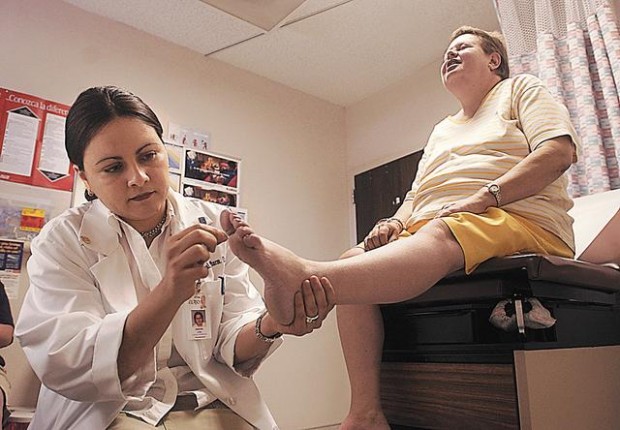
We are going to talk, frankly, about feet. Don't say, "Ewwww." At least we're not talking about ear wax.
Feet, built from muscles and tendons and 26 bones, are marvelous evolutionary creations. They surely do not deserve the shabby treatment most of us force our tootsies to endure.
We stuff them away in the humid darkness of too-small or otherwise torturous shoes for a dozen-plus hours at a time, stand on them, kick things with them and don't take them to their own special doctor until something hurts a whole lot.
Truth is, most of us pretty much ignore our feet. They're our farthest-away body part, after all, difficult to examine up close without contorting. And they're harder to wash and moisturize and pamper than, say, elbows.
"People seem to think it's normal to have foot pain, but it's not," says Mark B. Friedman, a podiatrist in Albany, N.Y. "No pain is normal. It's a problem if there's pain."
People are also reading…
Common sources of foot pain:
● Corns, which are callus tissue that accumulates over or near a bony prominence on a toe or between toes, often from pressure from ill-fitting shoes.
● Ingrown toenails, which develop when the sharp edges of toenails grow into adjacent tissue; they can cause swelling, infection and drainage.
● Plantar warts, a viral infection that causes growths on the ball of the foot or heel.
● Hammertoes, which are crooked toes often caused by a muscle or tendon irregularity that bends the toe out of shape.
● Bunions, an inflammation of the joint at the base of the big toe, often caused and exacerbated by shoe friction or ill-fitting shoes.
"All kinds of things can go wrong with the foot. Every system that's in the body is in the foot," says D. Joel Valentini, a podiatrist in Albany and Troy, N.Y.
The American Podiatric Medical Association calls feet "mirrors of health." Podiatrists are sometimes the first to spot foot problems that can be indicators of systemic health issues such as diabetes, arthritis and circulatory disease. Dry skin, brittle nails, sensations of burning and tingling, coldness or numbness, discoloration: All can be signs of something wrong.
Friedman estimates that a third of his practice deals with diabetes-related foot problems.
Diabetes can cause numbness and poor circulation in the feet, which in turn can contribute to dry skin — nerve damage prevents sweat glands from functioning properly — to wounds that take an eternity to heal.
Friedman and Valentini agree that women generally pay more attention to their feet than men do, but women also have more problems.
The main culprit: their shoes. Most women's shoes scrunch toes, jack up heels and otherwise abuse feet.
"Quit wearing high heels," Friedman says, um, flatly.
High heels put all the wearer's weight on the ball of the foot, they can cause the Achilles tendon to shorten, as well as bunions and hammertoes.
Finally, make sure your shoes fit.
"So many people are wearing the wrong shoe size," says Friedman. On the one extreme, he regularly sees women who refuse to admit their feet have grown — pregnancy can add a half or even a full size to a woman's feet — and still cram into the size 5 or 6 they wore in high school.