Consider the crayon — often the first artistic medium most of us dabble in.
Oils, watercolors, acrylics — now those are the tools of adults. Right? Um, not always.
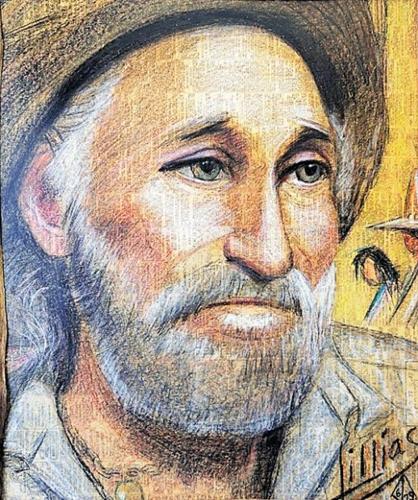
"Most people have no idea about crayons," says Lillias Apland, who's created thousands of portraits — all in crayon. "They were using this encaustic medium, combining color pigments and beeswax, thousands of years before Christ."
Best of all, she continues, crayons are something you can work with for five minutes or five days, with no "putting up, cleaning up or putting away."
Little wonder, then, that Apland also carries the name "The Crayon Lady," given to her by one of the thousands of school kids she's taught over the years.
"I think I've taught art at half the grade schools in Tucson," says Apland, who during the late '70s started going into the classroom as a visiting art teacher, giving instruction to both teachers and students.
People are also reading…
One of the first was the elementary school on the Tohono O'odham Reservation's San Xavier District, south of Tucson. "I had them doing self-portraits, desert scenes, the mission — all in crayon," says Apland.
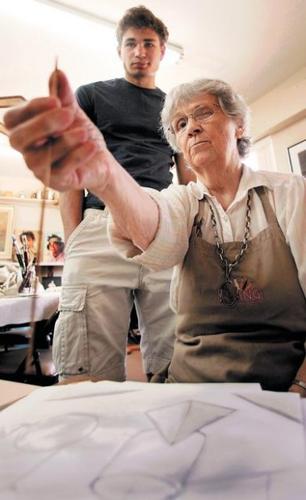
Amazingly spry at 88, Apland is still teaching, including in her home, giving lessons in everything from oils to crayon for students ranging in age from 13 to 78.
"I get excellent instruction, and it's fun," says Irving Winick, 78, a retired law judge who's churned out more than 100 oil paintings in the eight or nine years he's been with Apland.
"She has taught me a ton of stuff and gotten me into different mediums," says Steve Sommitz, 15, who's been coming to Apland's classes since he was 9.
"I get a tremendous thrill seeing people master painting," says Apland, whose own artistic career goes back to high school in Redlands, Calif.
"I did portraits. People saw I could do a likeness and would say, 'Do one for me.' I did them in pencil and crayon, even crayon on cloth. Half the time I just gave them away."
By the 1940s, she was married, living in Riverside and realizing she needed more training. So she contacted noted Western painter R. Brownell McGrew — whom she'd met earlier — and asked if he would take her on as a student.
"He apparently saw something in me," says Apland, who made the 100-mile round trip between Riverside and his home in Palm Springs every week.
The training, which lasted on and off for eight years, was intense. "He taught me how to see light on form. I learned how the old masters painted."
During that time, she also worked as a visiting art teacher in elementary schools in California while turning out her own artwork, mainly portraits.
In 1971, she came to Tucson for her health. "I traipsed out into the desert for five years, did drawings of desert scenes and sold them as souvenirs."
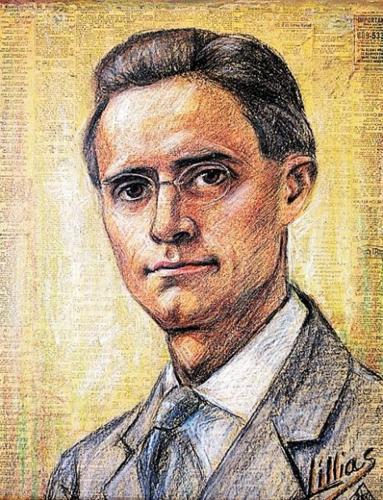
A few years later, she started using the classified section of the newspaper as the background for her crayon portraits, gluing the paper on Masonite board. "I think I'm about the only one doing this," says Apland. "It has a see-through transparency."
In 1977, she set up shop in the lobby of the old Marriott Hotel downtown, where for four years she churned out hundreds of portraits of people passing through the lobby.
"Those portraits have gone all over the world," says Apland.
Working some from pose but mostly from photos, she did infants; she did old men; she did the Dutch ambassador's family. All were signed "Lillias."
Some took as little as a half-hour, others as much as three days. "It depends on what they want," says Apland, who still does portraits, asking anywhere from $50 to $5,000, depending on detail.
Toughest to portray, she says, are those without strong muscle and bone structure. "You have to fight hard to find little things to capture them. Otherwise, it's just a head instead of them."
As for the background, today's classifieds, she says, have become too busy with ads. She now prefers The Wall Street Journal. "Friends save them for me."
She's equally choosy about her crayons. "I use Prang, made by the Dixon Ticonderoga Company."
In fact, during the early 1990s, the company contacted her to demonstrate the company's new soybean crayon. "They ended up booking me in South Dakota, Indiana, New Orleans."
Today, she's still busy teaching, at home and in the occasional classroom. "I teach you to be independent," she says. "I give you the classic underlying skills, and you take it from there."
There's also no thought of slowing down. "People ask me why I don't retire. I say why should I retire? I'm already doing what many people retire to do."
DID YOU KNOW
One of Lillias Apland's crayon portraits is of the late Tucson artist Ted DeGrazia.