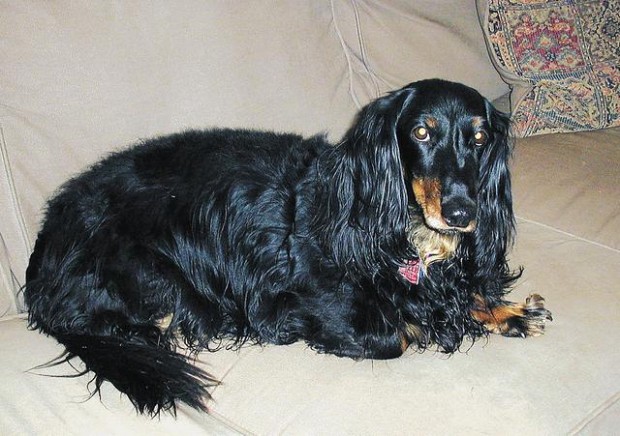
Dogs excel at expectations. They'd major in it in college, if dogs went to college.
When two particular dogs wake up in the morning, dogs I know quite well, they wake up with the expectation that today will be a good day. They fully expect that breakfast will show up in their bowls, that the school bus will show up across the street — a highly barkable event — and that they'll be loved and adored.
Audrey and Ziggy expect tremendous things to happen.
Dogs are optimists.
They operate on the principle that if something good happened once, it can happen again. If a slice of ham dropped from the dinner table to the floor two years ago, there is no reason it won't happen tonight. Or tomorrow. Or the day after that. Dogs operate on the "could" principle. Today could be a floor-ham day.
People are also reading…
Yet at the same time, dogs don't seem particularly good at expecting bad things to happen. At least, not our dogs.
Ziggy hurt his back pretty severely, yet he still longs to relax on the sofa, something he's no longer able, or allowed, to do. He's 95 percent recovered, but he still gets a twinge every time he tries to jump up. A quick yelp of "ouch!" and he remembers he can't do that. But he never seems to expect that it will happen.
Sometimes enthusiasm overshadows expectation.
So many times, the fulfillment of our expectations is not up to us alone. We can try our best and hope and pray and wish, but there are too many moving parts for us to pretend we really have control. We can expect the best, or expect the worst, but we're still anticipating what will happen.
Experts say that one of the biggest causes of holiday angst is unrealistic expectations, wisdom that likely applies during the rest of the year, too. We don't learn from our experiences and continue to put pressures on ourselves and others. But that's part of being human: We, too, are often optimists. Sometimes it's self-delusional positive thinking, which we often secretly know way down deep, but that doesn't stop us, even when we should know our expectations will hurt.
Part of that urge is a desire to create a protective cushion around ourselves. We follow advice and visualize positive outcomes, like athletes preparing for a big game. We find great comfort in pretending we know what will happen.
But when we make New Year's resolutions, we're proclaiming our expectations of ourselves. It's a much dicier proposition.
And then it's up to us to make it happen. We are in control.
We choose what we resolve to do, and we're in control of whether it happens. If we make wildly unrealistic resolutions — I'm going to become a billionaire in 2006 and my name is not Bill Gates — we're in charge of that. We're the ones who can set ourselves up for failure or success.
When I was in grade school, I resolved one New Year's Day that I would cuss no more. I can't say that expletives were a major problem for me, then or now, but I was going through a short-lived ladylike phase. It didn't last. I don't remember exactly what brought my resolve to its end, but I strongly suspect it involved my little brother.
When it comes to expectations of ourselves, the complicated moving parts of life — like pesky little brothers, or work schedules — can also interfere. We are most in danger of letting that messiness become an excuse for lowering our expectations of ourselves. It's easy to cheese out on a promise to ourselves.
New Year's resolutions are a chance to create expectations for ourselves grounded in our own experience, for good or bad; a chance to stop doing something that's harmful, or to start something good; a chance to look ahead and make a declaration of intent.
But the challenge then is that we're in charge of making our expectations come true, which requires work and holding ourselves accountable.
I resolve to see each day as a floor-ham day.
Editor's note: We don't know what you can expect to find in this space — exactly. Another week it may be about cats or Cats or kids or cars. That will be the fun of it. It's called Expectations, but we think that can be applied to most any topic. If you'd like to contribute an essay for Sunday Accent, e-mail it to mparham@azstarnet.com with Expectations in the subject line or mail it to Expectations, Maria Parham, Arizona Daily Star, P.O. Box 26807, Tucson, AZ 85726. The length is limited to 800 words.