

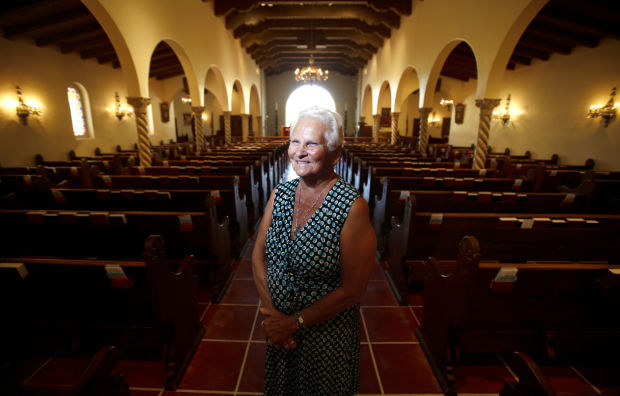
Margret Joesler Shook is breathless as she walks through the mighty wooden doors of the church her father built, considered the masterpiece of eminent Tucson architect Josias Joesler.
“I get goose bumps when I come in here,” says Shook, 76, as she gazes at the hand-hewn beamed ceiling and the spectacular arched window at St. Philip’s in the Hills Episcopal Church that looks out over the Santa Catalina Mountains.
Shook, who spent many years away from Tucson after her family moved when she was a child, is happy to once again live in the city where her father left his striking architectural imprint decades ago.
“It’s just so special to me that he was so well known and had such a great history,” said Shook, the only child of Josias and Natividad Joesler. “Having people still know and admire his architecture after so many years is wonderful.”
People are also reading…
Shook said she was among the first babies to be baptized at St. Philip’s, which opened its doors for Christmas Eve Mass in 1936. Her godparents were “Uncle John and Aunt Helen” – John and Helen Murphey, who brought Joesler to Tucson in 1927 to serve as their lead architect as they developed the Catalina Foothills and other landmark Tucson homes and buildings, including St. Philip’s.
“It’s a very special place for me,” Shook said of the church, which was built on the outskirts of town on land that was donated by the Murpheys, accessible only by dirt roads. The church building, at River Road and Campbell Avenue, is now on the National Register of Historic Places.
“The feeling I get looking out that window and knowing he designed it – it can’t get any more special than that,” Shook said, her powder blue eyes shining.
Josias Thomas Joesler was born in Zurich in 1895 and was raised in Arosa, Switzerland, where his architect father served as mayor, according to the University of Arizona’s “Through Our Parents’ Eyes: History & Culture of Southern Arizona.”
He studied architecture in Bern, engineering in Heidelberg and history and drawing at the Sorbonne in Paris. From 1916 to 1923, he worked as an architect in Switzerland, Germany, Italy and Spain.
“Dad spoke German, English, Italian, Spanish and French,” recalled Shook, who spoke only Spanish until starting school.
Joesler met his Spanish wife, Natividad, while serving in the Swiss army in Spain, Shook said. After they married, “they decided to be adventurous and travel the world.”
They ended up in Cuba, and made their way to Mexico City, where they traveled north by donkey, Shook said.
“My mother was sturdy. She was tough. You’d have to be to do that.”
The couple landed in Los Angeles in 1926, where Joesler “nearly went broke working on his own as an architect. He was eventually hired as a draftsman at a prefabricated house manufacturer. While in Los Angeles, he came to the attention of architect George Washington Smith,” according to “Through Our Parents’ Eyes.”
Back in Tucson, the Murpheys, who had purchased 7,000 acres of what is now the Catalina Foothills, were looking for an architect who could interpret their vision of “elite communities and buildings that portrayed the various historical revival styles popular in other parts of the West. Joesler’s extensive travels, combined with his education in both the technical and artistic realms of architecture, provided the Murpheys with just the palette of styles needed to express their vision,” according to “Through Our Parents’ Eyes.”
In 1927, Joesler, who was introduced to the Murpheys by Smith, started his prolific 30-year career working with the Tucson developers.
He was a busy man, taking part in 56 jobs in 1928 alone. Under the patronage of the Murpheys, they produced more than 400 buildings in Tucson, including Broadway Village.
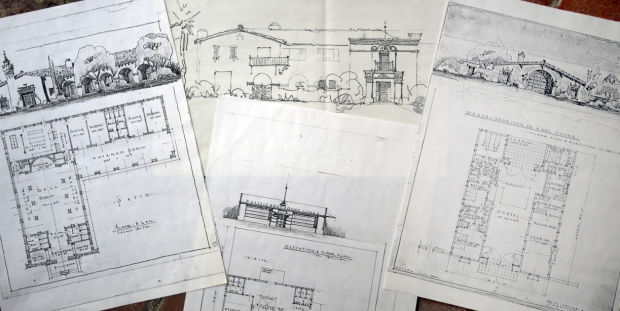
Shook has original drawings and copies of her father’s drawings, as he sketched out designs that gave Tucson its sense of place.
Shook said she spent her earliest years in Tucson, having been adopted as an infant by the Joeslers from the Stork’s Nest – a maternity home in downtown Tucson. The couple tried to adopt a baby boy, as well, but the adoption fell through.
By her birth in 1938, Joesler had made his mark on Tucson. Shook has few memories of those early years here, as the family moved to San Diego when she was a young child. Her mother yearned to live by the ocean.
In Ocean Beach, Joesler built a shopping center, where his wife and daughter later operated a Mexican import store. In the same shopping center is Nati’s, a Mexican restaurant Shook said was named after her mother, which remains popular today. He also built the family a home with spectacular views in Point Loma.
While Natividad wanted to live by the ocean, Josias longed for Tucson. He spent long periods of time here, working. When Shook was a senior in high school in San Diego, word came that her father had died of a heart attack on Feb. 12, 1956. He is buried at Evergreen Cemetery.
Upon his death, Shook’s mother told her she was adopted. After Shook married, her mother moved back to Spain and they never saw one another again.
Shook, the mother of four and grandmother of two who worked as a secretary before retiring, said her father’s love of Tucson and its desert beauty was unwavering.
On a recent afternoon, she strolled about the grounds of Hacienda Del Sol Guest Ranch Resort, which was built by the Murpheys as a ranch school for girls. In the late 1930s, Joesler rebuilt and redesigned sections of the ranch, according to Hacienda Del Sol’s website.
As a guest ranch, the property attracted movie stars of the ’40s, including Spencer Tracy, Katharine Hepburn, John Wayne and Clark Gable.
“I just love seeing my father’s work,” Shook said as she walked through the doors of Hacienda Del Sol. “Just look at the gorgeous building and the beautiful view.”
She said her father was innovative, building in the rocky foothills, often with no infrastructure in place. He incorporated the architectural styles and features that he saw during his travels.
“His architectural style was very unique,” she said. “It had a lot of Spanish and Mexican influence. The European and Mexican styles that he loved came through.”
He was meticulous in the placement of his structures.
“He wanted those homes placed just right, to maximize all of the natural beauty, the views, the sunsets, the sunrises.”
She said her father had an impeccable work ethic. “That’s why he was so successful.”
She remembers time spent at home with her parents – her father drawing at his desk and her mother making pottery. They both loved classical music and her father smoked a pipe.
“He was a wonderful man – always very affectionate, very generous, very kind, very smart. If anyone needed anything, he would be there.”
She has fond memories of the Murpheys, as well. “Uncle John and Aunt Helen were kind people,” Shook said.
Shook returned to Tucson two years ago, after her husband, Michael Shook, died.
“To return to where I was born is very meaningful to me,” Shook said. “And to live in the city where my father had so much architectural influence is very meaningful, indeed.”