

A coconut is one tough nut to crack. Tropical, exotic, tasty and utilitarian, the coconut is so much more than piña coladas and a lacy frou-frou topping for cupcakes.
Local artist Pat Napombejra hails from Thailand, one of the most prolific coconut-producing countries. There were several trees on his family's property.
"As a boy, I was always fascinated by the men who would climb those trees and scratch their fingernails on the husks to determine the degree of ripeness. Then back on the ground they would cut into the husk and we would drink the coconut water — which looks sort of like lemonade and has just a faint scent but tastes so good."
What we buy in the grocery store has already been husked, and it's definitely an odd-looking thing. Three dark, circular indentations — which are actually germination pores — give the appearance of a monkey's face or a "coco" — a scary witch in Portuguese folklore. Some think the coconut palm is native to South Asia; others say South America. A buoyant nut can travel many a nautical mile, guided by marine currents, and still maintain its viability. Because it thrives on high humidity, sandy soils, abundant sunlight and regular rainfall, there's little wonder that the coconut palm has become a tropical icon.
People are also reading…
Now, about its nut — which really isn't a nut at all but a drupe (a fruit with a hard stone) — countless curiosities abound.
Let's get cracking.
How to crack a coconut
You will need: a coconut, a hammer, a thin-ish nail and a towel.
• Drive the nail with the hammer through the softest "eye" or dark indentation. You can pierce each eye if you desire.
• Place the coconut over a glass or container to drain the water. If it's not draining well, you can drive a nail in the end opposite the "eyes." Or use a drill.
• Place the coconut on the towel, which should be large enough to enclose the 'nut completely.
• Tuck the edges of the towel so that the pieces of smashed coconut don't go flying.
• Place the towel-enclosed coconut on a hard, flat surface, like your garage floor or brick walkway. Bash away. Caution: using your kitchen counter is not a good idea.
• Note: Coconuts in grocery stores often come scored to make opening easier. You can use the non-smashing end of the hammer to pry/crack the 'nut open.
• Once you've cracked it open, you might want to hit it a few more times to break up the bigger pieces, which will make it easier to get at the meat.
• Pry the meat away from the shell using a small knife. Carefully scrape off the thin layer of shell on the coconut meat.
• You can grate or shred or just store the chunks. The fresh coconut meat will last two to seven days in the fridge; one to three months in the freezer; six to 12 months if shredded or grated and dehydrated.
Coconut: The catalog
Besides its culinary uses, most every part of the coconut palm is useful, making it very economical.
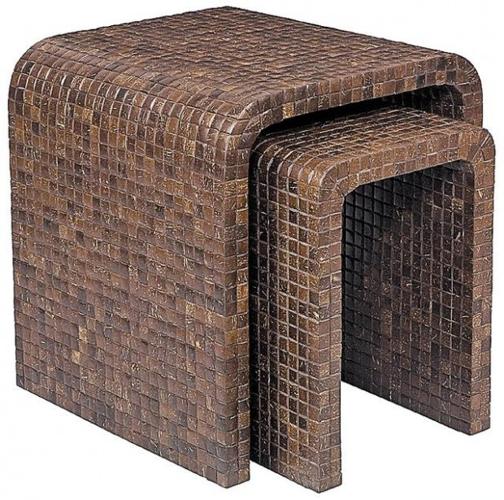
• The wood from the trunk is used for furniture and building materials.
• The husk is covered with fibers called coir. Those fibers are used in making ropes, mats, brushes, stuffing material and compost and potting soil.
• In theater, half coconut shells are used for sound effects, such as the clomping of horses' hooves. And, for comic effect, they are used for improvised bras, usually for men portraying women.
• Leaves are used for roofing thatch and baskets.
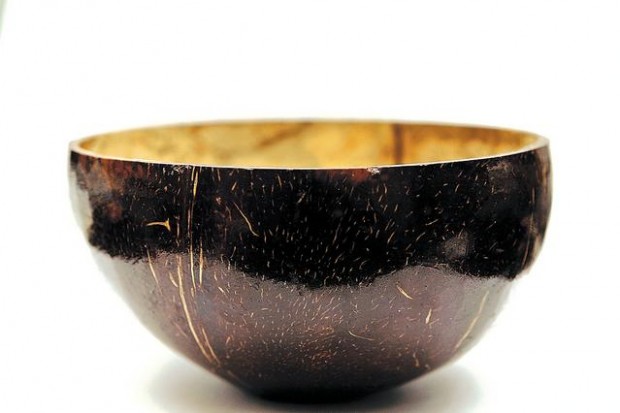
• Half shells are used as the bodies of musical instruments. They can also be used as cups and bowls.
• Dried shells can be used as birdhouses or feeders.
• The trunk can be hollowed for use as containers, drums or canoes.
• And if you need to catch a monkey — and who among us doesn't from time to time? — you can drill a 1.5-inch hole in a coconut, place a banana inside, and hang it from a tree. The monkey, who has a serious sweet tooth, reaches in to grab the banana but can't pull its hand out without letting go of the fruit. And it won't do that. So it, in effect, becomes a prisoner.
Coconuts: The down side
Yes, it's true. People have died as a result of coconuts dropping on their heads.
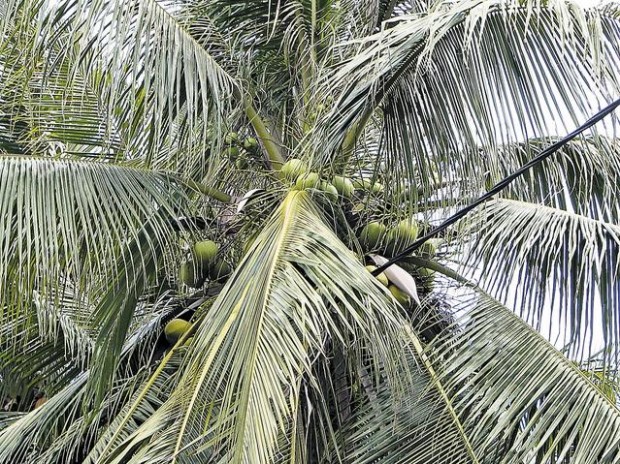
Mature coconut palms may reach a height of about 78 to 114 feet. An unhusked coconut may weigh 2-9 pounds. That means blows to the head could have the force of more than a metric ton.
Although there is no reliable incidence count, it does seem to be a rare occurrence.
Coconuts: In the kitchen
Curries, cookies, candy, cakes. Coconut has a distinctive flavor that stars in numerous cuisines and confections.
But let's make sure we know what we're dealing with here.
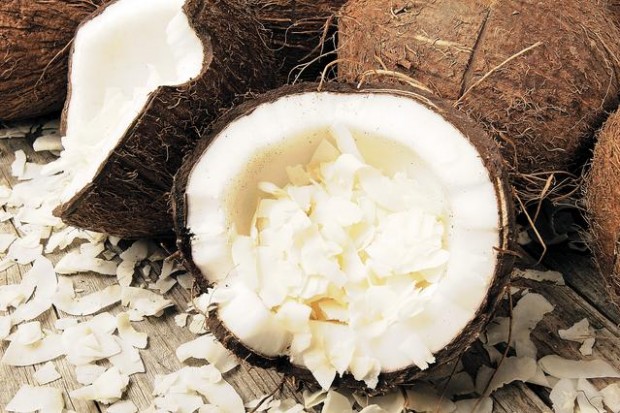
The liquid inside the nut is called coconut water or coconut juice. There's more in young coconuts, and some are harvested just for the juice — a big nut can contain a liter of liquid. The liquid is high in nutrients and, in tropical cultures, is served as a refreshing drink, says Tucson artist Pat Napombejra, who comes from Thailand. At this stage, the endosperm (the meat) is quite gelatinous and can be eaten with a spoon. In ripe 'nuts, which fall from the tree of their own accord, there is much less water and they're rather bitter.
Coconut milk is made by simmering the grated coconut meat in water and then straining. Napombejra remembers folks just putting the meat chunks into a bag and squeezing until the milk was extracted. It's widely available canned — or even frozen or as a dried powder. And some would argue that cans of coconut milk imported from Thailand actually taste better than trying to make it yourself, probably due to the type of coconuts we have available commercially.
Howard Thompson, who teaches Asian cuisine at Culinary Concepts, agrees that canned coconut milk works just fine. "I even like using the powdered form — that way you can really control the thickness of the sauce or whatever you're working with. I think the canned milk and dried flakes are great. I mean, it's like with milk: You can go to the cow or go to the store. Which do you really need and want to do?"
Coconut cream is quite thick, with a ratio of four parts coconut to one part water. It actually rises to the top of canned coconut milk and can be spooned off if needed. Make sure to shake the can well if using as coconut milk.
Cream of coconut is not the same as coconut cream. It's a sweetened mixture used in drinks and desserts.
To grate coconut, one can use a special tool. There are relatively simple handheld tools, and a type that fastens to a table. It has a hand crank that drives a blade to ream out the meat. Napombejra remembers there was a small stool with a rasp attached that was the standard in his central Thailand. There's an impressive collection available at www.gourmetsleuth.com.
Grated or shredded coconut is widely available in grocery stores. It is usually sweetened. Unsweetened shredded coconut can be purchased in Asian markets.
Coconut: A communion
My mother was a wonderful Southern cook, and her fresh coconut cakes were masterpieces.
A coconut cake was often part of the enormous inventory of homemade treats made for the Christmas holidays. My younger brother and I were always fascinated when the fresh coconut was brought home from the market, its "face" staring menacingly from atop the counter. It was not at all hard to conclude that it was alive — or, even more threateningly, had recently been so. At the same time, it was sort of cute. We were intrigued by its hairy outside and the way its insides sloshed around. And we were always a little grossed out to watch a nail banged into one of the "eyes" and its coconut "blood" draining into a glass.
Next, in this chilling culinary ritual, the little head was wrapped in a towel and was taken outside to have its execution concluded. There was a hammer involved, and numerous whackings against concrete. Then, the Humpty-Dumpty-like pieces were returned to the countertop, the beautiful white meat exposed like the inside of a geode.
And then the grating began.
It was about at this point that my brother and I lost interest in the process. It was awakened again when the finished cake was presented, a lofty white tower of homemade goodness.
It was a labor-intensive endeavor, and over the years, as commercially shredded coconut became more widely available, that's what was used. The recipes evolved as well, until it was settled that Mother's sour cream coconut cake was the favorite.
It's a really simple recipe. Frozen coconut takes the place of the fresh, and you can even use a cake mix — something Mother would never consider in the early years. It never fails to delight family and guests, and it sends me ever-so-sweetly back to memories of the mysteries and magic of Mother's kitchen.
Coconut oil: The controversy
Remember a few years back when there was such a brouhaha about movie theater popcorn, which was going to kill us because it was popped in coconut oil, which was totally saturated fat, which, they said, was, of course, absolutely horrible and they switched to canola oil or some such thing, thereby changing the whole movie and popcorn-munching experience forever? Well, guess what? That thinking could change.
"Coconut oil deserves a re-evaluation," Walter Willett, a professor of epidemiology and nutrition at the Harvard School of Public Health, told the San Francisco Chronicle.
But Dr. Andrew Weil, responding to a question about the benefits of coconut oil on his Web site, urges caution.
"We don't have any evidence suggesting that coconut oil is better for you than other saturated fats. . . . Until we have more and better evidence, I do not recommend using it."
So, the jury's still out. We'll just have to wait to see if movie popcorn can return to its former glory.
By the way, everyone seems in accord that coconut oil is great for your skin.
Sources
Sour Cream Coconut Cake
* 1 2-layer white cake (make your favorite — we're partial to the "Buttermilk Cake" in the "Joy of Cooking" — or use a box mix)
* 18 ounces frozen shredded coconut
* 2 cups sugar
* 1 cup sour cream
Mix together coconut, sugar and sour cream. Stir well. Refrigerate 24 hours.
Make cake according to instructions. When cool, split the layers. Spread the coconut/sour cream mixture between the layers, and on the top layer.
Wrap cake in plastic wrap and foil (or place in air tight container). Refrigerate for at least four days before eating (be patient — it's worth the wait).
Can be frozen. Thaw completely before serving.
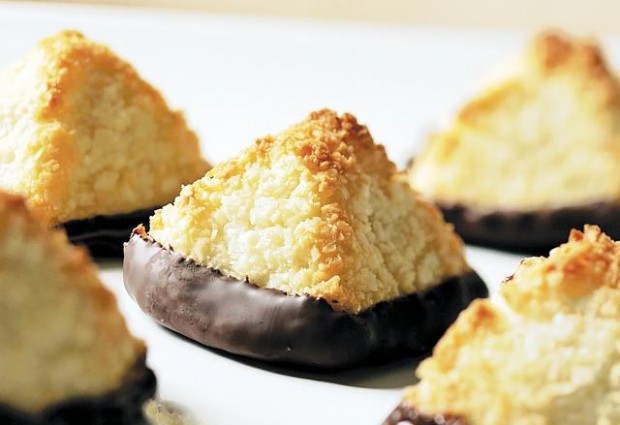
Chocolate-Dipped Coconut Macaroons
Yield: 18 (2-inch) cookies
* 9 large egg whites
* 1 cup sugar
* 4 cups unsweetened dried flaked coconut
* 9 ounces semisweet chocolate, finely chopped
* 1 tablespoon canola oil
Preheat oven to 350 degrees and line 2 baking sheets with parchment paper.
In food processor, whirl together egg whites, sugar and coconut until the flakes are shredded and the mixture holds together well, about 2 minutes. You want the batter to attain the texture of thick mud. If it is too thin, add another tablespoon or two of coconut.
Using a 1 1/2-inch scoop or 2 tablespoons, scoop up balls of batter and place on cookie sheets about 1 inch apart. Moistening your fingertips with cold water, pinch the balls into the shape of pyramids.
Bake macaroons 26 to 28 minutes or until light golden brown with darker brown edges. Cool on baking sheet 10 minutes, then move them to a wire rack and let cool completely.
Meanwhile, place the chopped chocolate and oil in a heat-proof bowl over a saucepan of simmering water or in a double boiler, making sure the bottom of the bowl or boiler does not touch water. Stir until chocolate melts and is smooth. Remove from heat, transfer chocolate mixture to a small bowl, and let cool about 10 minutes to thicken slightly.
Dip bottom of each macaroon in chocolate and lift, allowing excess to drip back into bowl. Place cookies on their sides on a wire rack to cool thoroughly and allow the chocolate to get firm, an hour or more.
Store in an airtight container in the refrigerator 3 to 5 days.
– "Simply Sensational Desserts" by François Payard (Broadway, 1999).