

Tell me you're not going to dump all those pumpkins gracing your house for Halloween. What a loss that would be.
Pumpkins are not just for jack-o-lanterns. Nor are they mere autumn décor gracing your front doorstep or dining room table.
Pumpkins are for eating but not simply in desserts or breads. Among other things, pumpkins add great flavor to stews and make a tasty soup.
Roast and salt the seeds, and it's move over, sunflower seeds — you've got competition in the snack department.
But, alas — there are some areas where pumpkins have proved to be a disappointment over the ages: They will not, as once thought, remove freckles or cure snake bites.
We offer a few pumpkin facts, some tips for cooking pumpkins, and a couple recipes from local residents.
People are also reading…
Laurel Loew, who owns Agua Linda Farm in Amado with her husband, Stewart, makes a White Bean and Sausage Stew — baked in small sugar pumpkins.
And native Tucsonan Amy Valdenegro, who grew up in Tumacácori, where her father, Tierso Ayon Trujillo had homesteaded property, is known for her Empanadas de Calabaza.
The stew makes a perfect evening meal as the weather gets cooler, and the empanadas? They're perfect anytime.
Wondering how to cook a pumpkin?
If you've ever cooked fresh butternut, Hubbard or other squashes, you can follow the same process, advises The Pumpkin Nook, an online site.
Here are some pumpkin-cooking tips:
• Select a ripe and firm medium pumpkin. Larger ones may be used, but they begin to take on a grainy texture the larger they get.
• Cut open the pumpkin and remove seeds and fibrous strings. (Pumpkin Nook calls them "pumpkin brains.")
• Cut the pumpkin into four to eight pieces, then line a large baking pan with aluminum foil to minimize cleanup and put the pieces onto the baking pan.
• Bake in a 375-degree oven for 1-11/2 hours or until pulp is soft.
• Remove the pulp from the rind with a spoon, discarding the rind. Use a blender, food processor or mixer to blend the pulp until smooth.
• For really thick purée, after blending, put the pulp into a cheesecloth and squeeze out excess water.
For the best taste and flavor, use fresh purée whenever possible. Leftover purée can be frozen for a short period of time, but canning the purée is not recommended by the USDA.
WHERE THEY CAME FROM
Pumpkin seeds, dating to about 7000 B.C., have been found in Mexico, leading experts to believe that pumpkins probably originated in North America.
But the name actually comes from the Greeks — pepõn, meaning "large melon." The French translated that to "pompon," and the English dubbed that funny squash a "pumpion."
Early pumpkins didn't look like the orange things we associate with jack-o-lanterns, however.
They were crook necks, possibly green or even bright red.
And when those Pilgrims sat down to that first Thanksgiving dinner, it wasn't pumpkin pie that was served for dessert.
It likely was a custardlike dish that gave rise to our pumpkin pie.
Those early Americans cut the top off the pumpkin and scooped out the seeds and fibers. Then they filled it with milk, spices and honey, put the top back on and buried the whole thing in the ashes of a cooking fire.
When it was done, they scooped out the flesh, and voilà! pumpkin custard.
Did you know
• The Pilgrims relied on pumpkins to stave off starvation. The Web site All About Pumpkins quotes a 1633 poem that underscores their lives:
"For pottage and puddings and custards and pies
"Our pumpkins and parsnips are common supplies,
"We have pumpkins at morning and pumpkins at noon,
"It it were not for pumpkins we should be undoon."
• Early Scots and Irish hollowed out root vegetables — turnips and potatoes — and carved jack-o-lantern faces. Lumps of coal were used to light them.
Pumpkins and squash are all members of the same cucurbita family.
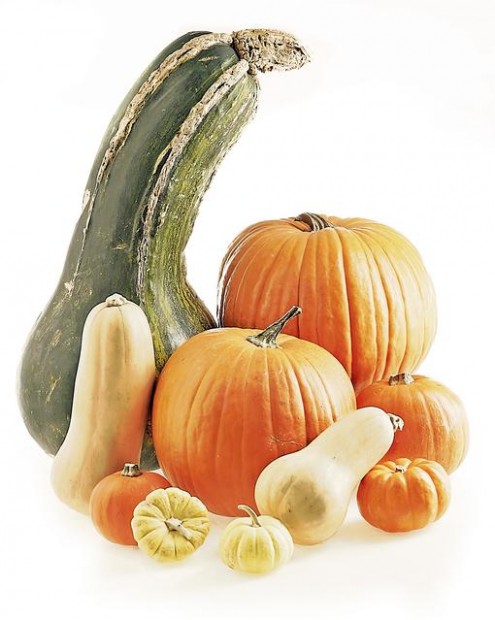
Pictured above: The big green Mexican calabaza, two jack-o-lantern pumpkins (used generally for carving), a smaller Trickster pumpkin (a little sweeter than the jack-o-lantern type; great for pies), the white Baby Boos (mostly used for decorating), two Munchkin mini-pumpkins that kids love and two butternut squash that can be cooked as a savory vegetable or with brown sugar in a pie or other dessert.
Includes information from Bill Wall, director of produce merchandising for Fry's Food and Drug, corporate office.
RECIPES
White Bean and Sausage Stew in Sugar Pumpkins
Yield: 12 servings.
* 2 cups dried navy beans
* 12 small (2 pound) sugar pumpkins
* 1/2 cup olive oil
* Salt and pepper
* 2 dried bay leaves
* 2 sprigs fresh thyme
* 1 teaspoon whole black peppercorns
* 5 cups chicken stock
* 1 large onion, chopped
* 3 tablespoons unsalted butter
* 2 large leeks, trimmed and sliced lengthwise
* 4 medium carrots, chopped into 1/4-inch rounds
* 1 celery stalk, diced
* 36 white or red pearl onions
* 12 small new potatoes, halved
* 1 pound turkey sausage, cut into 1/4-inch pieces
* 1 cup baby peas frozen
* 8 ounces mushrooms, quartered
* 1/4 cup all-purpose flour
* 1 1/4 cups milk
* 2 tablespoons fresh sage, chopped
Soak beans overnight.
Preheat oven to 350 degrees.
Cut the top off each pumpkin; remove seeds and pulp. (Save seeds for roasting, the tops for the stew.)
Rub the insides of the pumpkins with olive oil and sprinkle with salt and pepper. Then place the pumpkins right side up on a cookie sheet lined with foil or parchment and bake for 30 minutes.
Turn the pumpkins over and bake until slightly tender, but still firm.
Place bay leaves, thyme and peppercorns in a cheesecloth square and tie with twine. Drain the beans and put them into a medium pot. Add chicken stock, herb bundle and onion.
Cover, bring to a boil. Then reduce to a simmer and cook until beans are tender, about 30 minutes. Drain, reserving liquid.
In a large pot, melt butter. Add leeks, carrots, celery, pearl onions and potatoes. Cook until soft. Add sausage and brown for 5 minutes. Stir in peas and mushrooms and sprinkle with flour and cook for 2 minutes.
Reduce heat; add milk and reserved liquid and stir until thickened — about 20 minutes.
Stir in beans and sage. Divide stew among pumpkins and return them to the oven. Bake until pumpkins are soft and stew is heated through, about 15 minutes.
Replace the pumpkin tops and serve.
Laurel Loew of Agua Linda Farm, Amado. Adapted from a Martha Stewart recipe.
Empanadas de Calabaza
Yield: About 3 dozen.
Stuffing
* 5 1/2 cups pumpkin purée, or 1 29-ounce can and 1 15-ounce can pumpkin)
* 2 1/4 cup brown sugar
* 3 teaspoons ground cinnamon
* 1 1/2 teaspoons salt
* 1 1/2 teaspoons ground ginger
* 3/4 teaspoon ground cloves
* 3/4 cup (1 1/2 sticks) butter
* 3 tablespoons dark rum
Put all but last two ingredients in a 3-quart pot, stir and let simmer slowly for about 35 minutes or until the mixture is smooth and the spices are well blended.
Remove from heat and add the butter to the hot mixture. Stir to blend and add rum.
Cool in the refrigerator and make the empanada pastry.
Pastry
* 6 cups all-purpose flour
* 1 teaspoon salt
* 1/2 cup granulated sugar
* 2 cups butter-flavored Crisco, chilled
* 3/4 cup (about) ice water
* 2 tablespoons vanilla
* 1 egg, beaten
Mix flour, salt and sugar together until well blended.
Cut in the chilled Crisco, working it into the flour until the mixture resembles little peas. Use your hands or a food processor.
Combine the vanilla and water.
Make a well in the center of the flour/Crisco mixture and add the water and vanilla a little at a time, working it into the dry ingredients by meshing your fingers together until the dough holds together.
Do not knead the dough.
Divide into three parts and put them in a plastic bag. Refrigerate 30 minutes to an hour.
To make empanadas, work with one ball of dough at a time.
Break or cut each ball into small balls, each enough for one empanada. (Each ball yields 10-11 small ones.)
Roll each little piece of dough into a circle about 4-4 1/2 inches in diameter.
Place a heaping tablespoon of the chilled pumpkin mixture on half of the circle and moisten the circle's edges with water. Then fold the dough in half, sealing the edges with the tines of a fork.
Place the empanadas on a baking sheet lined with parchment paper and brush surfaces with beaten egg. Lightly sprinkle the empanadas with sugar and pierce each with a fork to allow steam to escape.
Bake at 400 degrees for about 15-20 minutes, or until each is golden brown.
Recipe from Amy Valdenegro
Nutrition facts
• Pumpkins are low in calories and sodium; high in fiber and beta-carotene, which converts to vitamin A. The seeds are high in protein, iron and B vitamins.
• One cup of cooked pumpkin flesh contains:
Calories 49
Protein 2 grams
Carbohydrate 12 grams
Dietary fiber 3 grams
Calcium 37 mg
Iron 1.4 mg
Magnesium 22 mg
Potassium 564 mg
Zinc 1 mg
Selenium .50 mg
Vitamin C 12 mg
Niacin 1 mg
Folate 21 mcg
Vitamin A 2650 IU
Vitamin E 3 mg