

Interior designer Marcia Wolff wanted a house that's energy-efficient, ecologically sensitive, fire-resistant and, above all, beautiful.
So she chose a building material that might surprise some people: straw.
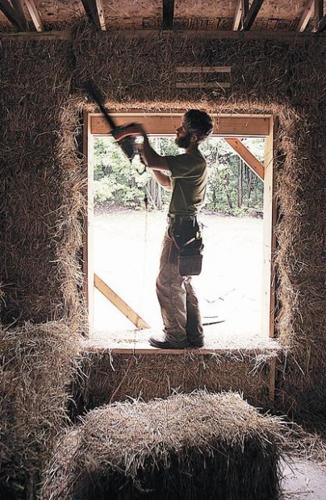
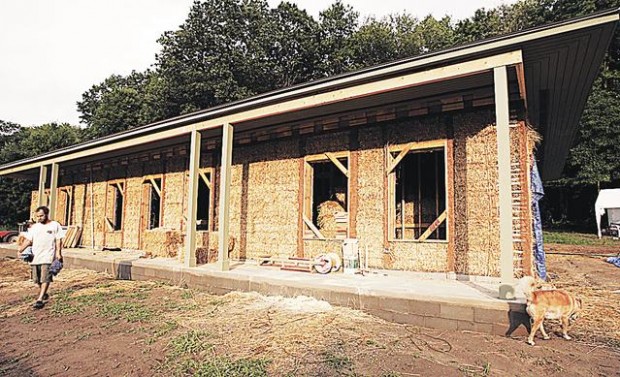
Wolff and her husband, Steve Tarr, are building a 2,600-square-foot house in South Akron, Ohio, using bales of wheat straw for insulation. The house's frame is similar to that used in conventional construction, but the walls were designed to accommodate stacks of bales that will be covered with plaster made from local clay.
The resulting house will resemble a stuccoed home, with high ceilings, thick exterior walls, deeply recessed windows and interior plaster finishes that lend an old-world feel — rich details that will be accompanied by a miserly heating bill.
"I want it to look very conventional. People who think about straw-bale houses think they're very hippie or very unconventional," said Wolff, who runs an interior design business, Design Council. But she values aesthetics as well as function, she said, and she wanted to build a home that might encourage others — particularly her well-heeled clients — to follow suit.
People are also reading…
Straw-bale construction is an old building practice that's getting renewed attention for its environmental benefits. It was developed about a century ago in the Nebraska Sandhills, where the soil was too sandy to build the sod houses that were common on the Great Plains, said Mark Hoberecht, a NASA engineer and natural-building consultant who is working with Wolff on her house.
Figures on the insulating value of straw bales vary, but the U.S. Department of Energy's Office of Energy Efficiency and Renewable Energy puts it at R-50 — about three times that of a wall system using fiberglass batting. "So that translates into about one-third the heating and cooling costs," Hoberecht said.
Straw has the added environmental draw of being a renewable resource and a byproduct of food production that might otherwise go to waste. Straw is the dead stems of cereal grains, and while Hoberecht said there's plenty of demand for it in Ohio as animal bedding and mulch for newly seeded lawns, in some areas it's burned.
What's more, straw has what he calls low embodied energy — in other words, little energy is needed to harvest or process it. And since it's produced locally, the energy needed to ship it is minimal, too.
Wolff was drawn to the idea of straw construction by both its practical considerations and its use of nontoxic materials. She learned about it through her involvement in the Cleveland Green Building Coalition, which she joined out of a desire to learn more about alternatives to the common building materials that she believes are contributing to high cancer rates and harming the environment.
Pure straw bale construction involves stacking bales to create load-bearing walls. Although the construction method is labor-intensive, it's an easy one for do-it-yourselfers to master.
That method is impractical in Ohio, however, where the climate makes it difficult to keep the bales dry during construction, Hoberecht said. So in Wolff's one-story house, the load of the roof is supported by the wood structure — a construction system Wolff calls a post and frame hybrid — and the straw is used only for insulating purposes. That way, the roof could go up first and protect the bales from the elements.
It's also easier to sell building inspectors on a hybrid system, Hoberecht noted. Having a supporting structure eases their fears that, in a worst-case scenario, the straw might rot and the house would collapse, he said.
In reality, the bales are protected against rotting by the use of earth plaster to cover them. The plaster has a lower moisture content than the straw, Hoberecht explained, so it draws moisture out of the bales. Excess moisture evaporates into the air.
That's why any exterior cladding or interior finish used on a straw-bale house needs to breathe. Wolff said it's possible to cover the exterior plaster with wood siding or most other exterior materials, as long as the covering is gas-permeable. The walls can't be painted with typical paints, so she intends to color the finish plaster used in her house.
Wolff and a group of craftspeople have been building the house since June.
The straw makes wiring the house a bit more complicated, Wolff said. All the switches will be on interior walls, and receptacles on the outside walls will be attached to structural members that protrude into the room from the window frames — a design that will allow window seats to be constructed easily. "It was a happy accident, actually," she said.
Those sorts of considerations make straw bale construction "a fussier process," but the problem-solving also spurs creativity, she said. She's pleased with the cooperation she's gotten from Akron building inspectors, who are learning just as she is.
Another question that's commonly raised about straw-bale construction is whether the straw will burn easily, but Wolff and Hoberecht say it has a better fire rating than conventional 2-by-4 construction. While care has to be taken with loose straw in the construction process, the tightly packed, plaster-covered bales are unlikely to burn. "It's like trying to burn a phone book," Hoberecht said.
Although straw-bale construction uses a cheap material, it isn't an inexpensive process. Wolff figures the labor required to build and finish the exterior walls will add about 15 percent to the cost of her house over conventional construction, but she's counting on more than recouping that expense in energy savings. She expects her heating bills to be about $50 a month in winter and said the straw's insulating properties will eliminate the need for air conditioning.
Neither is straw-bale construction a fast way to build. Wolff expects the rough plastering, applied by hand, to take two months and the finish plastering to take a year or more, but she intends to use a variety of elegant finishes.
Wolff believes the house will be worth the effort, though.
» STRAW-BALE INFO
Find Sustainable Sources' green building sourcebook, www.greenbuilder.com/source book. Straw-bale construction is one of a number of topics covered.