

Question: I have two Plumerias that I received as cuttings from a friend last year. They have grown very well in my house. The first months I had them they bloomed beautiful yellow flowers. Now all I have is thousands of fungus gnats and no blooms this year. The gnats are driving me crazy. I have had people tell me to water from the bottom. Others have told me to water from the top. I also put out the bright yellow sticky tape to catch them. They still fly everywhere in my house. I vacuum up dead ones all over the place. How can I get rid of them?
Answer: The trick to managing fungus gnats is to reduce watering so that the fungus in the soil they are feeding on is unable to survive. This means you have to let the soil dry between watering, especially the top inch or two. Repotting can also help. There are some products you can use to kill the larvae in the soil. One organic product is called Gnatrol and contains bacillus thuringiensis israelensis (Bti). Another organic treatment is insect parasitic nematodes of the species Steinernema feltiae. Other fungus gnat products contain pyrethroids such as bifenthrin, cyfluthrin, permethrin, and lambda-cyhalothrin. These products will last up to three days and that makes them effective.
People are also reading…
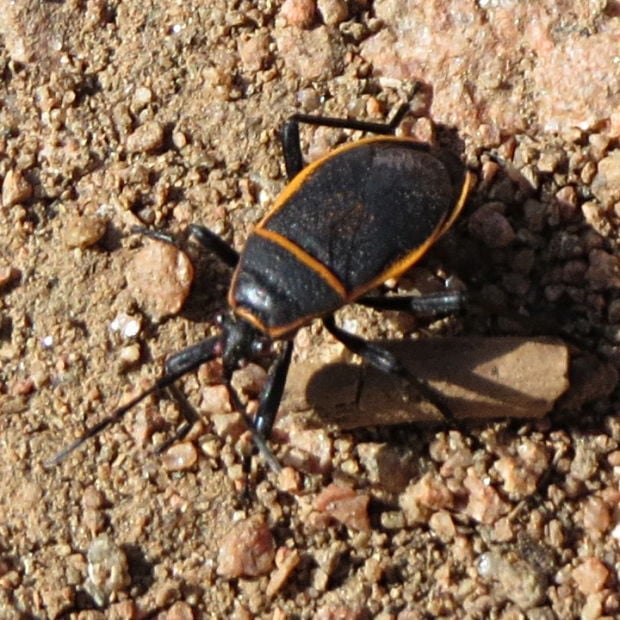
Q: I found these insects all over my acacia tree. What are they, and should I do something about them?
A: These are bordered plant bugs (Largus species). The adults are brownish with a yellow border on the edges, hence the common name. The nymphs are shiny blackish blue with a red spot in the center of the back. They are plant feeders but they do not do significant damage, especially on mature trees. You don’t need to do anything about them.
Q: We recently moved to Arizona from another state. I would like to plant some fruit trees and would like to know the chill hours for my area. We live in Show Low, and the USDA hardiness zone for Show Low is 6b. However, we are actually in the White Mountain Lake area ZIP code 85912, which has a zone of 7a. I would greatly appreciate any information that you can provide.
The topic of chilling hours for trees is fuzzy in that there are a variety of opinions of how they should be calculated. Most believe it is the accumulation of hours between 32 and 45 degrees. Elevation is the main factor but you also have to consider microclimates at your location. For elevations between 4,000 and 6,000 feet like you have in the Show Low area, look for varieties, like golden delicious apples and Bartlett pears, with chilling requirements between 750 and 1,000 hours a year. For additional information, check your local Cooperative Extension office or local nurseries that sell fruit trees.
Peter L. Warren is the Urban Horticulture Agent for the University of Arizona Pima County Cooperative Extension. Questions can be emailed to plwarren@cals.arizona.edu