

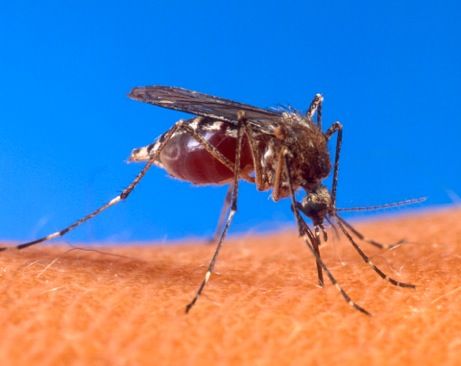
Q: It seems as if mosquitoes are everywhere since the recent rains. What are the suggestions of experts for those of us who don’t want to douse ourselves in DEET and other smelly, greasy, nasty chemicals? The specter of the West Nile Virus just adds to my concerns. (Yes, I’ve emptied the pot saucers and looked for other standing water in my yard. It doesn’t seem to help.)
Answer: Mosquitoes are one of the most important insect pests that affect the health and wellbeing of humans and domestic animals worldwide. They can cause a variety of health problems due to their ability to transfer (vector) viruses and other disease-causing pathogens even in the arid Southwest. Female mosquitoes require a blood meal for egg production, and they can produce a painful bite as they feed. While feeding they can transmit to humans and other animals brain inflammation (encephalitis), dengue fever, yellow fever, malaria and filariasis. The most susceptible to the effects of these mosquito-borne pathogens are children and the elderly. However, life-threatening illness and/or permanent debilitation can occur in infected human hosts of any age.
People are also reading…
Mosquito management has several options and the most successful strategy is to use an integrated approach. The first tactic you already mentioned is habit destruction. The immature mosquitoes live in water, and reducing the amount of standing water in your community will reduce their population. Stagnant water left from monsoon rains and irrigation water can increase mosquito activity and produce hundreds of thousands of mosquitoes if larvae are allowed to live as little as three days. Stagnant water in neglected swimming pools is the ideal habitat, though mosquitoes cannot live in a well-maintained swimming pool. In addition to the obvious containers, you might also look for clogged rain gutters, leaky irrigation parts in gardens, and drainage problems in your landscape. If you have a pond or birdbath that is stagnant, you can use mosquito dunks that will kill larva and not harm other organisms like birds and fish.
The second tactic is protecting yourself when outdoors.
- Wear light-colored clothing with loose-fitting long sleeves, long pants and socks. Use protective clothing when exposure to mosquitoes cannot be avoided.
- If possible, avoid outdoor activity before dawn and after dusk when mosquitoes are most active.
- Properly apply insect repellent even if you are outside for just a short period of time, and share your insect repellent with those around you. For additional help selecting which repellent is right for you, go to the EPA search page: cfpub.epa.gov/oppref/insect/
#searchform - Use a DEET product or a good non-DEET alternative (organic all natural or plant-based insect repellent), and, if you are outside for more than a few hours, reapply repellent frequently. The higher the temperature, the more frequently you must reapply repellent for it to be effective.
- Apply repellents only to exposed skin and/or clothing (as directed on the product label). Do not use under clothing.
- Never use repellents over cuts, wounds, or irritated skin.
- Do not apply to eyes and mouth, and apply sparingly around ears. When using sprays, do not spray directly onto face; spray on hands first and then apply to face.
- Do not allow children to handle the products, and do not apply to children’s hands. When using on children, apply to your own hands and then put it on the child.
- Do not spray in enclosed areas. Avoid breathing a repellent spray, and do not use it near food.
- After returning indoors, wash treated skin with soap and water or bathe. If you suspect that you or your child is reacting to an insect repellent, discontinue use, wash treated skin. Call your local poison control center if symptoms persist.
- Using repellent and sunscreen products at the same time is acceptable practice. However, the use of combination products that contain both an insect repellent and a sunscreen is not recommended.
- Type of repellents: According to the Centers for Disease Control and Prevention (CDC) the three most common active ingredients in repellents are DEET, picaridin, and oil of lemon eucalyptus. The CDC considers DEET and picaridin to be the most effective. Between the two active ingredients, picaridin products are less problematic when used repeatedly over extended periods of time. For more information on repellent active ingredients, see
The third tactic is applying pesticides to the mosquito habitat. We divide this into insecticides that affect the adults and those that affect the larvae. Adulticides such as synthetic pyrethroids can be applied to vegetation, tree trunks, walls of buildings and catch basins. Larvicides can be applied to places that cannot be drained or overturned in a timely fashion, such as ponds and problem drainage areas in landscapes. Larvicides include Bacillus thuringiensis israelensis, Bacillus spaericus, spinosad, methoprene, and temephos. Alternatives include surface films for late-stage larvae in water and gambusia fish that eat larval mosquitoes in ponds.
With the use of any pesticides, it is important to read the label and follow the instructions to ensure the safety of the user as well as any non-target organisms that may come in contact with pesticides accidentally.
For more information please see the University of Arizona Cooperative Extension publication AZ1221 on mosquitoes.
Peter Warren is the urban horticulture agent for the Pima County Cooperative Extension at the University of Arizona. Questions can be sent to plwarren@cals.arizona.edu