

When you visit the home of Michael Bamba and Eric Cuestas-Thompson, you can't help but look out and up.
Their 1949 midtown house is all about outside living, with its backyard full of ponds and koi goldfish, artificial grass and a spa. Up on the roof, there's even more.
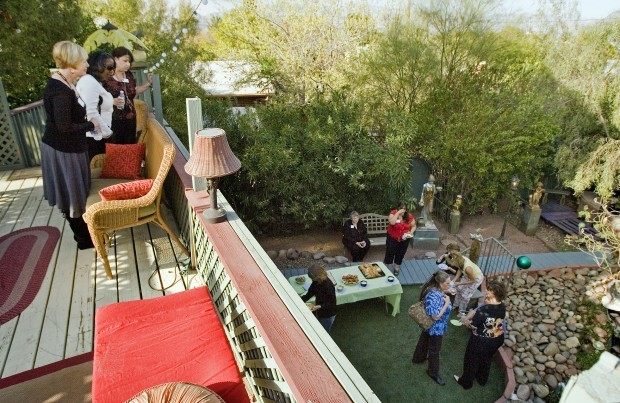
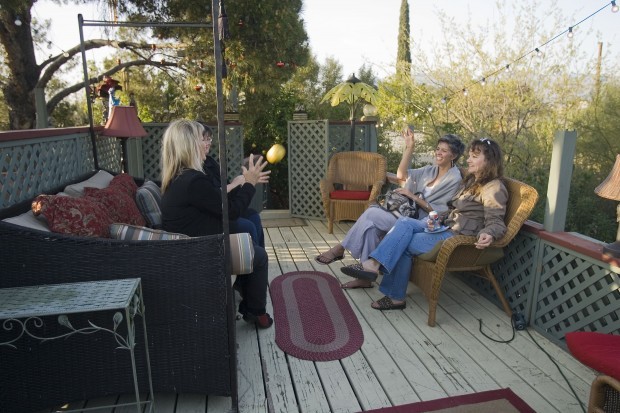
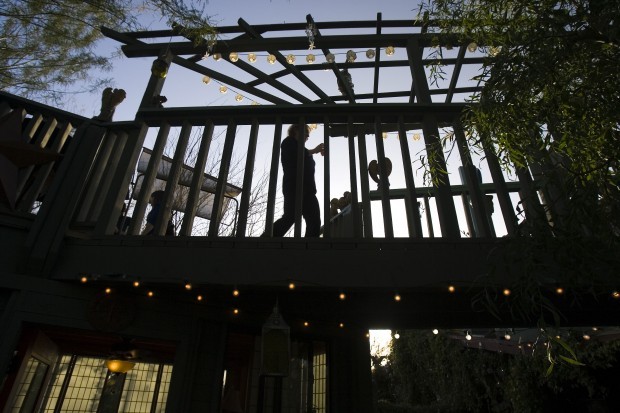
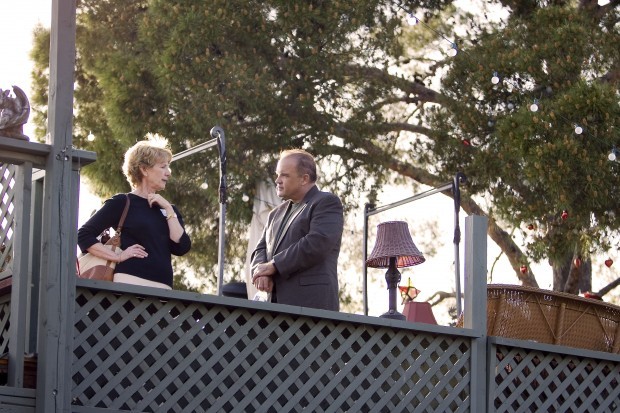
In a two-stage project begun in 2008 and finished last year, the couple has nearly doubled their living space with a roof deck that spans around 1,000 square feet. There's a living area, dining area, bar and treehouse, all made out of Douglas fir, painted and sealed against the elements. They often sleep up there (there's a daybed and also a hammock), and they always entertain up there. When the sun goes down, the string lights go on.
Handyman Jim Johnson , who did the work for them, replaced some beams on their existing patio roof to strengthen it, then attached joists from there upwards to form the deck, which is on the back side of the sloped roof.
People are also reading…
Bamba and Cuestas-Thompson have picked up cut-price bargains from the likes of Target and Home Depot: plastic wicker-look furniture, a patio set, and lots and lots of statues.
Tucson architect Bob Vint, who has designed several houses with roof terraces, says "sleeping porches," as they are known, go back centuries in the Southwest.
In 19th-century Tucson, before swamp coolers and air conditioning, people would put beds on wheels and roll them into their backyards in the summer with mosquito netting and damp sheets for evaporative cooling, he says. Later they'd build screened-in porches on their second floor for privacy.
But since today's homeowners like to surround themselves with more than just a bed and a damp sheet, rooftop living and sleeping requires some forethought. Here are some tips:
• Buy the right furniture. Light or modular pieces won't do it, says interior designer Liz Ryan, who added a large upstairs balcony with daybed to her own home. "The biggest issue is that you're sitting there on top of a building, so furniture has to be very weighty." Ryan recommends something heavy, weather-proof, and that won't get too hot in the sun. She cautions against wrought iron.
• Beware the wind. Take down any umbrellas after use, or awnings that might be blown away, says Cuestas-Thompson. "And anything like art or statues we have glued down with Liquid Nails."
• Avoid precious or valuable items. "It's more like your rummagey living room," says Cuestas-Thompson of his own space. He says you should only have belongings you'd be OK with getting broken or even stolen.
• Have some privacy. "Orient the rooftop away from the street," says Bamba, for privacy and also to avoid street noise.
• Sleep safe. If you're sleeping on the roof, make sure you're protected from the morning sun. Bamba and Cuestas-Thompson drape a blanket over their daybed. They say mosquitoes aren't an issue because they have mosquito-eating fish in their ponds below. "But there's a certain point in May when you're not sleeping (because of the heat). I say only sleep outside in the fall and the spring."
• Choose the right shade. Although you'll want to protect yourself from the sun, you also want to enjoy views and evening light. Go for shade that's more dappled rather than solid, says Ryan, like an arbor of plants or a trellis.
What it takes to add a rooftop sanctuary
• Get a qualified, preferably licensed, contractor to do the work.
• Have an engineer or architect draw up the plans - don't try it yourself. The building will have to be assessed for its strength: foundations, bearing points, and the roof itself.
• You are likely to require a permit for a roof terrace. If it's a retrofit, be prepared to spend upwards of $10,000, depending on its size and features.
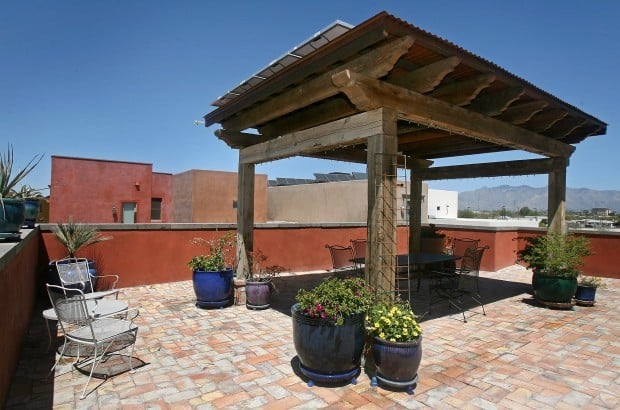
Incorporating a roof deck or terrace into a new home is easier. In the case of the Rammed Earth Development home (as shown in the photo above) the owners were able to work in 25,000 pounds of pavers, and a ramada whose posts go into the beams of the garage below.
Make sure you remember to incorporate shade on the roof and easy access, says Tom Wuelpern, president of Rammed Earth Development. The home his company constructed has access from inside of the home. Bamba and Cuestas-Thompson have a stair from the backyard up to their deck.
Meet the other rooftop inhabitants
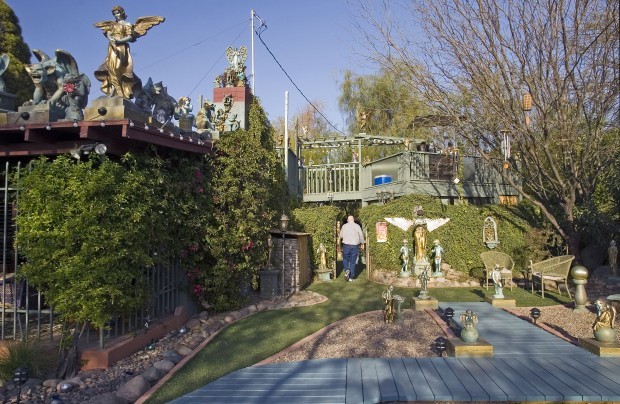
The view up from the entrance to the Bamba/Cuestas-Thompson property can be intimidating; the first thing you notice are scores of gargoyles, perched on the front pitch of the roof as if they're guarding the place.
Cuestas-Thompson is the gargoyle lover. (He says it comes from a fascination with "The Hunchback of Notre Dame," and after visits to Paris, Marseilles and Geneva.) But since opening up a home office for his psychotherapy practice, he made sure to add some angels too, so clients weren't put off visiting.
All of the pieces are picked up from post-Christmas and post-Halloween sales at Kmart, Walmart, Ross Dress for Less and T.J. Maxx, and many of them repainted gold or silver by Cuestas-Thompson.
Small mirrors are dotted among the statues. Cuestas-Thompson and Bamba are both feng shui practitioners.
Mirrors are used in feng shui to shift energy flow and pull in beneficial feng shui energy. "It's a protective element," says Cuestas-Thompson, who believes the mirrors on the rooftop have helped keep away burglars, too.
Resources:
• Bamba and Cuestas-Thompson run Those Feng Shui Guys, 245-6057 or
• Jim Johnson, 661-7417
• Rammed Earth Development, 623-2784 or www.rammedearth.com
• Liz Ryan Interior Design,
299-2123 or www.lizryandesign.com
• Vint & Associates, 882-5232 or www.vintarchitects.net