
Docents at the Tucson Botanical Gardens call barrio gardens "ordered chaos."
Landscape architect Stephen Grede calls the style a "mishmash," while homeowner Anne Hazen says her garden is "random" in the way it's growing out.
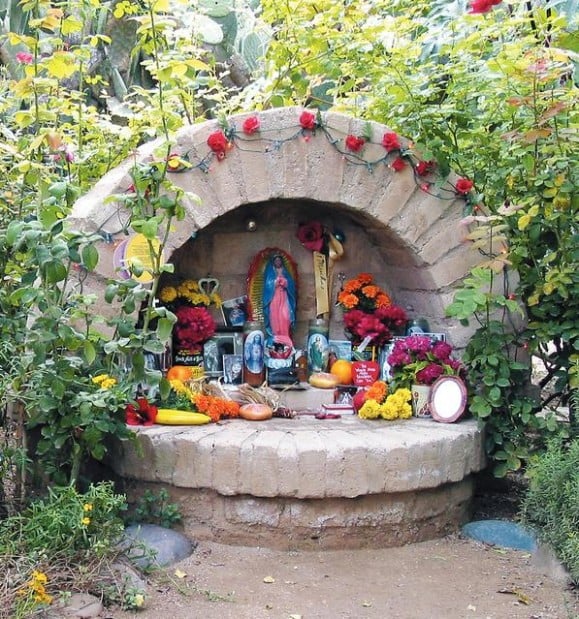
In all cases, what they're describing is a gardening style — Grede prefers to call it a "tradition" — that focuses on plants growing in found items and having usefulness or special meaning to the gardener.
Plant cuttings, gifts and serendipitous growth dominate the landscape. Human gathering spaces and religious shrines also mark the style.
"You know how people like to exchange plants and that sort of thing? It has that feel," Hazen says about the yard behind her 1903-vintage adobe row house in Barrio Viejo, south of the Tucson Convention Center.
People are also reading…
"My garden is not a formalized garden," Hazen says.
Her backyard includes some well-placed mesquite, ironwood and citrus trees, rosebushes, and pomegranate and fig trees.
She didn't plan on the "gigantic" palo verde that sprouted one year and thrived, nor the ivy that a neighbor gave her when she moved into the home 16 years ago, she says.
Hazen also has an Aleppo pine that was a Christmas tree that she then planted, Texas mountain laurels that popped up from seed, a tree that started in a pot, and wildflowers that take care of themselves.
While creating the garden, Hazen discovered all sorts of discards in the undeveloped yard, including parts of a car, and soda and milk bottles. She's kept them in the yard to provide a different visual element to the landscape.
Hazen's garden, which Grede designed, emphasizes function, the hallmark of barrio gardens.
"A barrio garden traditionally comes out of Hispanic traditions," Grede explains. It reflects old knowledge of medicinal plants, the food that Mexican-Americans prepare, their religious practices and a penchant for frequent family gatherings outdoors."
Grede bristles at a modern interpretation of the barrio garden that includes tile, brightly painted walls, a water feature and a courtyard. He calls this style Spanish colonial and says, "It's far more designed and intentional. There's more spontaneity to barrio gardens."
» Make your own
Barrio gardens fit with any style of home, landscape architect Stephen Grede says. The landscape has these elements:
• Plants in unconventional, recycled containers such as coffee cans or buckets.
• Colorful flowers.
• Edible and medicinal plants, including citrus, figs, herbs and vegetables.
• Spontaneous growth of plants that find their way into the landscape.
• Offerings from friends and neighbors.
• A gathering place tucked within the vegetation.
• A small religious shrine with a statue and space for cut flowers, candles and other offerings.