

Q: My wife left many collector plates in their original boxes. How do I sell them? One is DeGrazia's "Los Niños."
— Harold, Boynton Beach, Fla.
A: Please accept my sincere condolences.
This column has often covered the fact that the collectibles market tanked long before the current recession. Simply, it was an artificial, speculative market and the bubble burst.
In 1960, "Los Niños," a painting by Tucson artist Ettore "Ted" DeGrazia, was the UNICEF Christmas card, showing children in a ring-around-the-rosy dance. In 1976, Gorham issued a limited-edition collector plate based on DeGrazia's painting. Four years later, a miniature-plate series launched. Recently, Goebel released a figurine of "Los Niños."
When collector plates were hot, "Los Niños" was a popular and pricey plate. The popularity of the late artist endures for his renditions of children, but plates are a hard sell. We found two unsold on eBay at $500 and $990. A version described as hand-signed sold for $350.
People are also reading…
The DeGrazia Foundation (www.degrazia.org) may be able to help you on how to sell.
Q: In 1973, I bought a portrait of Lucretia Mott from her grandson. I love it but want to sell it. My husband didn't like the painting in the bedroom because she looks so stern.
— Janet, Tenants Harbor, Maine
A: Massachusetts-born Lucretia Coffin Mott (1793-1880) was an early promoter of women's rights. Mott and her husband, both Quakers, were active in the Abolition movement. In a time when women were expected to know their place, she traveled to London and Scotland to speak out against slavery and for women's rights. Mott fought for female and freedmen's suffrage, was a founder of Swarthmore College, and is honored by a statue in the U.S. Capitol.
Period art shows her as an austere figure. I can see why your husband objected to her portrait in the bedroom.
Important in many historic arenas, Mott counts in Americana, women's rights and human rights. The portrait would make an excellent donation to a museum honoring any of those causes.
But you want to sell, so I'd shop images of the portrait to auction houses that sell Americana. Shoot images of the front and back, including close-ups of any damage and signature. Also, send info such as to how you got the portrait, how long you've had it, dimensions, documentation or paperwork, condition and so forth.
Provenance is excellent. Depending on how and where sold, you may do well with that portrait. Your task is to be a smart collector and shop it well.
Q: Several family members worked in the circus in the 1800s. I have brown-and-cream-on-cardboard photos of them in costume. The photos are about 5-by-8 inches and 4-by-6 inches in size. How can I sell?
— Marie, Debary, Fla.
A: The performers will interest circus historians and collectors who look for early circus images. The fact that you can ID the individuals and vouch for authenticity is a big plus.
Size tells us they are cabinet cards, popular from about 1870 to the early 1900s.
Old photographs are collected as historical records. The more W's (who, what, where, when) you can tell a potential buyer, the better the sale can be.
I'd post the cards in an online auction where collectors worldwide can see them. First check completed eBay sales for prices. When we looked, results ranged from $6 to $31 for a freak-show cabinet card.
Q: Enclosed find photos of a clock that has been in the family for at least 100 years. The clock is 6 feet tall. At center face is 1753. Is that the year it was made? How do I find the maker and value?
— Joseph, Newport News, Va.
A: The long case floor timepiece seen in photos has a simple case in the Arts and Crafts style. At 6 feet, it is a grandfather clock. Wood used is hard to make out, but it may be painted pine or oak. The case interior has shelves.
This is a basic clock case from the early 1900s and was not premium when new. An important maker's mark inside the case could challenge that statement.
Clock works are critical, and a clockmaker needs to see them to determine their date. He can tell you what the numbering on the face means (it may be an inventory or model number) and give you a value.
If the clock has not been cleaned recently, it's time. Clock-repair people make house calls for floor models and can give you info then.
3/4 AUCTION ACTION
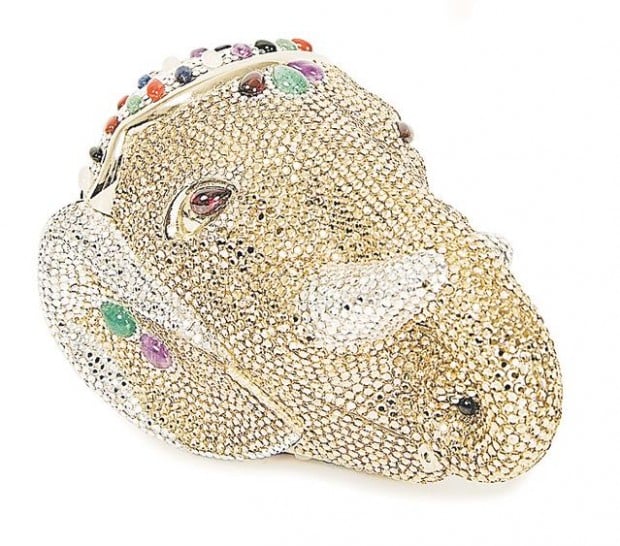
When the estate of soprano Beverly Sills sold recently at Doyle New York, everything from furniture to fur coats and operatic memorabilia became available to fans. Sills' sizable collection of Judith Lieber handbags brought good prices, led by a circa 1988 elephant deity minaudiere (small ornamental case or clutch) at $3,125.