

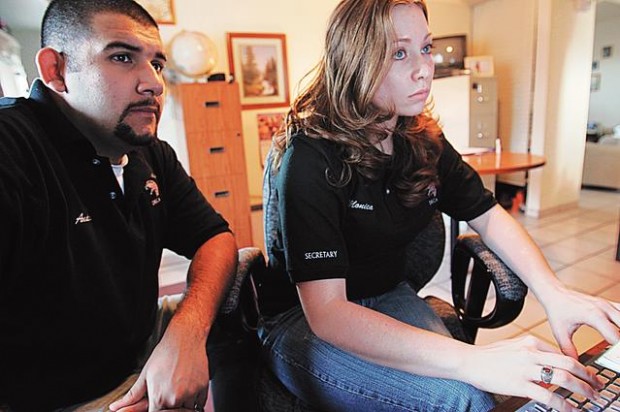


Like most high school juniors, MyAnh Diep has friends who ask her to the movies and the mall on weekends.
But the 17-year-old doesn't always go.
"All together, I spend about three hours a night studying," Diep said. "My history class gives me the most work. I spend all my time going over U.S. History."
When it comes to her life, Diep looks at the bigger picture.
"I see other people who are successful in their lives and I want to be like them," she said.
"If I don't go to school and get the skills I need, when I look for a job, I won't get the one I want. College gives you more options."
Diep is showing the determination that's increasingly important in the competition for scholarships and admission to universities, but like hundreds of thousands of upper-level high school students around the country, she still struggles with questions.
People are also reading…
Which colleges are best for me? How do I get in? How will I pay for it?
This year, she joined Project College Bound, a Sunnyside Unified School District initiative launched in 2004 that helps guide students through the ins and outs of college admissions and scholarships. Students start as juniors — a time when they need to kick their studies up a notch and start looking into what needs to be done to prepare for their future.
"We've had a really good turnout from our students," said N. J. Utter, a Desert View High School counselor and co-founder of Project College Bound. "We've seen a rise in enrollment in our more rigorous courses such as advanced placement and honors courses. We tell the kids the more you can get involved the more you can get out of it."
Sunnyside, a district where many students would be the first in their families to attend a four-year university, wants students to reach for the stars without fearing any obstacles that may stand in their way.
"We currently send about 9 percent of our graduating class to a four-year school, " Utter said. "Our initial proposal was hoping to double that. I'm still optimistic that we will get close to that goal."
At Desert View, more than 140 juniors and seniors are involved in the program. That includes 81 of the 99 students originally asked to join at the end of their sophomore year in 2004. Students must maintain at least a 3.0 grade-point average to participate.
Diep's classload demands hours of reading, studying and afterschool tutoring on weekends and evenings.
"It can get difficult," said Diep, whose dream is to work in international business. "Physics is the hardest class for me. You have so many equations to do and there is a lot of reading involved."
Despite the advanced courses, Diep maintains a 3.6 GPA that puts her in the top 10 percent of her class.
She also takes advantage of College Bound's afterschool seminars and guest speakers to learn about scholarships and filling out college applications. She has already visited the University of Arizona and Arizona State University. And she believes the program's workshops will help boost her scores in the college entrance exams she'll take in the spring, particularly in her weakest area, vocabulary.
When her family moved to Tucson from Vietnam five years ago, she had very little formal education and couldn't speak a lick of English.
"Starting school here was confusing," she said. "I didn't know how to read or write and couldn't understand anything. It took me a couple of months to really get to know it."
Senior Monica Russell has rounded into the homestretch.
Last month, she was accepted to Northern Arizona University. Last week, the letters from UA and ASU arrived. Now she must decide on which school she wants to attend before the undergraduate classes fill up.
Russell, who wants to be a teacher, will be the first in her immediate family to attend a four-year university. She also knows the struggle between short- and long-term payoffs.
"I am the captain of the spirit line, and sometimes I've had to miss practice or I've had to sit down during practice and draft ideas for an essay," the 17-year-old said. "The weekends are especially bad. Usually people just want to hang out and have fun. But sometimes I have to read 30 pages or write a five-page essay or I have a huge project to do," she said.
"I don't mind," she added, "because I know it is going to benefit my future. I can have fun later."
Russell has been part of Project College Bound since it began. For her, the hardest part wasn't getting into college, but how she was going to pay for it.
College doesn't come cheap, and the UA's tuition costs have risen more than 70 percent — to more than $4,000 per year — since Russell started high school in 2002.
"Money is definitely a big issue," she said. "I will probably end up at the school that offers me the most."
She's already applied for several scholarships, including one through the UA Alumni Association. She hopes to get a few more in by the end of the school year.
College Bound has tried to ease what can be an intimidating and time-consuming process for many students. The program has held several classes on where to look, and every few weeks Utter sends out a scholarship newsletter updating students on what's available.
"I am going to keep applying for scholarships as long as I can," Russell said.
Russell's boyfriend, senior Andrew Provencio, also was recently accepted into NAU and the UA. He wants to follow in his brother's footsteps. Oscar Provencio, a 1999 summa cum laude graduate from Sunnyside High School, is a 2004 UA business management graduate.
However, Andrew Provencio doesn't want his parents to foot the bill. With two little sisters and a cousin living in the house, money is already stretched thin.
"All the scholarship information came from Project College Bound," he said. "I knew this stuff before but wasn't really serious about it. But free money is free money."
Many influences in Provencio's life have driven him toward college. He has always had strong support from his family, particularly his parents and brother.
"They are the best," Provencio said. "My mom has always said she doesn't care what school I go to as long as I go to college. That is her goal. And my brother has always encouraged me to take harder classes, classes that would help me in the future."
More recently, however, Provencio's friends and classmates — especially Russell — have been a major motivation. And Provencio says just being in courses like the Pima Community College writing class and AP biology with others who have the same drive is a great help.
"You see yourself and tell yourself, 'Oh yeah, I am not the only one,' " said Provencio, who was a starting offensive tackle on the Desert View football team this year. "And there is more competition. You think they are going out for the same schools and scholarships you are, so you have to beat them. It is the competition that gets me started."
Senior Richardo Silva has wanted to be a heart surgeon ever since he can remember and has been taking advanced classes since elementary school.
As he nears graduation in May, the 17-year-old credits College Bound for part of the reason more of his friends are making serious runs for four-year colleges and universities.
"It has an effect on me," Silva said. "They aren't saying, 'I'm going to go ditch and do drugs and go drink this weekend.' They are saying, 'Oh, I have to stay after school and do homework.' Stuff I can relate to."
He's kept his grade-point average high throughout high school and last summer participated in a "Medical Ignorance Program" sponsored by the UA College of Medicine. The seven-week program — he learned about it through a friend's mom — let him witness a heart surgery and assist in an autopsy and strengthened his desire to enter medicine.
"I held the man's brains, his liver," Silva said. "The examiner had me transporting organs into little boxes."
Silva is already accepted at the UA and was waiting to hear back from the University of New Mexico and the University of Redlands, a highly ranked private liberal arts and sciences university in Southern California.
Despite a packed schedule — football, afterschool clubs and a job with TeleTech — he still puts a lot of effort into school.
"It would be a bad habit to say, 'I'm in. I don't have to do anything anymore,' " Silva said. "Colleges and scholarships still look at your last semester, and it wouldn't look good if I slacked off."
● Junior year
l Get serious about preparing for college entrance exams.
l Start sleuthing colleges. Make lists of what you like, what you're good at and things you may want to study and do in college.
l Think about college costs and financial aid.
l Talk to your high school counselor about your college plans and attend your school's college night.
● Why senior year matters
l Many college applications want to know your senior courses, including info about course levels and credit hours. It will be very obvious if you've decided to "take the year off."
l Even after you are accepted, many colleges reserve the right to deny you admission should your grades drop as a senior.
l Take the most rigorous courses available. Consider AP courses, which can also earn you credit at many colleges.
l Try a college course. The challenge can help you avoid sliding into an academic slump and get you interested in the possibilities of college.
● Based on information from www.collegeboard.org online.