

Editor’s note: This is the next in our series exploring our communities and neighborhoods – the homes, the vibes, the people. Look for the Where We Live series in the Home + Life section of the Arizona Daily Star.
Forty miles south of Tucson, Tubac was once home to Hohokam and Pimas, Spanish settlers and explorers, becoming what is said to be the oldest and best preserved Spanish colonial presidio site in Arizona.
Today, this valley just off Interstate 19 serves as an enclave of artists and creative folks, drawn to its serenity and high desert beauty.
As a playwright, author and actress, Polly Schlitz has lived in New York, Los Angeles and Nashville, but never felt home until she found Tubac.
“I realize I am finally where I can put down roots and I’m happy,” Schlitz said looking out at the Santa Rita Mountains from her living room window. “I have had an amazing life, but I can’t say I was ever happy. When I came here, I took a breath and I thought, this is what happy is.”
People are also reading…
One of a little more than 1,000 Tubac residents, Schlitz has thrown her energy into Tubac Center of the Arts, and started the Tubac Civic Theater Company.
She finds refuge in her tranquil hacienda home, surrounded by the art of her father, the late American artist Walter Blakelock Wilson, who spent the last part of his life in Tubac. She is the great-great-granddaughter of American painter Ralph Albert Blakelock.
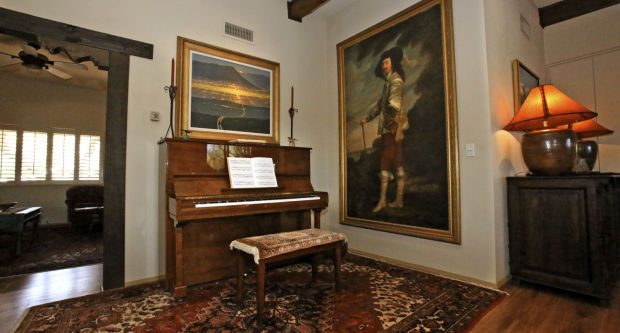
Schlitz is surrounded by paintings, sculpture, Oriental rugs and striking furnishings. An 1800s, life-size portrait of King Charles I that came with the house stands watch as she plays Mozart on the piano.
Her family discovered Tubac 27 years ago, when her mom and dad, who was a pilot, flew overhead. They became residents shortly after. Schlitz made the move seven years ago.
“For me it’s about the quality of life,” Schlitz said. “You are suddenly not in the city, not in the rat race. It’s a great place to write and there is an arts support system. I have everything I want right here. If you get antsy, you can drive to Tucson or Phoenix or L.A.”
Two casitas serve as a respite for visiting artists, family and friends. Her rescues – Maltese Hank and schnauzer-lab mix Joe have the run of the gardens.
She writes in her kitchen, with great natural light and beautiful views.
“At any given moment, I walk into nature and have my breath taken away,” Schlitz said.
She loves the privacy, but cherishes close relationships she has formed with neighbors and friends.
“You have neighbors who will be right there if you need them but no one bugs you about who they used to be or what they have done,” she said.
Down the street, Lee Ann Lucas and Murray Damitio found their patch of heaven, and it came with a golf course nearby.
For these longtime Alaskans, the weather and the stunning views sold them.
In 2013, they purchased a red brick home built in the early 1980s, a home with great bones in need of updating, not far from the lovely Tubac Golf Resort on what was the old Otero Ranch property.
Lucas, a decorative finisher, and Damitio, who owned restaurants in Alaska and Palm Springs, have done all of the work themselves, from adding 800 trees, plants and shrubs to pouring or updating more than 2,000 square feet of concrete patios around the house.
They brought a bit of Alaska to the desert, with totem poles on the back patio overlooking a pool, gardens and the Santa Ritas. The home is filled with artwork, pottery and metal work, much of it from local artists
“We loved the home because it was so well built and it has a casual, comfortable feel,” Damitio said.
They have made many connections in Tubac – her with book club, wine club and the Tubac Center of the Arts, and he with civic groups and on the golf course down the street.
“People are here because they want to be here, not because they have to be here for a job,” Lucas said.
Their home serves as a gathering spot for friends stopping by for a glass of wine and conversation. They also enjoy the restaurants and shops in the charming Tubac village down the road.
“It’s a wonderful place to live,” Damitio said.
Sharon Pierce and Ron Kurpius live in a newer subdivision of 57 homes called Barrio de Tubac.
Pierce, who served as president of the Delicious Cookie Company in Chicago, came to Tubac to visit an aunt and uncle whenever she could. When she became a consultant, she and Kurpius moved to Tubac in 2006. She is now retired.
“Tubac had a certain charm, a rural charm, and it was an artistic center, which was very important to me. When I thought about what I was eventually looking for in retirement, Tubac had it all,” Pierce said.
The couple shares their home with rescue standard poodle Daniel Boone and English and French antiques Pierce has collected for most of her life.
“I have all of these pieces from the 1700s and 1800s and I thought what am I going to do? I took a deep breath and I mixed them all up with southwestern accents,” Pierce said.
It was important to have a music room for Kurpius, and the second-story room looks out over their expanded patio, with a stunning view.
“I love the Southwest, and performing arts are my passion,” Pierce said. “And this is an arts community. We have found the people of Tubac to be so extraordinary. They are so welcoming.”
They appreciate the nature, sharing the land with raccoons, javelina, jack rabbits and more.
“I love the rural nature of Tubac,” said Kurpius, who grew up on an Illinois farm.
The two volunteer in the community, at the Tubac Center of the Arts and Tubac Presidio State Historic Park, Arizona’s first state park and oldest European community, established in 1752 as Presidio San Ignacio de Tubac.
Several years ago, it looked as if state budget cuts would close the park. But Tubac residents negotiated with the state, providing funding and volunteers to keep it open, Pierce said.
“We always say you don’t mess with Tubac,” she said. “People here are very well informed and very involved. That’s why we love it.”