

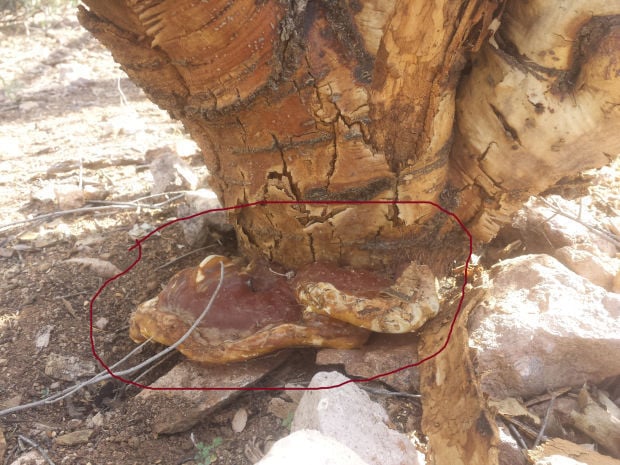
Q. There is a section of our property where we have lost three palo verde trees. The first tree died about 3 years ago — it turned all yellow, then brown and was dead. The next year, a second palo verde, which was about 10 feet from the first tree, died the same way. Last spring we lost a third palo verde the same way — this one was about 15 feet away from the second tree. I noticed that the remaining stump of the third palo verde tree had some kind of growth around the stump that I had never noticed before. Is this perhaps what is killing our trees? What is it? If not, then do you have any idea what is killing our trees? What do I do to prevent additional deaths?
A: The growth is a sign of Ganoderma root rot. It is associated with dead or dying trees. Those fungi are great at breaking down dying and dead trees. This fungus is a sure sign your tree is in trouble but since this is only a stump the trouble is not now. Because your trees were close together it is possible it was transmitted from roots to roots. There is no control for Ganoderma root rot once the plant is infected. The best way to prevent infection is to prevent wounding. Cutting roots during construction or landscape maintenance should be avoided . The death of your trees could also be attributed to the drought we have been experiencing for several years. Trees often die of more than one problem so it is sometimes difficult to pin it on one problem unless you can blame it on a chainsaw.
People are also reading…
Q: Hopefully The Garden Sage can help me determine what went wrong with my 3-year-old Beavertail Cactus. It is planted on a 3-foot high berm, not irrigated. Just this week I noticed that it was leaning over, and upon investigation it has rotting stems. The rot seems to be moving upward into the pads. The soil is dry. I can’t explain this problem. What to do?
A: The rotting from the base up is most likely root rot. Although overwatering can contribute to this, there is likely a bacterial pathogen that entered the plant through a wound of some sort. If you notice any wounds caused by insects, pruning, or other abrasions, that could be the entry point. Even though the soil is dry now, the pathogen could have easily gotten started during the monsoon season when we had a good bit of rain. If it appears the whole plant is affected, you might want to cut your losses and plant something else in that spot that is less susceptible to the conditions the cactus encountered.
Q: My honey mesquite tree is entirely covered with a white substance. I have other mesquite trees that look normal. What could be wrong ?
A: The white substance is powdery mildew, a common fungus in the desert. It is found on a variety of plants including mesquite. Under a microscope you can see the tiny orange fruiting bodies associated with the white mycelium and asexual reproductive spores that gives the tree its overall whitish appearance. If you rub the leaves, the white stuff will come off and this is a good test to verify the fungus.
Unlike many pathogens, powdery mildew fungi grow and infect their hosts in the absence of free water. In fact, overhead watering can hinder or kill the spores. The good news is you can leave it alone. Powdery mildew does little damage to mesquite trees and the cold weather soon to come will take care of the fungus for you.
Peter Warren is the urban horticulture agent for the Pima County Cooperative Extension at the University of Arizona. Send questions to plwarren@cals.arizona.edu