

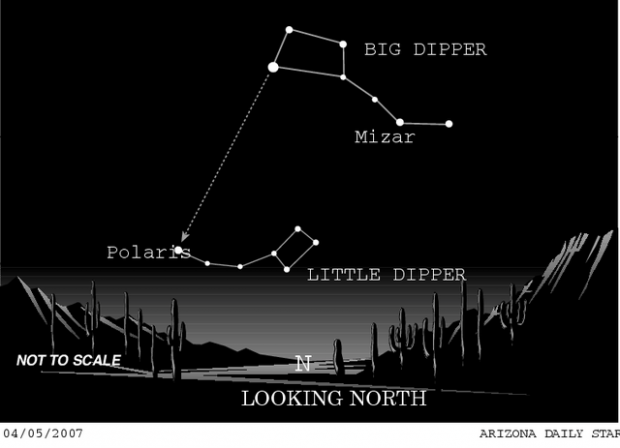
The Big Dipper is probably the most familiar constellation in the sky. It is actually part of Ursa Major, the Great Bear.
The Little Dipper is the most recognizable part of Ursa Minor, the Little Bear.
These constellations predate the written word, though they did not necessarily represent bears in the lore of other civilizations.
The Earth's complete rotation about its axis every day makes the stars appear to circle around a point in the sky, the North Celestial Pole in the Northern Hemisphere and the South Celestial Pole in the Southern Hemisphere.
The Big Dipper can be thought of as a giant watch hand going completely around the North Celestial Pole once a day.
Now is a particularly good time to look at the Big Dipper. After sunset it will be upside down, seeming to pour its contents onto the northern horizon. Look at the Big Dipper again at midnight or just before morning twilight. You will see it in a different position.
People are also reading…
The Big Dipper is so well known because its stars are bright, and it has an easily recognizable pattern. But there is more. The two end stars in the bowl of the Dipper point to Polaris, the North Star; and the handle of the Big Dipper points to Arcturus, a very bright red star in the constellation Boötes. Mizar, the second star from the end of the handle of the Big Dipper, forms a double star with a close companion, Alcor.
The stars in the Big Dipper are moving through space, just like the sun. Over thousands of years, the Dipper will gradually change its shape and disappear, but we have plenty of time to enjoy it now.
Tim Hunter has been an amateur astronomer since grade school. He is a prime example of someone whose hobby has run amok, spending more time and money on it than common sense would dictate. Contact him at skyspy@azstarnet.com.