

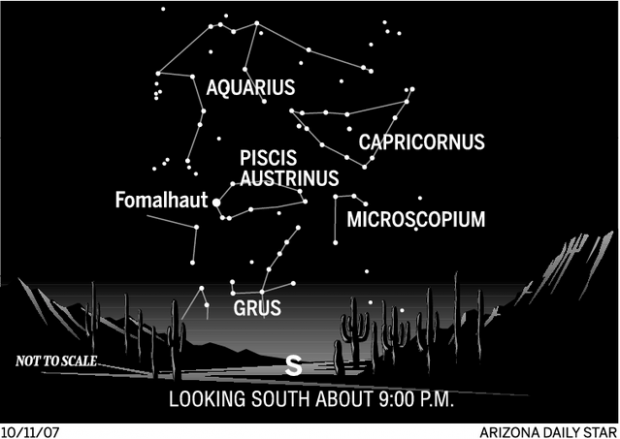
Now is a good time to take up a tough challenge in the southern sky.
For the next few days while the moon sets in the early evening, try to get a good southern horizon — preferably not overlooking the city lights.
About 9 p.m., several faint constellations will be near the meridian. The meridian is the imaginary line in the sky directly overhead that runs north and south and divides the sky into eastern and western parts. When you're looking south and a star crosses your meridian, that is as high in the sky as it will get. With a good dark sky and some imagination, you will be able to find, among other constellations, Grus, the Crane; Piscis Austrinus, the Southern Fish; Microscopium, the Microscope; Aquarius, the Water Carrier; and Capricornus, the Sea Goat.
These are challenging constellations, but Capricornus is quickly recognized with a little experience. It is an ancient constellation and is part of the zodiac.
People are also reading…
What saves the day in this challenging part of the sky is lonely Fomalhaut. I call it "lonely" because Fomalhaut is the only bright star seemingly in the middle of nowhere with no other bright stars anywhere near it.
Fomalhaut, the brightest star in the constellation Piscis Austrinus, is a favorite for amateur astronomers because it has a catchy name ("fish's mouth" in Arabic) and it stands as a lonely sentinel in the southern sky. Fomalhaut is 25 light years from us and has a luminosity 16 times greater than the sun's. It's the 18th-brightest star in the sky. Go out and say hello to Fomalhaut.