Mounir Koussa, at the age of 17, is probably too young to be called a genius.
But give him some time — and who knows?
This much is clear right now: Koussa is a budding superstar of science, a student whose amazing accomplishments are eclipsed only by his promise for future achievement.
He won a raft of national and international awards for high school research projects in the complex field of neurobiology. Now, in his freshman year at the University of Arizona, he conducts research at a campus neurobiology lab while pursuing three majors and two minors.
And the really cool thing?
Koussa apparently is anything but a science nerd or an arrogant academic. One of his former teachers describes him as a "very personable guy" who makes people "feel good about the world." A friend says he has a "heart of gold." — Doug Kreutz
People are also reading…
It comes as a relief to learn that Mounir Koussa likes to sing karaoke — hamming it up at the mike to get a yuk from his friends.
Why a relief?
Because it makes the 17-year-old Koussa seem like a regular, everyday kid — someone we can relate to, even as we realize he lives in an intellectual universe rather far from our own.
See there? Look at him — crooning along goofily to a pop-music soundtrack. He could pass for an average, even faintly frivolous young man.
He is not.
Not average. Not typical. Not frivolous. Not even close.
Koussa, in a sentence, is an emerging superstar of science — an almost impossibly precocious student whose brilliant work in neurobiology has won international awards, dazzled his instructors and primed him for a career he hopes will benefit people around the globe.
"My passion is working with a very difficult problem and pulling out the answer," says Koussa. "My overall goal is to further the field of neuroscience and ultimately help the people of the world who suffer from disorders of the brain."
Maybe you recall having a similar goal at the age of 17. Probably not.
In Koussa's case, the goal is perfectly realistic — and he's well on the way to achieving it.
Among his accomplishments so far:
● Winning a first-place Grand Award in the 2007 Intel International Science and Engineering Fair. Then a senior at Tucson High Magnet School, Koussa brought home a $3,000 prize in May for a complex research project on "Category Specific Semantic Deficits of Object Recognition in Adults with Neurological Brain Damage." The Intel competition attracted more than 1,500 students from 52 countries.
● Winning a first-place award and $3,000 prize in a U.S. Air Force science competition.
● Winning a $2,000 Top of Fair award at the Southern Arizona Regional Science and Engineering Fair.
● Winning a $500 award for third place in an American Psychological Association competition.
● Having an asteroid named for him by the Massachusetts Institute of Technology's Lincoln Laboratory, which names asteroids after outstanding students and teachers.
● Training himself to become a professional-level computer technician and installation specialist — often taking his payment in the form of cookies or other sweets.
● Enrolling this semester at the University of Arizona with three majors — biochemistry and molecular biophysics, psychology, and mathematics with an emphasis on life sciences — and two minors — Arabic and Spanish. He considered other schools but says he chose the UA because he was familiar with UA faculty members and was awarded scholarships here amounting to $6,000 a year for four years.
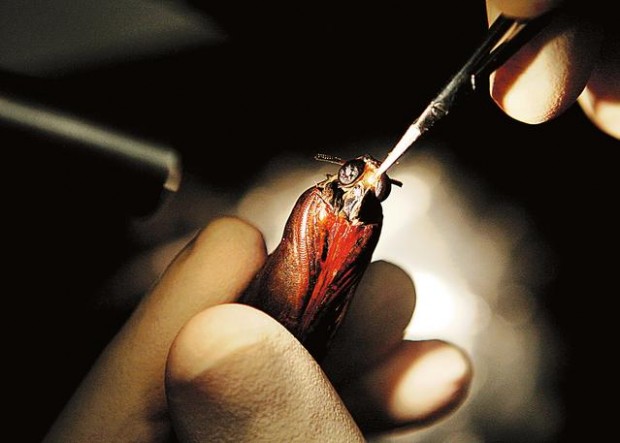
● Working one day a week and parts of several other days in a UA neurobiology research laboratory. His research involves dissecting moth brains in a quest to find new ways of dealing with brain damage in people.
It is all, Koussa says, just a start.
"After my undergraduate work, I'm looking at about seven more years" of formal study, he says. "My plan is to get an M.D.-Ph.D. in either neuropsychology, neurophysiology or neurobiology. I'm not sure which yet.
"My big goal is to continue in research and perhaps become head of a research lab. Then, way out there, the Nobel Prize would be great."
Those who know him best believe those lofty dreams could well come true.
"Mounir joined our lab this year and he has made fantastic progress," says Lynne Oland, a UA research scientist who guides Koussa's work in the Tolbert/Oland Neurobiology Laboratory.
"When we consider a student for work in the lab, we look for several things: passion, curiosity, fine-motor skills, articulate communication, a good sense of humor and a high frustration tolerance — because there are lots of difficult challenges to surmount in a laboratory," Oland says. "Mounir was a very good fit."
Says Margaret Wilch, a Tucson High teacher who helped shape some of Koussa's award-winning work: "He's intelligent. He's curious. He's disciplined. And he's intrigued to find answers. I think that's a form of brilliance."
Koussa's father, Ahmad Koussa, is understandably proud.
"We raised him as an independent kid," the elder Koussa says of himself and his wife, Rima. "We've given him room — and wings to fly as high as he can. He has been awesome.
"But believe it or not," Koussa adds, "he is a normal kid. And he and I have been friends more than father and son. I call him a friend of a lifetime."
* * *
The towering talent we see in Mounir Koussa — let's go ahead and call it brilliance — does not just pop up overnight.
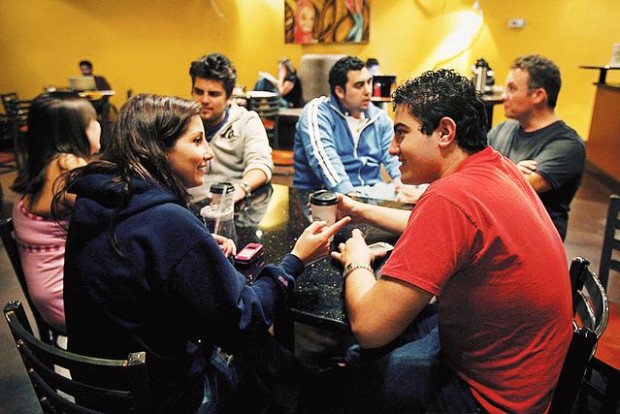
Koussa has been nurturing his remarkable intellect since childhood. In conversation at a campus cafe one day recently, he shows that he has a sense of humor about it.
"As a child, I wasn't interested in Category Specific Semantic Deficits of Object Recognition in Adults with Neurological Brain Damage," he says with a sly smile between sips of hearty java.
"But I've always been very inquisitive," he adds. "I ask questions about everything."
Koussa, a tall, robust fellow of Lebanese heritage, describes another pair of personality traits.
"I'm a very stubborn and very self-critical person," he says. "Even in second grade, if I made one mistake in my homework, I'd start the whole thing over."
He attended public schools — first finding his science groove at Mansfield Middle School.
"I was in a program called GATE — Gifted and Talented Education," led by teacher Joan Steel, Koussa says. "Ms. Steel was one of the first to bring neuroscience into my life. I was hooked."
But like other bright, inquisitive kids, Koussa was showing promise in several areas other than science.
"In middle school, Mounir was in a class called Teen Court," recalls his father, an electrical engineer who is general manager of Jim Click Ford. "He did quite a bit of research and writing on a proposed law having to do with bullying. He was the presenter (for the proposal), and they won regional and national awards. So at that time, we thought he was going to be an attorney."
But it was sciences — specifically sciences dealing with the nervous system and the brain — that enthralled Koussa in his high school years.
He had his motivations: satisfying his seemingly endless curiosity, learning things that could one day benefit humankind in general, and something else — something more personal.
"My sister, Reina, has a learning disability," Koussa says. "Doctors haven't been able to find the reason. That was another part of my motivation — doing something that could help her."
With dreams of helping his sister, who is now 14, and others, he read voraciously, studied with passion and began formulating research projects like the one that brought him the Intel award and a namesake asteroid. See accompanying story "Mounir's mind at work" for details on the project.
Like many would-be Einsteins before him, young Koussa was more focused on knowledge than good grades.
"I didn't have the highest SAT scores or the highest grade-point average," he says. "But I can say I took more out of my high school years than many others."
His former teacher Wilch can vouch for that.
"I first met Mounir in the spring of 2006 when he came to tell me he would be taking my class" in Honors Research Methods, Wilch says. "The class would begin in the fall of 2006, but he wanted to work out some details on his project in advance.
"He had a textbook on biochemistry or molecular biology. He was so excited about reading it because he wanted to get started early. It was pretty awesome."
Koussa, not content to stick with textbooks and classrooms, sought laboratory experience during his high school years. He began learning the ropes of research in the laboratory of Dr. Steven Rapcsak, a professor of neurology and chief of neurology at the Southern Arizona Veterans Administration Medical Center.
"I started seeing what a real lab is like, what real science is like," Koussa recalls. "It's nothing like 'CSI' (Crime Scene Investigation television shows). Things usually don't work. It's a lot of tweaking and changing.
"I learned that real science is responsibility, time management and many other things that don't sound like science."
By the time Koussa began classes at the UA this fall, he'd honed his lab skills to such an edge that research scientist Oland found him worthy of a place in the university's neurobiology lab. See the accompanying "Into the lab" story.
* * *
Egghead?
Science nerd?
Technical wizard with the social skills of a laboratory rat?
You might think.
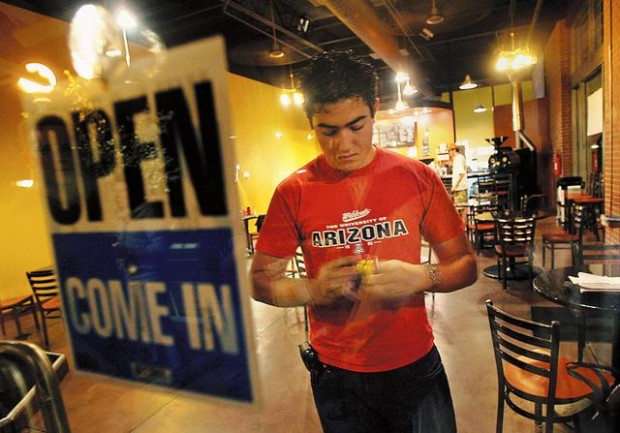
But not so. Mounir Koussa is not only an outstanding student scientist — he's also, by all accounts and his own personal deportment, a normal, gregarious, enormously likable, karaoke-singing college kid. See the accompanying story "Off the science clock."
"Mounir is just a very personable guy," says high school teacher Wilch. "He's fun and he's comfortable with everybody. . . . He makes you feel good about the world.
"In terms of his character, if he saw that I or anybody else had a need, he was willing to help," Wilch says. "He is really gracious that way. He's just so good with people that, whatever he does with science, he needs to keep working with people, too."
One of Koussa's friends, Chelsea Baraff, calls him "one of the most intriguing people I know."
"I could talk about him all day," Baraff says. "He's done all these amazing things, but he's also a good person. . . . He has a heart of gold. He really cares about people. He doesn't just talk to people on the surface. He wants to really get to know them."
Says Koussa's dad: "He has touched many people's lives. He's a blessing to have around. We love him, and we are extremely proud of him."
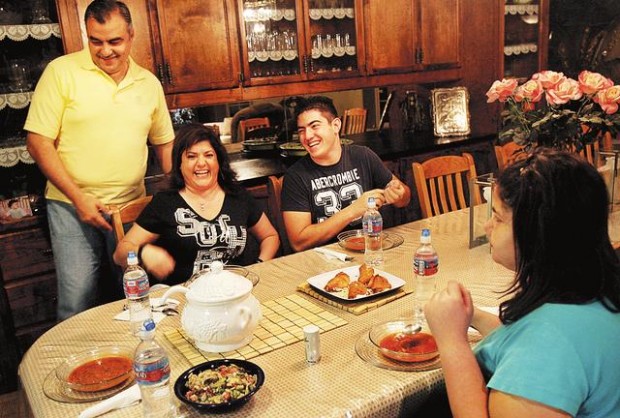
Those feelings, clearly, are mutual. If Koussa, who lives at home with his parents, ever becomes more animated than when he's talking science, it's when he speaks of his mom and dad.
"They are wonderful," he says solemnly. "They've provided a very enriching environment. They've given me freedom. They've given me support. I thank my parents for all they've done."
Into the lab
It is a radiant autumn morning on the University of Arizona campus — a perfect day for hanging out on the mall, talking with friends, flirting, maybe cutting class and going for a coffee.
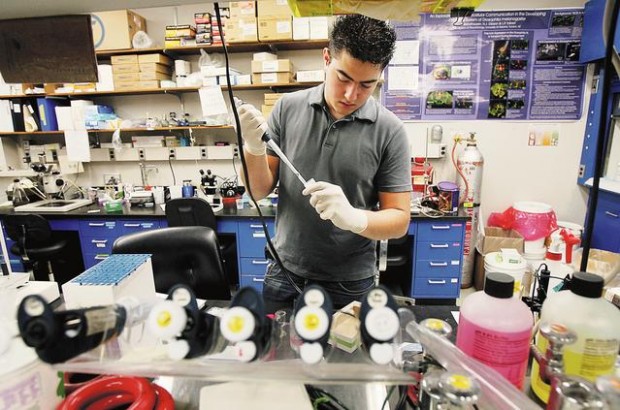
Mounir Koussa is forgoing these extracurricular enticements in favor of dissecting the brain of a moth in the UA's Tolbert/Oland Neurobiology Laboratory.
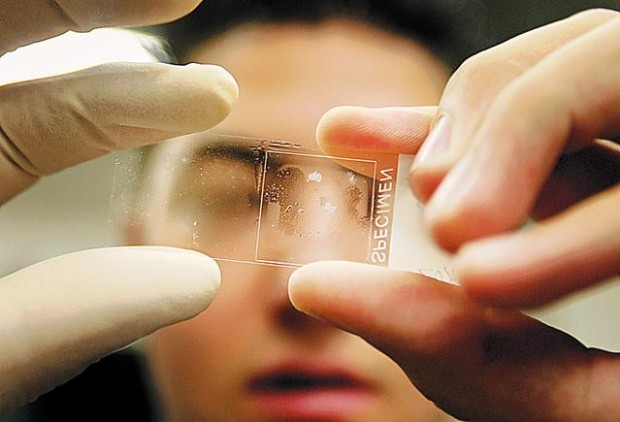
With the anesthetized little insect secured under the lens of a microscope, he uses tiny scissors, a scalpel and forceps to remove the moth's minuscule brain, which he'll later slice into razor-thin 100- micron sections for study.
Why?
It's actually kind of a long and complex story — above the heads of most of us but perfectly clear to Koussa and lab neurobiology research scientist Lynne Oland.
In a simplified nutshell: Koussa blocks the antennae of some moths so they can't smell things — and then examines the brains to see how the altered olfactory experience affects them.
"The study is to see if olfactory experience affects how a moth brain develops," Koussa says. Those findings can have implications for human brain development because "moth brains, in a way, are very similar to human brains."
Says Oland, an accomplished researcher who guides Koussa's work in the lab: "We are particularly interested in brain development — how this incredible structure is precisely wired during development. Mounir's project is looking at a late-development phase and trying to understand what role experience plays in that development."
Specifically, his study is using the olfactory system to learn about possible changes in brain connections caused by limiting a moth's experience of smell.
The findings, Oland says, ultimately could help in dealing with brain injuries in people.
"Suppose there is an injury to the brain," she says. "Regrowing neurons need to go through many of the steps they did in wiring up the brain during development. If we can understand the molecular signaling that happens during development of connections, maybe we can figure out how to use those signals to provide the right environment to re-establish the damaged brain's circuits."
Clear?
Well, if not, that's why we have expert researchers such as Oland and promising students like Koussa.
The rest of us are free to find a sunny spot on the mall.