

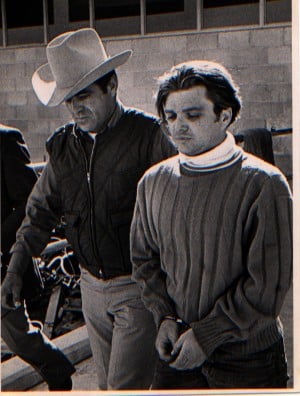
Escorted by an armed Arizona State Prison official, convicted killer Charles H. Schmid Jr., 30, was transferred yesterday back to the prison from Pima County Jail.This photo ran in the Arizona Daily Star Nov. 15, 1972.
Charles Schmid Jr. did his best not to stay in prison. He appealed his convictions to the Arizona Supreme Court, but they were upheld.
He tried to escape a couple of times and was even successful once, although his freedom was of short duration.
On Oct. 12, 1972, Schmid disappeared from his maximum security cell in the Arizona State Prison. Roadblocks were set up on every major road and law enforcement personnel searched inside and outside the prison. Schmid was found three hours later in a clothing locker in the prison welding shop.
From an article in the Arizona Daily Star, Oct. 13, 1972:
Warden Bud Gomes said the 15-inch wide by 12-inch deep clothing locker was a short distance from where a hollowed out gymnastics side horse had earlier been found. He said Schmid had been carried to the welding shop inside the wooden horse. ...
Four men carried the horse into the workshop, but Gomes said he did not know if they were aware Schmid was inside. He said he would investigate to determine who had helped Schmid.
People are also reading…
Hiding inside a wooden horse — hasn't that been done? His second try brought him more success. From an article in the Star, Nov. 12, 1972:
Thirty days after triple slayer Charles H. Schmid disappeared for several hours at the Arizona State Prison at Florence, the "Pied Piper of Tucson" has escaped.
But unlike the Oct. 12 incident, when Schmid was found hiding in a prison locker, he is believed this time to be outside the walls with another convicted triple murderer, Ray Hudgens.
Warden Bud Gomes said footprints believed to be those of the two men were discovered 3½ miles northeast of the prison, as were other prints just outside the 25-foot wall surrounding the prison.
Outside of those clues, however, Gomes said there was no hint as to where the men might be headed. Roving patrols are serarching within 25 miles of the prison and the Department of Public Safety has set up roadblocks as far away as Oracle Junction, he said.
But Gomes added that "It's raining like the devil," which has hampered the search effort.
Lt. John Czech of the Pima County Sheriff's Office said Tucson is the only place Schmid would want to go. "He has friends and family here, and they would probably help him." Department of Public Safety officials said they were in fact headed for Tucson. "It's hard to predict where a nut will go," one partolman said.
Czech, claiming Schmid was last seen at the prison at 6 a.m., said shortly after 7 p.m., "It's too late for roadblocks."
Gomes said, however, that Schmid was probably seen in the prison as late as 10:30 a.m. The two escapees were reported missing about 4 p.m.
An off-duty guard said he saw two men at 2:30 p.m. walking across a field where the tracks were later discovered, but did not report the sighting because he had not been told of the escape.
The Tucson Police Department said that witnesses who testified against Schmid in his 1965 trials would be protected.
Schmid was on the run for only 2½ days before he was captured. He had attempted to alter his appearance. His hair was dyed red, but when he was found, he was hiding that under a blond wig.
From an article in the Star, Nov. 15, 1972:
Triple-slayer Charles Schmid was captured in a southside Tucson freight yard yesterday after 2½ days of freedom from the Arizona State Prison. He was returned there later in the day amid official promises that he would not escape again.
The statewide hunt for the 30-year-old murderer came to a quiet end at 7:30 a.m., when a Tucson police officer and his trainee companion arrested the limping, haggard-looking convict after being tipped off to his whereabouts by one of Schmid's ex-schoolmates.
Another convicted killer, Raymond Hudgins, 32, who escaped with Schmid, is still free.
As a result of Schmid's second escape attempt within 33 days, prisoners will now be classified in security categories, Allen Cook, state Department of Corrections director, said yesterday. Schmid will be classified as maximum security — which Cook said has not existed since the abolition of the death penalty.
"He will be kept under maximum-security conditions, and I think I can guarantee the public that he will never escape again," Cook said.
The 5-foot-3 convict first attempted to escape Oct. 12. He was found hiding in a tiny prison locker after being gone from his cell for three hours.
Schmid, wearing a blond wig, and another man were noticed at about 6:20 a.m. by a Southern Pacific Railroad employe, Bill Lanier, 28. Lanier told officers he recognized Schmid becuase they went to high school together.
Police surrounded the area where Schmid and the other man had been seen.
Officer Barry Headricks and trainee Wayne Inman came across the two near a shack by the tracks. "Schmid asked if it was all right for him to hitch a ride on the train," Headricks said. "I replied,'you better check with train officials.'"
Headricks then pulled his revolver and told Schmid and the man later identified as Joseph Cloyd, 29, to freeze. "Charles said, 'please don't shoot me,'" Headricks said.
Schmid and Cloyd were taken to the police station for questioning. Officers said they ran a records check on Cloyd, found he wasn't wanted by any law enforcement agency, and released him.
Officers said Schmid was limping because of blisters on his feet. They said he told them he got blisters from walking through more than 60 miles of desert.
Schmid was taken to Pima County Jail and held isolated in a cell until shortly before noon, when two armed escorts from Arizona State Prison picked him up and took him back to the prison by car.
The following year, Schmid's death sentences were reduced to life. From the Star, Feb. 9, 1973:
State Court Spares Life Of Schmid
PHOENIX (AP) — Charles H. Schmid Jr., 30, has had two death penalties reduced to life imprisonment by the Arizona Supreme Court in accordance with last year's U.S. Supreme Court ruling against the death penalty.
Court records show that Arizona Supreme Court Chief Justice Jack D. H. Hays imposed the life sentence for Schmid on Monday. Schmid was originally sentenced to die for the murder of two Tucson sisters in 1965. He is also under a 50-year sentence for the 1964 slaying of another Tucson girl.
In 1974, Schmid legally changed his name to Paul David Ashley. According to his Coolidge attorney, Schmid felt his old name hindered his effort to rehabilitate himself. Changing his name didn't help his public image much. Subsequent newspaper articles still referred to him as Charles Schmid, with a side reference to the name change.
Next: The rest of the story.
In this Series
Tales from the Morgue: The Pied Piper of Tucson series

Johanna Eubank
Online producer
