

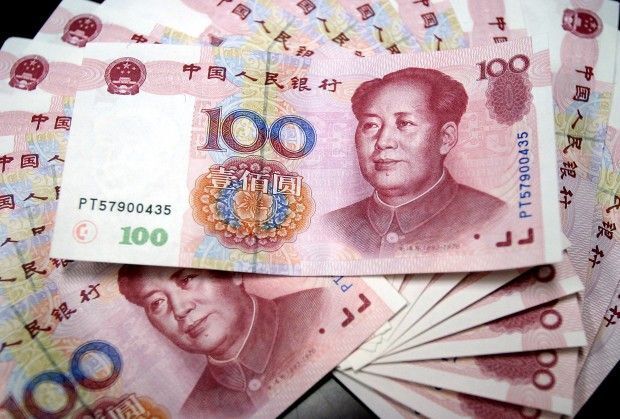
When Mitt Romney talks about punishing China for its undervalued currency, he never seems to mention Israel, Japan or Switzerland in the same sentence.
According to a report published this summer by the Peterson Institute for International Economics, those countries and many others manipulate their currencies to some degree. They buy foreign currencies with the goal of making their exports cheaper, and making competing nations’ goods more expensive by comparison.
China gets all the criticism because of its huge trade surplus, which has been a source of friction for a long time. In focusing on the currency issue, though, Romney is about five years too late.
During this week’s presidential debate, Romney said he would label China a currency manipulator “on day one” and then push for punitive tariffs against Chinese goods. It was a criticism of President Barack Obama’s Treasury Department, which several times has stopped short of applying the manipulator label. The Treasury has delayed a report on currency practices that was due this month.
People are also reading…
Most voters don’t follow foreign exchange markets closely, so Romney probably scored some points with his China-bashing. The value of the Chinese yuan, however, isn’t nearly the problem that it once was.
The yuan has appreciated about 30 percent since 2005 against a basket of international currencies, and the government does much less manipulating.
“The China Central Bank is not intervening in the market on the scale that they were a few years ago,” Nicholas Lardy says in an interview posted on the institute’s website . “Indeed they’re intervening very, very little.”
As the yuan has appreciated, China’s trade surplus with the rest of the world has shrunk. It’s still big, but it’s about one-fifth the size it was five years ago.
The International Monetary Fund long considered the yuan “substantially undervalued” but now calls it just “moderately undervalued.”
Romney’s approach would punish China despite that progress. If he and Congress were to slap new tariffs on Chinese goods, the Chinese would no doubt retaliate, perhaps against U.S.-made planes or electrical equipment. A trade war would do no one any good, and might throw our economy back into recession.
Paul Christopher, senior international investment strategist at Wells Fargo Advisors, says China will continue to let the yuan strengthen gradually, because that fits its long-term economic strategy.
When the yuan was far too cheap, China suffered from high inflation. Its inflation rate was 6.5 percent as recently as mid-2011, but now is in the range of 2 to 3 percent.
China’s growth rate also has slowed, and Christopher says that makes this a bad time to be talking about new sanctions. “Their economy is slow and they don’t need the extra pressure,” he says. “It would force them to retaliate against us, and we need trade to grow our economy, as do they.”
In fairness to Romney, China-bashing seems to be a tradition in recent U.S. elections. Candidate Obama also talked tough on the currency issue in 2008 and accused his predecessor, George W. Bush, of being a “patsy” on trade.
Fortunately, Obama toned down the rhetoric after taking office, and that appears to have been the right approach. A confrontation over the yuan now will do little good, and could do a lot of harm.
David Nicklaus is business columnist at the St. Louis Post-Dispatch. Subscribe to his Facebook page or follow him on Twitter @dnickbiz.


