JERUSALEM — Off an East Jerusalem side street, between an olive orchard and an abandoned hotel, sit a few piles of rubble that are yielding important insights into Jerusalem's history.
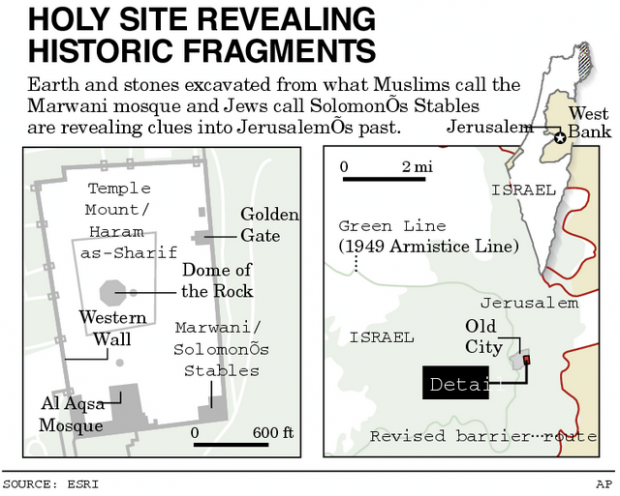
They come from one of the world's most disputed holy places — the square in the heart of Jerusalem that is known to Jews as the Temple Mount and to Muslims as the Noble Sanctuary.
Among finds that have emerged are a coin struck during the Jewish revolt against the Romans, arrowheads shot by Babylonian archers and by Roman siege machinery, Christian charms, a 3,300-year-old fragment of Egyptian alabaster, Bronze Age flint instruments, and — the prize discovery — the imprint of a seal possibly linked to a priestly Jewish family mentioned in the Old Testament's Book of Jeremiah.
And the finds keep coming. On a drizzly November morning, Gabriel Barkay, the veteran biblical archaeologist who runs the dig, sat in a tent near the mounds examining some newly discovered coins stamped by various Holy Land powers: the Hasmonean dynasty of Jewish kings more than 2,000 years ago, a Roman procurator around the time of Pontius Pilate, the early Christians of the Byzantine Empire, two Islamic dynasties and the British in the 20th century.
People are also reading…
Considering the wealth of findings, it is odd, perhaps, that this is an excavation that was never supposed to happen.
Jews revere the Mount as the site of their two ancient temples. Muslims believe it's where the Prophet Muhammad ascended to heaven during a nighttime journey recounted in the Quran. Two mosques stand on the site, as do some of the temple's original retaining walls, including the Jewish shrine called the Western Wall.
Rubble moved from site
In November 1999, the Waqf, the Muslim organization that administers the site's Islamic holy places, opened an emergency exit to an ancient underground chamber of stone pillars and arches known to Jews as Solomon's Stables and to Muslims as the Marwani mosque.
Ignoring protests from Israeli archaeologists who said priceless artifacts were being destroyed to erase traces of Jewish history, the Waqf dug a large pit, removed tons of earth and rubble that had been used as landfill and dumped much of it in the nearby Kidron Valley.
The Waqf's position was, and remains, that the rubble was of recent vintage and without archaeological value.
Zachi Zweig, a 27-year-old archaeology undergraduate at Bar Ilan University near Tel Aviv, went to the dump a few days later. With friends, he gathered samples of the rubble and discovered a high concentration of ancient pottery shards.
Zweig convinced Barkay, his lecturer at the university, that the rubble needed to be studied.
In 2004, after five years spent getting a dig license and raising funds, 75 truckloads of rubble were moved to a lot on the slopes of Jerusalem's Mount Scopus.
The first coin they found, Barkay said, was one issued during the Jewish revolt that preceded the Roman destruction of the temple in Jerusalem in A.D. 70, imprinted with the Hebrew words "Freedom of Zion."
The most valuable find so far, Barkay believes, is a clay seal impression discovered last year. Its incomplete Hebrew lettering appears to name Ge'aliyahu, son of Immer. Immer is the name of a family of temple officials mentioned in Jeremiah 20:1.