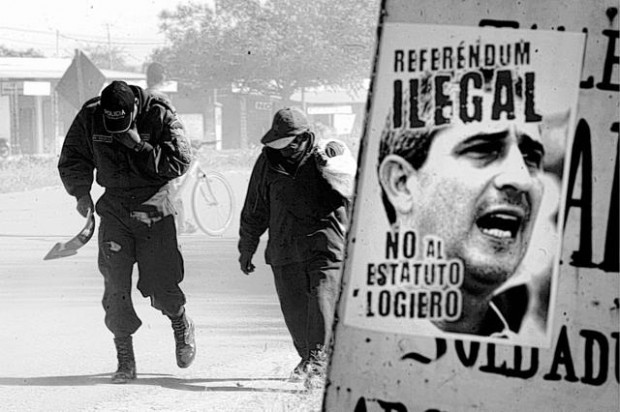
SANTA CRUZ DE LA SIERRA, Bolivia — This divided country faces a constitutional crisis today when its richest and second most-populous province votes whether to declare itself autonomous from President Evo Morales' national government, a referendum the president has called illegal.
If the referendum passes, as polls show it overwhelmingly will, leaders of Santa Cruz province say they'll elect a state legislature, organize local police and otherwise set up a government equivalent to that of a state in the United States.
Morales has called the referendum a move to split up this nation of 9.1 million and to thwart his government's efforts to rewrite Bolivia's constitution so that its indigenous majority wins more political power.
Bolivia has a centralized government, where police, taxation and other government functions are controlled by federal officials.
People are also reading…
"This referendum violates the current constitution, because there's no mechanism to convoke it," said Leonida Zurita, a close Morales ally and a substitute senator with the president's Movement Toward Socialism party. "They want to found a second Bolivian state, and we won't let the fatherland be divided."
Morales, a leftist critic of U.S. policies in the region, has received the support of Venezuela, Cuba, Ecuador and Nicaragua in the provincial- autonomy fight.
The Bolivian president also has accused the United States of backing the autonomy move, a charge that U.S. officials have rejected.
Autonomy advocates, including Santa Cruz business leaders, denied that they wanted to secede and insisted that their goal is modernizing an overly centralized government.
Three other eastern Bolivian provinces, Beni, Pando and Tarija, also are planning to hold autonomy votes in coming weeks, and leaders in two others, Cochabamba and Chuquisaca, are also advocating autonomy.
"We're seeing a social process that's happening all over this country," said Eduardo Paz, president of Santa Cruz's Chamber of Commerce. "After Sunday, the people will have sent the message that they want to do things in a new way."
Both Morales and autonomy advocates have called for calm today and canceled potentially incendiary actions by both autonomy supporters and the president's indigenous activists.
In the run-up to the vote in Santa Cruz, the government has prohibited civilians from carrying firearms, and Morales has pledged not to send troops to Santa Cruz to block the vote.
On Wednesday, the Organization of American States sent Political Affairs Secretary Dante Caputo to Bolivia to initiate last-minute dialogue between the two sides, but he left with only pledges to keep the public peace.
The OAS held its second meeting in less than a week on Friday to discuss the crisis in Bolivia. After Caputo briefed ambassadors, Bolivian Foreign Minister David Choquehuanca gave a hard-hitting speech, blaming the governors for failure to hold a dialogue before the Santa Cruz referendum and insisting that the referendum was illegal and risked breaking up the country.
OAS Secretary-General José Miguel Insulza warned that violence could break out and "could last a long time."
On the streets of Santa Cruz Wednesday night, thousands of people attended a pro-autonomy demonstration, with several saying they were ready to defend the referendum with force if necessary.
At the heart of the conflict is a July 2006 referendum in which Bolivians nationwide rejected allowing provincial autonomies, while voters in the four provinces now pushing referendums approved the proposal.