
BRUSSELS, Belgium — It sounds easy: Dispatch naval commandos to storm a hijacked cargo ship, shoot or capture the ragtag band of pirates and free the hostage crew.
But experts warn such a rescue attempt would be extremely risky, endangering 300 hostages on other hijacked vessels and breaching U.N. mandates, maritime laws and international merchant marine guidelines.
The problem is further complicated by regional politics and practical issues such as the massive size of the area being patrolled by a handful of warships: about 1.1 million square miles, an area larger than the Mediterranean Sea.
NATO currently has just four warships on duty off the 2,400-mile coastline of Somalia, an impoverished nation caught up in an Islamic insurgency that has had no functioning government since 1991.
Next month, the European Union takes over the NATO mission, sending four ships to replace the four currently patrolling under the NATO flag.
People are also reading…
Currently, patrols work under a restrictive U.N. mandate that allows force only in the case of direct attacks on the 20,000 cargo ships transiting through the area annually.
"They can patrol. They can deter. They can even stop attacks that are happening, but what they do not do is then board the ship that has been hijacked elsewhere to try and free it," NATO spokesman James Appathurai said.
The U.S. Navy is similarly constrained. "We have a full range of options . . . that allow us to stop pirates from attacking merchant vessels," said Cmdr. Jane Campbell, a spokeswoman for the 5th Fleet in Bahrain. "But once the ship is hijacked, it's a hostage situation, and we don't see a military solution is the right one to pursue."
Strategies proposed to combat the piracy scourge include attacking the bandits on land, arming merchant vessels and rerouting ships away from the volatile region near Somalia for a massive detour around southern Africa.
Experts reject such measures as unrealistic.
"The only solution I see is a coordinated effort by various naval forces. The problem is that no single country wants to take the lead," said Fred Burton, a vice president of Stratfor, a U.S.-based intelligence risk-assessment agency.
Last week, pirates seized their greatest prize yet, the supertanker MV Sirius Star, far south of the Somali coastline. The ship is now anchored off a Somali port.
Analysts say the Somali gangs have invested much of the $150 million in ransom paid so far in new speedboats with added firepower, including heavy 14.5 mm anti-aircraft machine guns and rocket-propelled grenade launchers — a serious threat to even the largest merchant vessels.
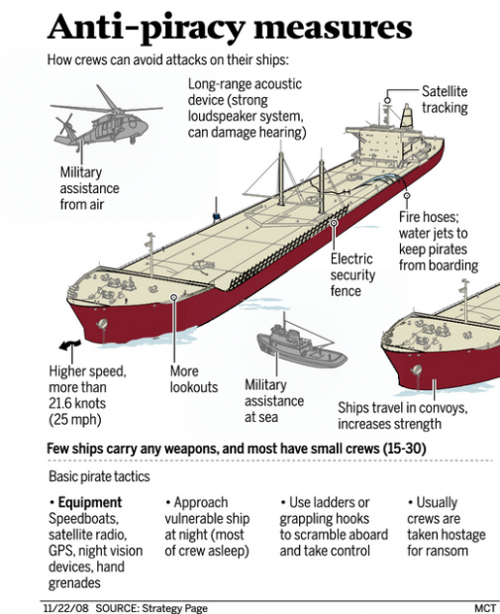
Some shipping companies have hired private security firms and are even considering arming their crews. But the International Maritime Organization opposes such measures which they say put crews in greater danger if they are boarded by pirates.
Instead, it recommends sailing through pirate-infested waters at night, battening down all hatches to prevent entry into the ship, and posting lookouts with high-pressure hoses to ward off the light speedboats.



 Historic bank vault now new Tucson speakeasy