

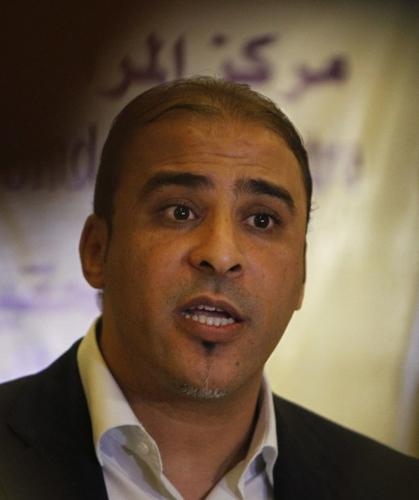
CAIRO - After anti-government unrest spread to the Libyan capital and protesters seized military bases and weapons Sunday, Moammar Gadhafi's son went on state television to proclaim that his father remained in charge with the army's backing and would "fight until the last man, the last woman, the last bullet."
Seif al-Islam Gadhafi, in the regime's first comments on the six days of demonstrations, warned the protesters that they risked igniting a civil war in which Libya's oil wealth "will be burned."
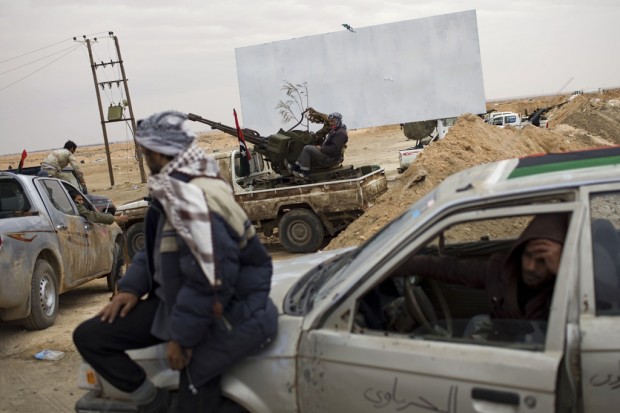
The speech followed a fierce crackdown by security forces who fired on thousands of demonstrators and funeral marchers in the eastern city of Benghazi in a bloody cycle of violence that killed 60 people on Sunday alone, according to a doctor in one city hospital. Since the six days of unrest began, more than 200 people have been killed, according to medical officials, human rights groups and exiled dissidents.
People are also reading…
Libya's response has been the harshest of any Arab country that has been wracked by the protests that toppled long-serving leaders in neighboring Tunisia and Egypt. But Gadhafi's son said his father would prevail.
"We are not Tunisia and Egypt," the younger Gadhafi said. "Moammar Gadhafi, our leader, is leading the battle in Tripoli, and we are with him.
"The armed forces are with him. Tens of thousands are heading here to be with him. We will fight until the last man, the last woman, the last bullet," he said in a rambling and sometimes confused speech of nearly 40 minutes.
The younger Gadhafi, who is the regime's face of reform, conceded the army made some mistakes during the protests because the troops weren't trained to deal with demonstrators, but he said the number of dead had been exaggerated, giving a death toll of 84.
Western countries have expressed concern at the rising violence against demonstrators in Libya.
In the speech, the younger Gadhafi offered to put forward reforms within days that he described as a "historic national initiative" and said the regime was willing to remove some restrictions and begin discussions for a constitution. He offered to change a number of laws, including those covering the media and the penal code.
Dressed in a dark business suit and tie, Seif al-Islam wagged his finger frequently as he delivered his warnings. He said that if protests continued, Libya would slide back to "colonial" rule. "You will get Americans and European fleets coming your way, and they will occupy you.
He threatened to "eradicate the pockets of sedition" and said the army will play a main role in restoring order.
"There has to be a firm stand," he said. "This is not the Tunisian or Egyptian army."
Protesters had seized some military bases, tanks and other weapons, he said, blaming Islamists, the media, thugs, drunks and drug abusers, foreigners - including Egyptians and Tunisians.
He also admitted that the unrest had spread to Tripoli, with people firing in central Green Square before fleeing.
MORE INSIDE
Protests also continued Sunday in Tunisia, Morocco, Yemen, Bahrain, Jordan and Kuwait, with ripples felt in Italy. Page A21
Travel Warning
The United States is urging its citizens to avoid non- essential travel to Libya.
In a travel warning issued Sunday, the State Department also cautioned citizens already in Libya against traveling to eastern Libya, where many of the protests are taking place.
Demonstrators haven't targeted Westerners, but the U.S. warns that even peaceful demonstrations could "quickly become unruly" and foreigners could be subject to harassment or worse.
The U.S. Embassy in Tripoli is offering to help citizens leave the cities of Benghazi, Ajdabiya, Al-Bayda, Al Marj, Derna and Tobruk.
The Associated Press
U.S. Response
A senior U.S. diplomat on Sunday condemned the brutal crackdown on opposition protesters in Libya, saying Arab leaders facing pro-democracy protests need to lead the way rather than resist reform.
Susan Rice, the U.S. ambassador to the United Nations, said the Obama administration was "very concerned" about reported armed attacks by Libyan security forces on peaceful protesters in the eastern city of Benghazi.
"We've condemned that violence," Rice told "Meet the Press" on NBC. "Our view is that in Libya as throughout the region peaceful protests need to be respected."
The European Union also denounced the Libyan government's response to the protests, with the EU's foreign policy chief calling for an end to the violence.
The Associated Press

 As water lifeline evaporates, Arizona faces a cultural change over water use


